Wize University Macroeconomics Textbook > Government Debt and Deficits
Government Debts and Deficits
Popular Courses
ECON 203
Concordia University
Macroeconomics
University Study Guides
ECONOMIC 1022A/B
Western University
Macroeconomics
General Course
ECON 102
University of British Columbia
ECON*1100
University of Guelph
Macroeconomics
University Study Guides
ECON 102
University of Alberta
ECO102H1
University of Toronto
ECO 1102
University of Ottawa
ECON 209
McGill University
ECON 1BB3
McMaster University
ECON 112
Queen's University
AP/ECON 1010 3.00
York University
ECON 295
McGill University
ECON 110
Queen's University
ECON 105
Simon Fraser University
ECON 1102
Dalhousie University
ECON 1002
Carleton University
ECON 1BA3
McMaster University
0:00 / 0:00
The Government Budget Constraint
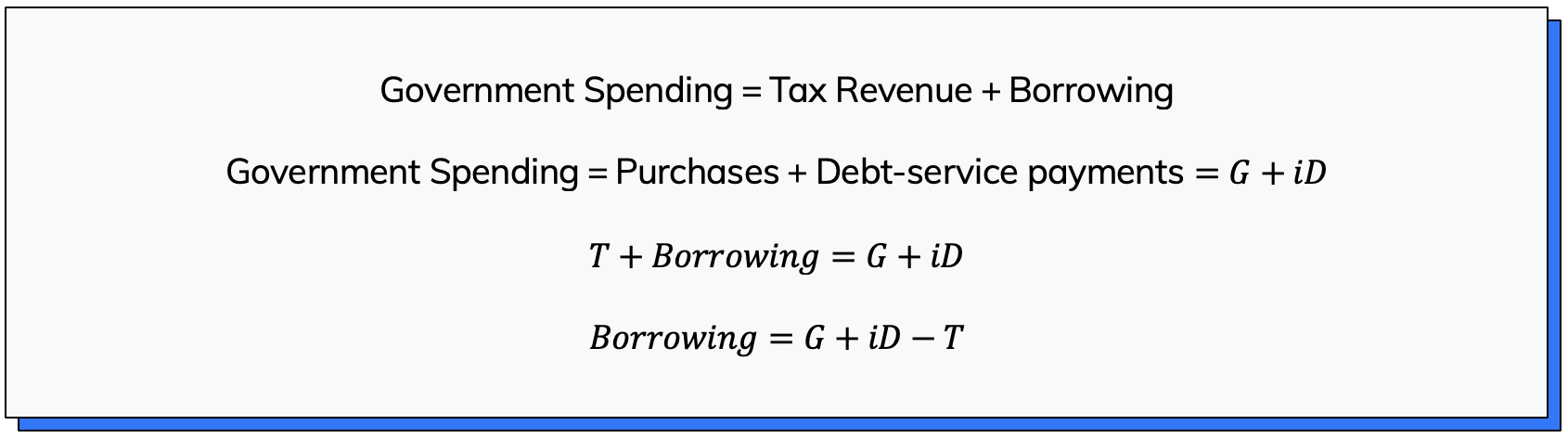
- Government raises money with tax revenue or borrowing.
- Spending includes purchases and interest payments on debt.
- Debt (D) is the accumulation of past deficits/borrowings.
Debts and Deficits
- Budget deficit () is equal to the change in government debt because the government will borrow when it is a deficit and repay debt when it has a surplus.
- Equal to borrowing
Primary Budget Deficit
- Difference between government spending (G) and tax income (T).
- Excludes debt-service payments

Debt-to-GDP Ratio
- Absolute debt does not give us the whole picture.
- Should be compared to a country‘s GDP.
- A lower debt-to-GDP ratio is generally considered more favourable, as it suggests that a country's debt burden is relatively smaller compared to the size of its economy.

Changes to the Debt-to-GDP Ratio
- Debt-to-GDP increases if the real interest rate on government debt increases (r) and if the government runs a deficit (x).
- The formula below describes the relationship between these variables and the change to the debt-to-equity ratio.

Practice Questions: Government Debts and Deficits
1. What is the difference between the government's debt and the government's deficit?
A) The debt is the annual shortfall of revenues minus disbursements whereas the deficit is the accumulation of past debts.
B) The debt is the amount the government pays in interest payments whereas the deficit has not yet incurred interest charges.
C) The debt is the amount payable to the Bank of Canada whereas the deficit is the annual shortfall of revenue minus disbursements.
D) The debt is the accumulation of past deficits whereas the deficit is the annual shortfall between revenues and disbursements.
E) The debt is the difference between tax revenues and government expenditures whereas the deficit is the difference between tax revenues and borrowing.
2. Consider the government's budget constraint. The accumulated stock of government debt will begin to fall
A) if the government's debt-service payments are zero.
B) if the government does not borrow money.
C) if the growth rate of real GDP is higher than the real interest rate.
D) when the government's annual budget is in deficit.
E) when the government's annual budget is in surplus.
3. Consider the federal government's budget constraint. If the government's overall budget deficit is $27 billion and its debt-service payments are $29 billion, then its
A) primary budget deficit is $2 billion.
B) primary budget deficit is $56 billion.
C) primary budget surplus is $2 billion.
D) primary budget surplus is $56 billion.
E) Not enough information to determine.
4. Suppose the stock of government debt in Canada at the end of one fiscal year (Year 1) is $475 billion. During the following year (Year 2), government purchases were $180 billion, debt-service payments were $25 billion, and net tax revenues were $208 billion. What is the stock of debt at the end of Year 2?
A) $422 billion
B) $457 billion
C) $472 billion
D) $475 billion
E) $478 billion
5. The government's current spending and taxation policies cannot affect the
A) primary budget deficit.
B) annual budget deficit.
C) size of its transfers.
D) change in the stock of government debt.
E) existing stock of government debt.
6. Consider two economies, A and B. Economy A has a stock of government debt equal to $800 billion and a debt-to-GDP ratio of 10%. Economy B has a stock of government debt equal to $22 billion and a debt-to-GDP ratio of 80%. What is the GDP for each economy?
A) Economy A: GDP = $8 trillion; Economy B: GDP = $27.5 billion
B) Economy A: GDP = $80 billion; Economy B: GDP = $18.7 billion
C) Economy A: GDP = $80 trillion; Economy B: GDP = $275 billion
D) Economy A: GDP = $800 billion; Economy B: GDP = $22 billion
E) Economy A: GDP = $8 trillion; Economy B: GDP = $2.75 billion