Popular Courses
ECON 203
Concordia University
Macroeconomics
University Study Guides
ECONOMIC 1022A/B
Western University
Macroeconomics
General Course
ECON 102
University of British Columbia
ECON*1100
University of Guelph
Macroeconomics
University Study Guides
ECON 102
University of Alberta
ECO102H1
University of Toronto
ECO 1102
University of Ottawa
ECON 209
McGill University
ECON 1BB3
McMaster University
ECON 112
Queen's University
AP/ECON 1010 3.00
York University
ECON 295
McGill University
ECON 110
Queen's University
ECON 105
Simon Fraser University
ECON 1102
Dalhousie University
ECON 1002
Carleton University
ECON 1BA3
McMaster University
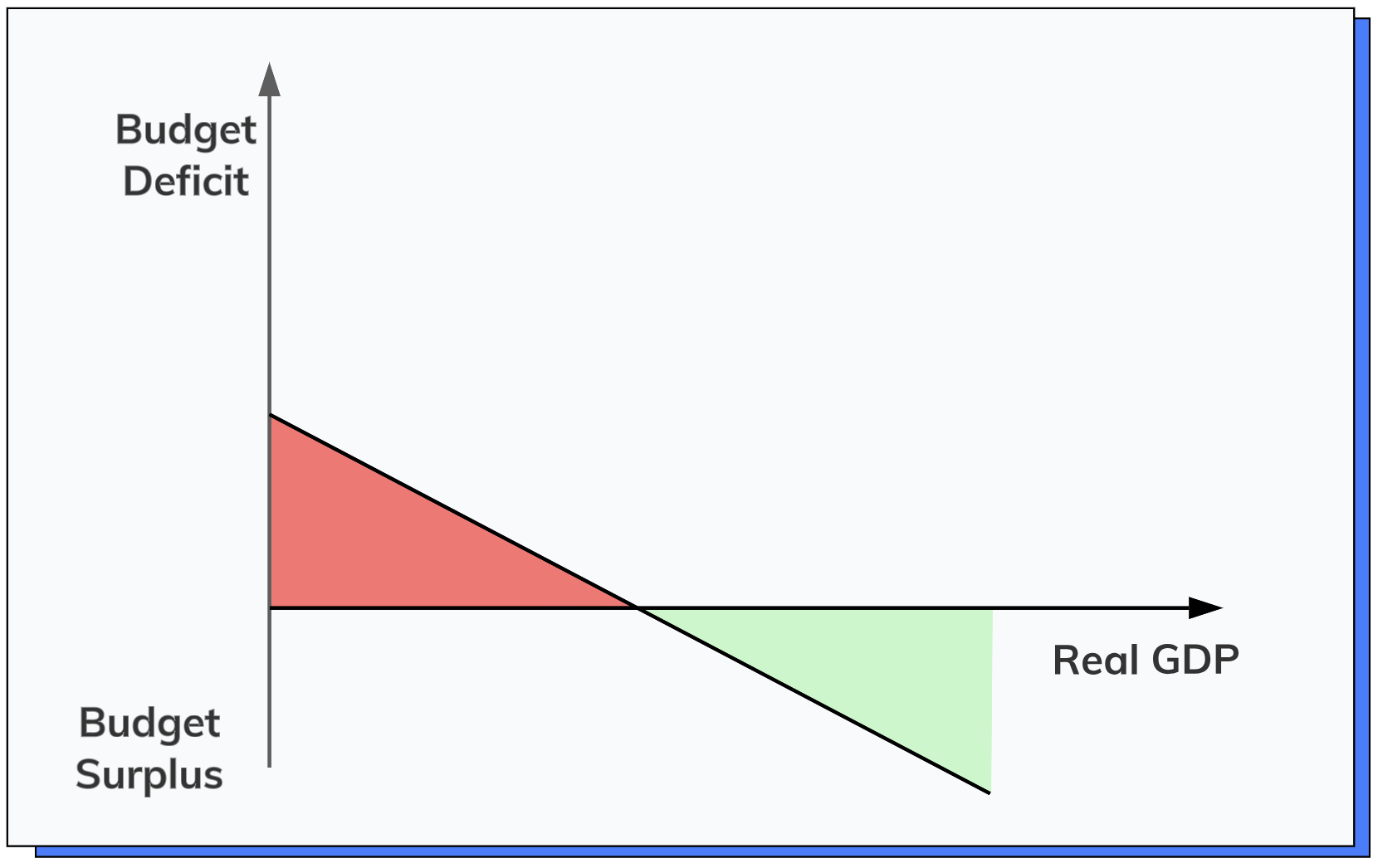
The Budget Deficit Function
- Shows the relationship between the budget deficit and real GDP.
- Downward sloping because as Real GDP increases, tax revenue increases and deficit decreases.
- Fiscal policy determines the vertical position.

Structural and Cyclical Budget Deficit
Structural Deficit
- A budget deficit that exists regardless of the state of the economy.
- It persists over time and is not affected by short-term economic fluctuations.
- Stems from permanent changes in government spending or tax policies.
- Also called cyclically adjusted deficit
- Deficit that exists when real GDP = potential GDP (Y = Y*)
- When Y > Y* (inflationary gap), actual deficit () < structural deficit ()
- When Y < Y* (recessionary gap), actual deficit () > structural deficit ()
Cyclical Deficit
- A budget deficit that arises due to economic fluctuations.
- Tied to the Business Cycle: It occurs during economic downturns or recessions.
- Tax revenues decline due to lower incomes and profits during economic downturns.
- Government expenditures often rise due to social welfare programs and automatic stabilizers.
- The cyclical deficit tends to diminish as the economy recovers and tax revenues increase.

Policy Implications
- Structural Deficit: Addressing it requires long-term fiscal adjustments, such as modifying tax policies or reducing spending.
- Cyclical Deficit: Short-term measures like stimulus spending or temporary tax cuts can help stimulate economic activity during downturns.
Practice Questions: The Budget Deficit
1. Consider the budget deficit function. With an unchanged fiscal policy by government, an increase in national income causes ________ the budget deficit function.
A) an upward movement along
B) a downward movement along
C) an upward shift of
D) a downward shift of
E) a downward rotation in
2. Consider the government's budget deficit function. Other things being equal, an autonomous increase in government purchases causes ________ the budget deficit function.
A) an upward movement along
B) a downward movement along
C) an upward shift of
D) a downward shift of
E) no change in
The diagram below shows two budget deficit functions for a hypothetical economy.
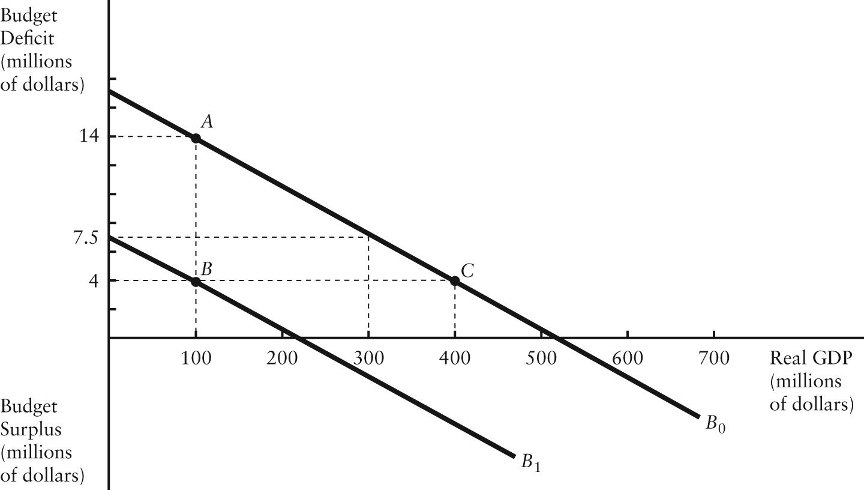
3. Initially, suppose real GDP is $100 million and the budget deficit is $14 million, as shown by point A. Which of the following events could result in a move from point A to point B?
A) the implementation of an expansionary fiscal policy
B) the implementation of a contractionary fiscal policy
C) the implementation of an expansionary monetary policy
D) the implementation of a contractionary monetary policy
E) the economy entering into a boom
4. Initially, suppose the economy is at point A on budget deficit function B0. Real GDP (Y) is $100 million. If the level of potential output (Y*) were $300 million, the structural budget deficit would be
A) $2 million.
B) $14 million.
C) measured by the vertical distance between the horizontal axis and B0 (at real GDP = 300).
D) measured by the vertical distance between point A and the budget deficit that would exist at real GDP = 300 million.
E) Insufficient information to know.
5. Initially, suppose the economy is at point A on budget deficit function B0. Real GDP (Y) is $100 million. If the level of potential output (Y*) were $300 million, the cyclical component of the actual budget deficit would be
A) $4 million.
B) $6.5 million.
C) $7.5 million.
D) $14 million.
E) Insufficient information to know.
6. Suppose the government's actual budget deficit is equal to the structural budget deficit. Then it must be the case that
A) the primary budget deficit is zero.
B) the overall government budget is balanced.
C) the debt-to-GDP ratio is stable.
D) real GDP is equal to potential GDP.
E) the government is not reporting all of its expenses.