Wize University Macroeconomics Textbook > Government Debt and Deficits
The Effects of the Government Debt
Popular Courses
ECON 203
Concordia University
Macroeconomics
University Study Guides
ECONOMIC 1022A/B
Western University
Macroeconomics
General Course
ECON 102
University of British Columbia
ECON*1100
University of Guelph
Macroeconomics
University Study Guides
ECON 102
University of Alberta
ECO102H1
University of Toronto
ECO 1102
University of Ottawa
ECON 209
McGill University
ECON 1BB3
McMaster University
ECON 112
Queen's University
AP/ECON 1010 3.00
York University
ECON 295
McGill University
ECON 110
Queen's University
ECON 105
Simon Fraser University
ECON 1102
Dalhousie University
ECON 1002
Carleton University
ECON 1BA3
McMaster University
0:00 / 0:00
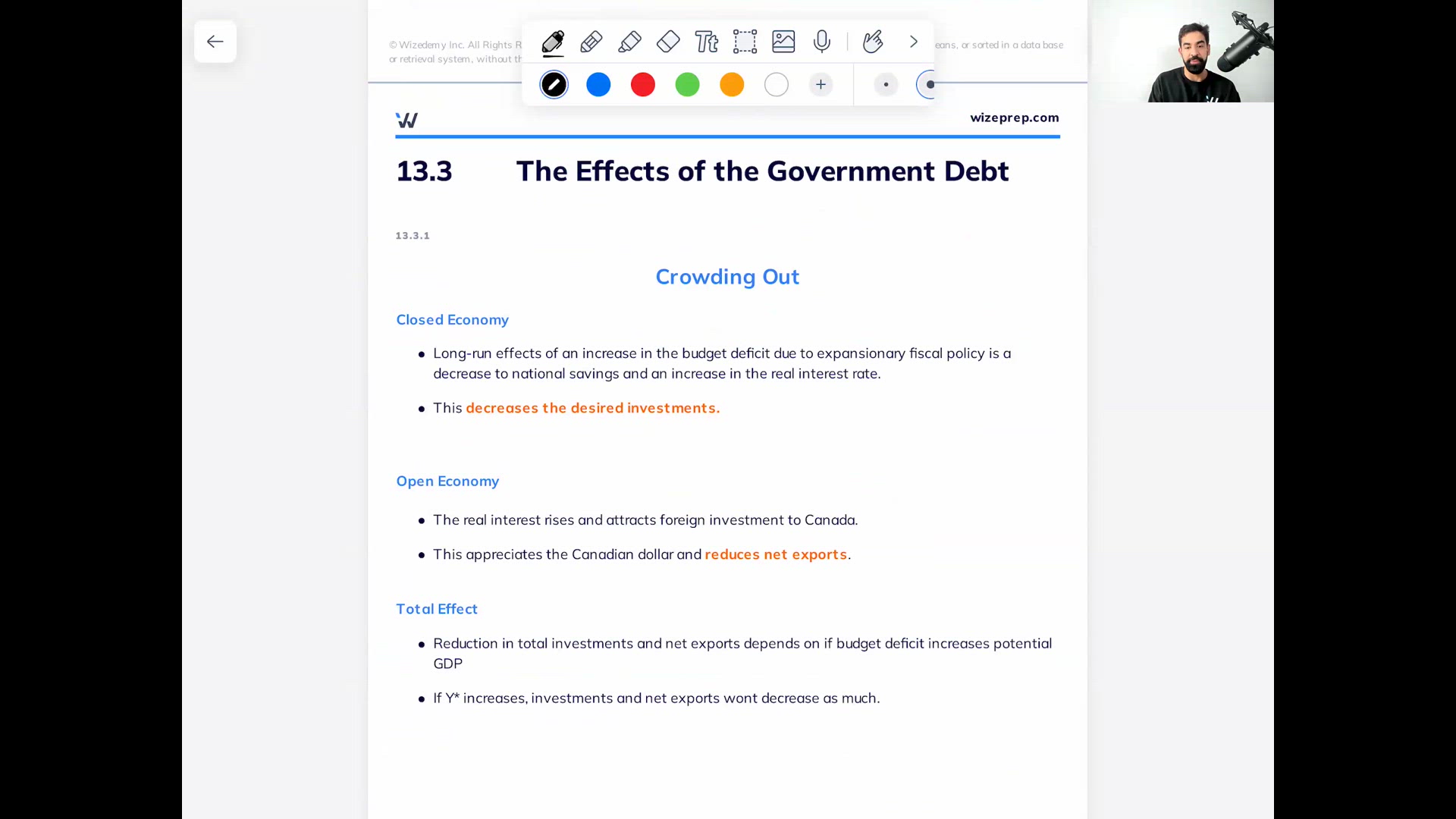
Crowding Out
Closed Economy
- Long-run effects of an increase in the budget deficit due to expansionary fiscal policy is a decrease to national savings and an increase in the real interest rate.
- This decreases the desired investments.
Open Economy
- The real interest rises and attracts foreign investment to Canada.
- This appreciates the Canadian dollar and reduces net exports.
Total Effect
- Reduction in total investments and net exports depends on if budget deficit increases potential GDP
- If Y* increases, investments and net exports wont decrease as much.
Effects on Future Generations
The Long-Term Burden of Government Debt
- Taxes that will be paid by future generations for current government's deficits.
- Could be harmful or beneficial for future generations, depending how the deficits were spent by the current government.
- With capital budgeting, current governments must classify expenditures as consumption or investments.
- Consumption mainly benefits current generation
- Investments mainly benefit future generations
Practice Questions: Effects of Government Debt
1. Consider a closed-economy AD/AS macro model. A policy-induced increase in the government's budget deficit is most likely to crowd-out private investment if
A) interest rates decrease sharply as a result of the deficit.
B) interest rates rise sharply as a result of the deficit.
C) rising income increases the volume of saving and interest rates rise very little.
D) there is a very large output gap.
E) consumers reduce consumption as a result of the deficit.
2. Suppose the government in this closed economy implements an expansionary fiscal policy, which increases the budget deficit. When the economy reaches its new long-run equilibrium, how has the composition of national income changed?
A) Government purchases have decreased.
B) Investment has fallen.
C) Consumption has increased.
D) Investment has risen.
E) The composition of national income at Y* is unchanged
3. Suppose the government implements an expansionary fiscal policy, which increases the budget deficit. The economy's adjustment process returns real GDP to Y* in the long run. Since real GDP is not affected in the long run, how are future generations likely to be harmed by this government policy?
A) Investment in public infrastructure has been crowded out, which will harm future generations.
B) Private investment has been crowded out, which may lead to a lower future growth rate of potential GDP.
C) The inflationary gap is harmful to the economy and reduces real GDP in the future.
D) The budget deficit causes an appreciation in the domestic currency which reduces the income of future generations.
E) Future generations are definitely not harmed by this policy.
4. In the long run, the government budget will add to sustained inflation if
A) they require decreases in the money supply.
B) continual deficits are financed by the continual creation of new money.
C) deficits are always accompanied by decreases in the money supply.
D) government borrowing lowers interest rates.
E) the government finances the deficit by borrowing from the private sector.