Wize University Macroeconomics Textbook > Exchange Rates and the Balance of Payments
The Balance of Payments
Popular Courses
ECON 203
Concordia University
Macroeconomics
University Study Guides
ECONOMIC 1022A/B
Western University
Macroeconomics
General Course
ECON 102
University of British Columbia
ECON*1100
University of Guelph
Macroeconomics
University Study Guides
ECON 102
University of Alberta
ECO102H1
University of Toronto
ECO 1102
University of Ottawa
ECON 209
McGill University
ECON 1BB3
McMaster University
ECON 112
Queen's University
AP/ECON 1010 3.00
York University
ECON 295
McGill University
ECON 110
Queen's University
ECON 105
Simon Fraser University
ECON 1102
Dalhousie University
ECON 1002
Carleton University
ECON 1BA3
McMaster University
0:00 / 0:00
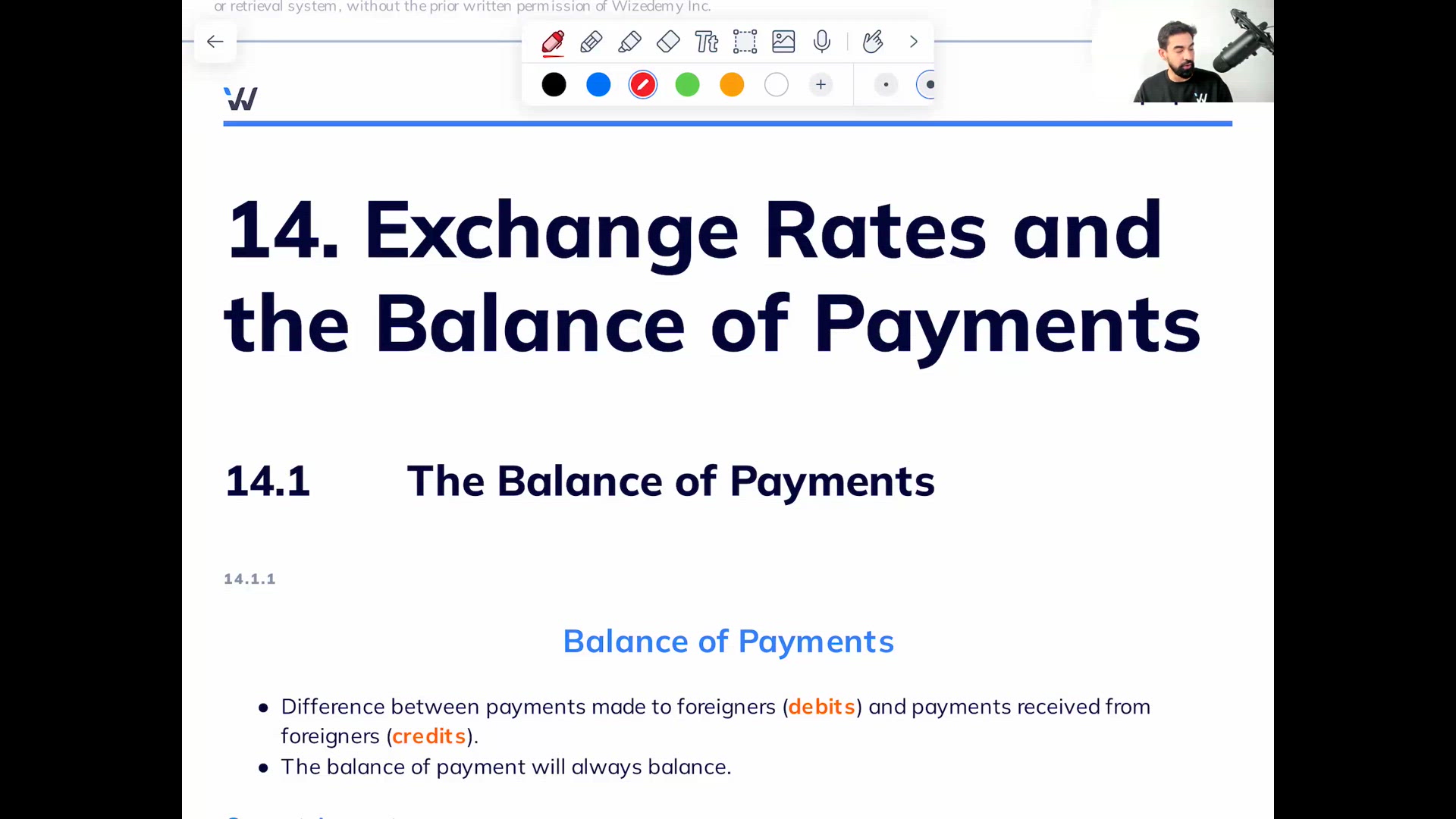
Balance of Payments
- Difference between payments made to foreigners (debits) and payments received from foreigners (credits).
- The balance of payment will always balance.
Current Account
- Records transactions from trade of goods, services and net investment income earned from foreign assets.
- Two sections of the Current Account
- Trade account
- Payments and receipts from import and export of goods and services
- Capital-service account
- Payments and receipts from income earned from asset holdings.
- Example of payment: a Canadian company pays dividends to foreign owner.
- Example of receipt: a Canadian investor earns income from investments made in foreign countries.
Capital Account
- Records international transactions in assets like bonds, stock, real estate and factories.
- Official Financing Account records government transactions in foreign-exchange market.
- Government increases in foreign reserves are debits and decreases of foreign reserves are credits.

Practice Questions: The Balance of Payments
1. A debit entry in the Canadian balance-of-payments accounts
1) is a credit in the balance-of-payments accounts for foreign countries;
2) arises when Canadian assets are sold to foreigners;
3) typically results in more foreign exchange being held by foreigners.
A) 1 only
B) 2 only
C) 3 only
D) 1 and 2
E) 1 and 3
2. Which of the following is true? A credit entry in the Canadian balance-of-payments accounts
A) is any transaction that results in a payment to other nations.
B) typically results in more foreign exchange being held by foreigners.
C) is a credit in the balance-of-payments accounts for foreign countries.
D) arises when Canadian assets are sold to foreigners.
E) arises when Canadians purchase assets from foreigners.
3. Canadian firms' receipts from foreign consumers arising from the exports of goods and services are shown in Canada's
A) investment account.
B) capital account.
C) official financing account.
D) trade account.
E) capital-service account.
4. Consider the components of Canada's balance of payments accounts. The purchase of foreign assets by Canadians is, for Canada, considered a capital ________ and is recorded as ________.
A) outflow; a debit on the current account
B) outflow; a debit on the capital account
C) inflow; a credit on the current account
D) inflow; a credit on the capital account
E) inflow; a debit on the capital account
5. Which of the following would appear as a credit item in the trade account of the Canadian balance of payments?
A) dividends payable to Canadians on Canadian-owned assets located in Cuba
B) sales of Canadian steel to European importers
C) Canadian purchases of American-made vehicles
D) purchases by Japanese firms of shares of Canadian firms in the entertainment industry
E) the opening of an Ottawa branch of a Swiss bank
6. Consider the following annual transactions in Canada's current account. If Canadian exports of goods and services are $40 billion, imports of goods and services are $35 billion, transfers by Canadians to foreigners are $2 billion and transfers from foreigners to Canadian citizens are $1 billion, then the current account balance is
A) + $6 billion.
B) + $4 billion.
C) - $4 billion.
D) - $6 billion.
E) - $7 billion
7. Consider Canada's balance of payments. If the Government of Canada were to sell some of its foreign-exchange reserves to a foreign government, the transaction would
A) represent the sale of an asset, and thus enter as a credit item in the official financing account.
B) represent the purchase of an asset from abroad, and thus enter as a debit item in the official financing account.
C) enter as a credit in the current account.
D) enter as a debit in the capital account.
E) enter as a credit in the capital-service account.
8. Canada's balance of payments is sometimes incorrectly said to be "in surplus." The reason this must be incorrect is that
A) Canada's balance of payments has been in deficit for almost all of its history.
B) unlike most countries, Canada's balance of payments is almost always balanced.
C) like any other country in the world, Canada's balance of payments is always perfectly balanced.
D) the Canadian government has long been committed to avoiding balance of payments surpluses.
E) it is not possible for capital flows to be in a surplus situation.
9. Consider Canada's balance of payments. Suppose Canada's current account has a surplus of $18 billion in 2013. It follows that Canada must have a capital account ________ of ________, meaning that there is a capital flow of this amount ________ Canada.
A) surplus; $18 billion; into
B) deficit; $18 billion; out of
C) deficit; less than $18 billion; out of
D) surplus; less than $18 billion; into
E) deficit; $18 billion; into