Wize University Macroeconomics Textbook > Exchange Rates and the Balance of Payments
The Foreign-Exchange Market
Popular Courses
ECON 203
Concordia University
Macroeconomics
University Study Guides
ECONOMIC 1022A/B
Western University
Macroeconomics
General Course
ECON 102
University of British Columbia
ECON*1100
University of Guelph
Macroeconomics
University Study Guides
ECON 102
University of Alberta
ECO102H1
University of Toronto
ECO 1102
University of Ottawa
ECON 209
McGill University
ECON 1BB3
McMaster University
ECON 112
Queen's University
AP/ECON 1010 3.00
York University
ECON 295
McGill University
ECON 110
Queen's University
ECON 105
Simon Fraser University
ECON 1102
Dalhousie University
ECON 1002
Carleton University
ECON 1BA3
McMaster University
The Exchange Rate
- The rate at which one currency exchanges for another.
- Can be expressed in terms of 1 unit of the domestic currency or 1 unit of the foreign currency.
- We will express it in terms of 1 unit of the foreign currency.
- For example: 1 USD = 1.35 CAD.
Appreciation and Depreciation
- If the exchange rate increases, the domestic currency is depreciating because it takes more of the domestic currency to purchase 1 unit of the foreign currency.
- If the exchange rate decreases, the domestic currency is appreciating because it takes less of the domestic currency to purchase 1 unit of the foreign currency.
The Supply of Foreign Exchange
- Supply of foreign currency = Demand for domestic currency
- When foreigners want to buy goods, services or assets from Canada, they must first buy Canadian dollars by selling their home currency.
Activities that Increase Foreign Currency Supply
- Exports
- Asset sales (capital inflow)
- Reserve currency
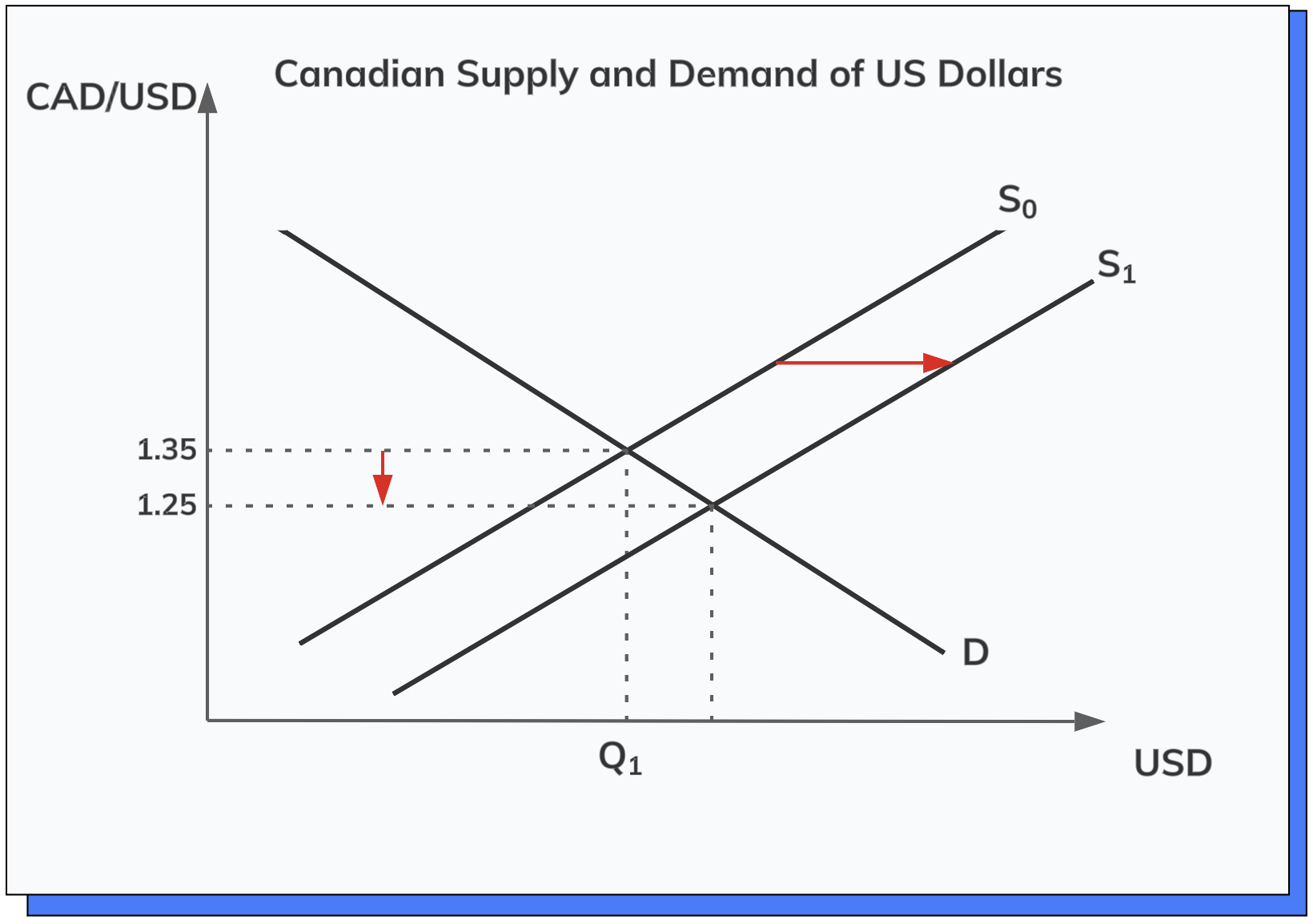
The Demand of Foreign Exchange
Activities that Increase Foreign Currency Demand
- Imports
- Asset purchases (capital outflow)
- Reserve currency
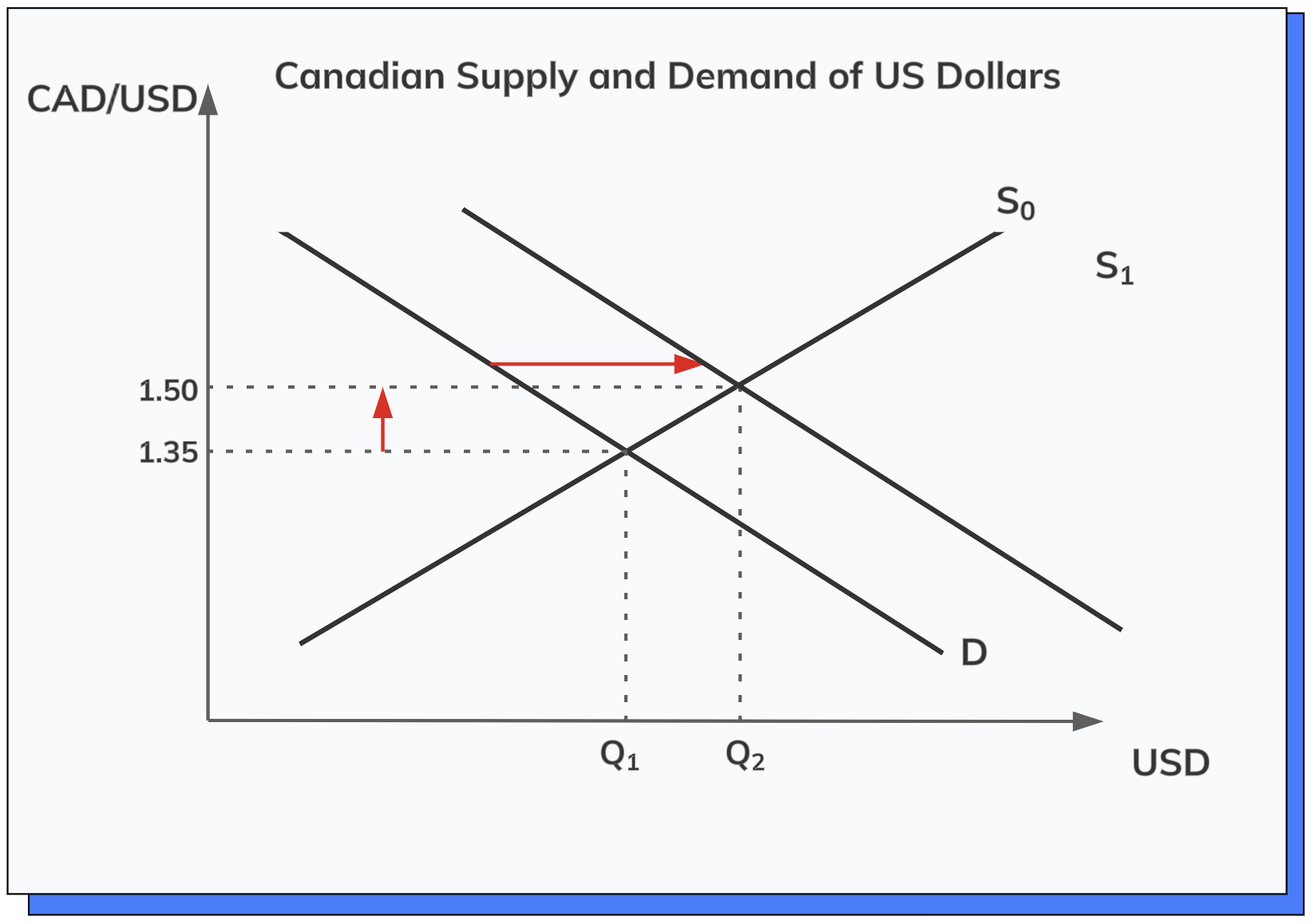
Practice Questions: Foreign Exchange
1. A depreciation of the Canadian dollar implies ________ in the value of the dollar relative to other currencies, such that ________.
A) a fall; fewer dollars are required to purchase foreign currency
B) a fall; more dollars are required to buy foreign currency
C) a rise; fewer dollars are required to purchase foreign currency
D) a rise; more dollars are required to purchase foreign currency
E) a rise; more foreign currency is held by the Bank of Canada
2. Consider Canada's trade with the United States. Canadian exports to the U.S., Americans travelling in Canada, and U.S. capital flows into Canada all give rise to
A) a supply of U.S. dollars on the foreign-exchange market.
B) a demand for U.S. dollars on the foreign-exchange market.
C) a lower value of the Canadian dollar.
D) a decrease in U.S. dollar reserves in Canada.
E) a depreciation of the Canadian dollar.
3. A Canadian traveling to the United States converts $100 Canadian into 85 U.S. dollars. One month later he does the same thing and receives only 80 U.S. dollars. There are no transactions costs. The Canadian-U.S. exchange rate has ________ and the Canadian dollar has ________ relative to the U.S. dollar.
A) increased; depreciated
B) fallen; depreciated
C) increased; appreciated
D) fallen; appreciated
E) not changed; remained stationary
3. Other things being equal, an appreciation of the domestic currency
A) lowers the domestic price of imported goods.
B) raises the domestic price of imported goods.
C) raises the world price of imported goods.
D) lowers the world price of imported goods.
E) lowers the value of our currency in a foreign country.
4. The demand for Canadian dollars in the foreign-exchange market is derived from
A) exports from Canada + capital outflows from Canada.
B) exports from Canada + capital inflows to Canada.
C) imports to Canada + capital outflows from Canada.
D) imports to Canada + capital inflows to Canada.
E) the Canadian government's holding of official reserves.
5. If Canadian demand for French wine increases, the supply of Canadian dollars to the foreign-exchange market will ________ and the demand for euros will ________.
A) decrease; decrease
B) decrease; increase
C) increase; decrease
D) increase; increase
E) increase; remain the same
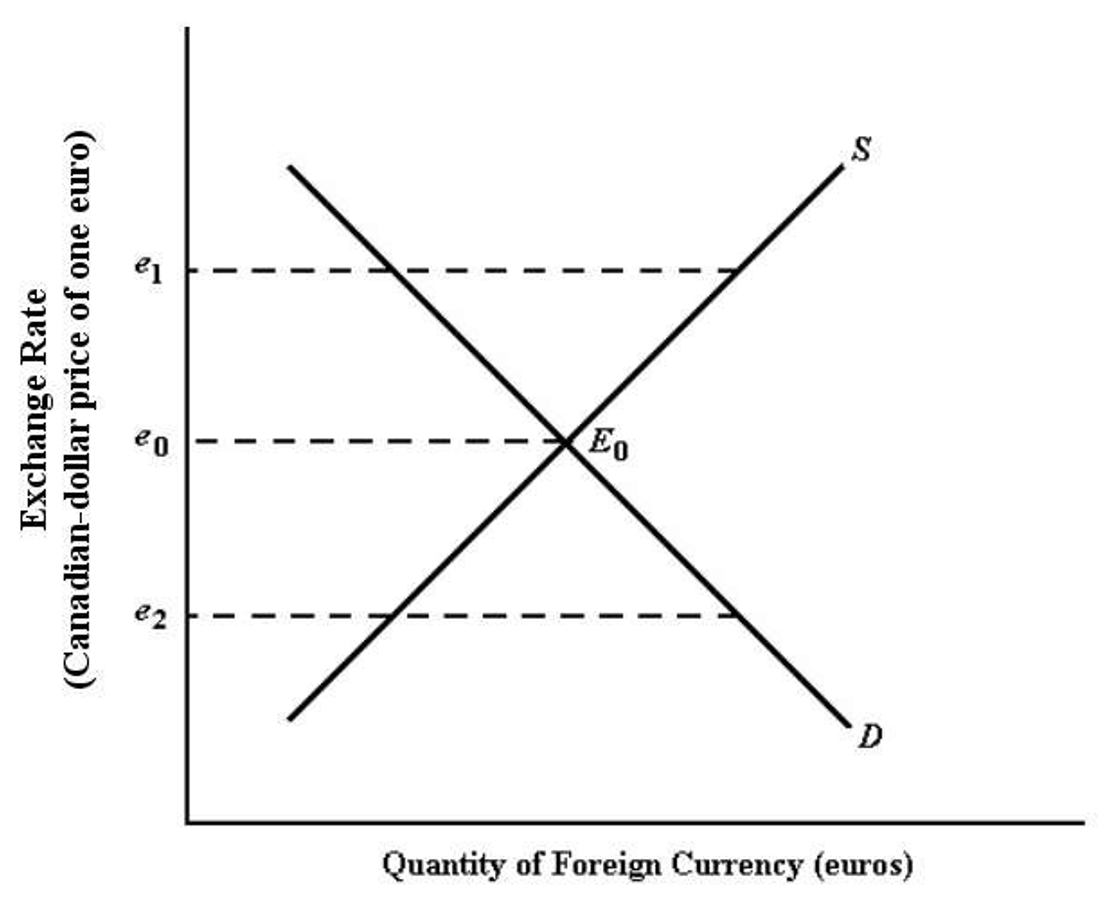
6. If the exchange rate is e1, there is
A) an excess demand for foreign exchange.
B) pressure for the Canadian dollar to appreciate.
C) pressure for the exchange rate to rise.
D) an excess supply of Canadian dollars.
E) a surplus of Canadian dollars.
7. If the exchange rate is e2, there is
A) a surplus of foreign exchange.
B) a surplus of Canadian dollars.
C) pressure on the Canadian dollar to appreciate.
D) pressure on the exchange rate to fall.
E) a shortage of Canadian dollars.