Profit Maximization
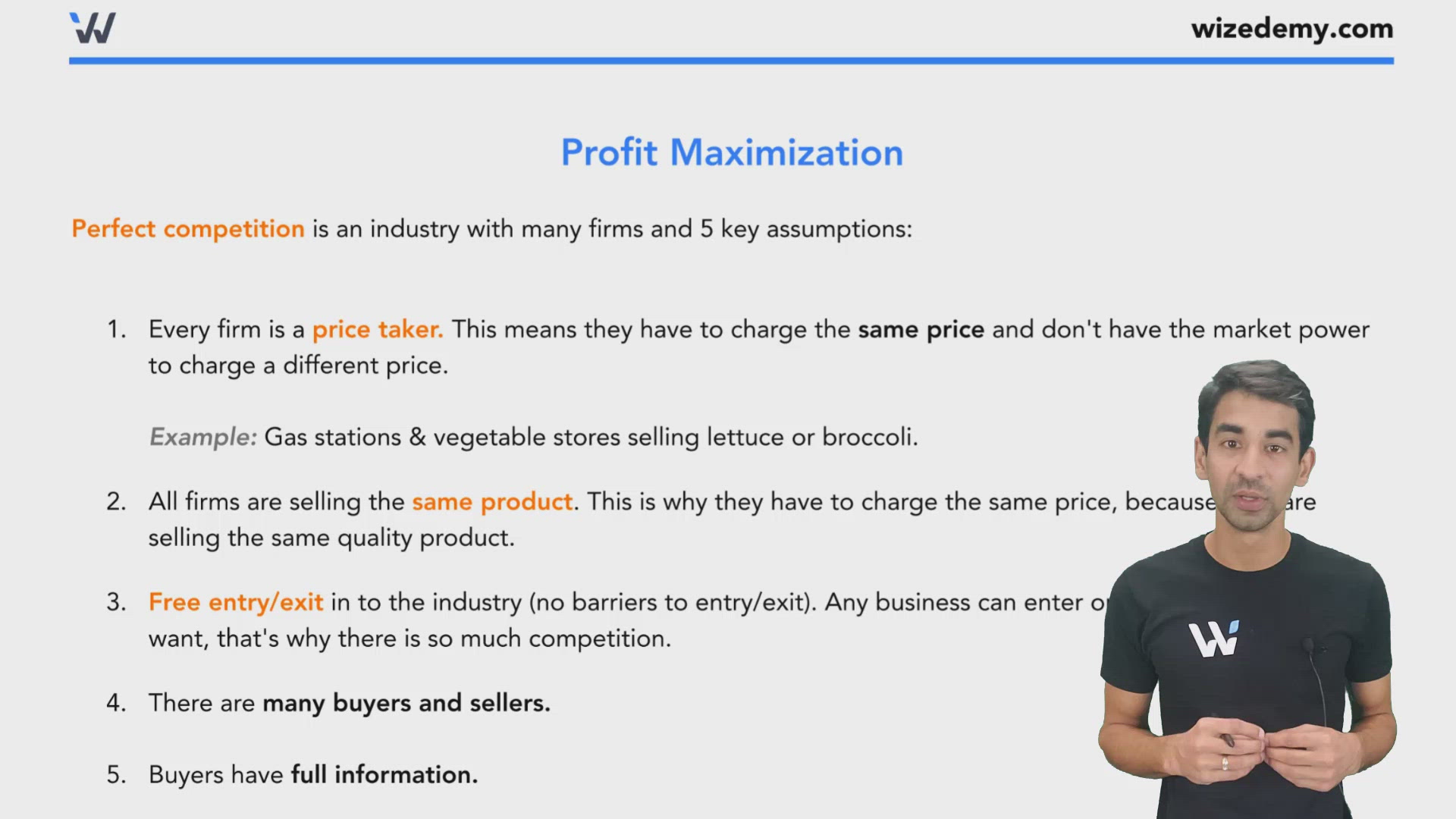
Perfect competition is an industry with many firms and 5 key assumptions:
- Every firm is a price taker. This means they have to charge the same price and don't have the market power to charge a different price. Example: Gas stations & vegetable stores selling lettuce or broccoli.
- All firms are selling the same product. This is why they have to charge the same price, because they are selling the same quality product.
- Free entry/exit in to the industry (no barriers to entry/exit). Any business can enter or leave whenever they want, that's why there is so much competition.
- There are many buyers and sellers.
- Buyers have full information.
Marginal Revenue
- This is the additional revenue the firm earns from selling one extra unit of the product. The marginal revenue is the price (only in perfect competition!) because every firm is a price taker (charging the same price) so the additional revenue from each extra unit is just the price.
- The average revenue means on average how much is the firm making in revenue on each unit they sell. This is also the same thing as the price (in every industry).

Profit Maximization
Profits are maximized when:
- If Price > Marginal Cost (MC) the firm should ________ output
- If Price < Marginal Cost (MC) the firm should ________ output
- In the graph above, the profit is maximized at an output of ________ units.
Steps to find the Profit
- Find the quantity where P = MC
- See where that quantity (output of 10 from the diagram above) hits the ATC
- Find profit by using the following equation:
________
Example: Profit Maximization
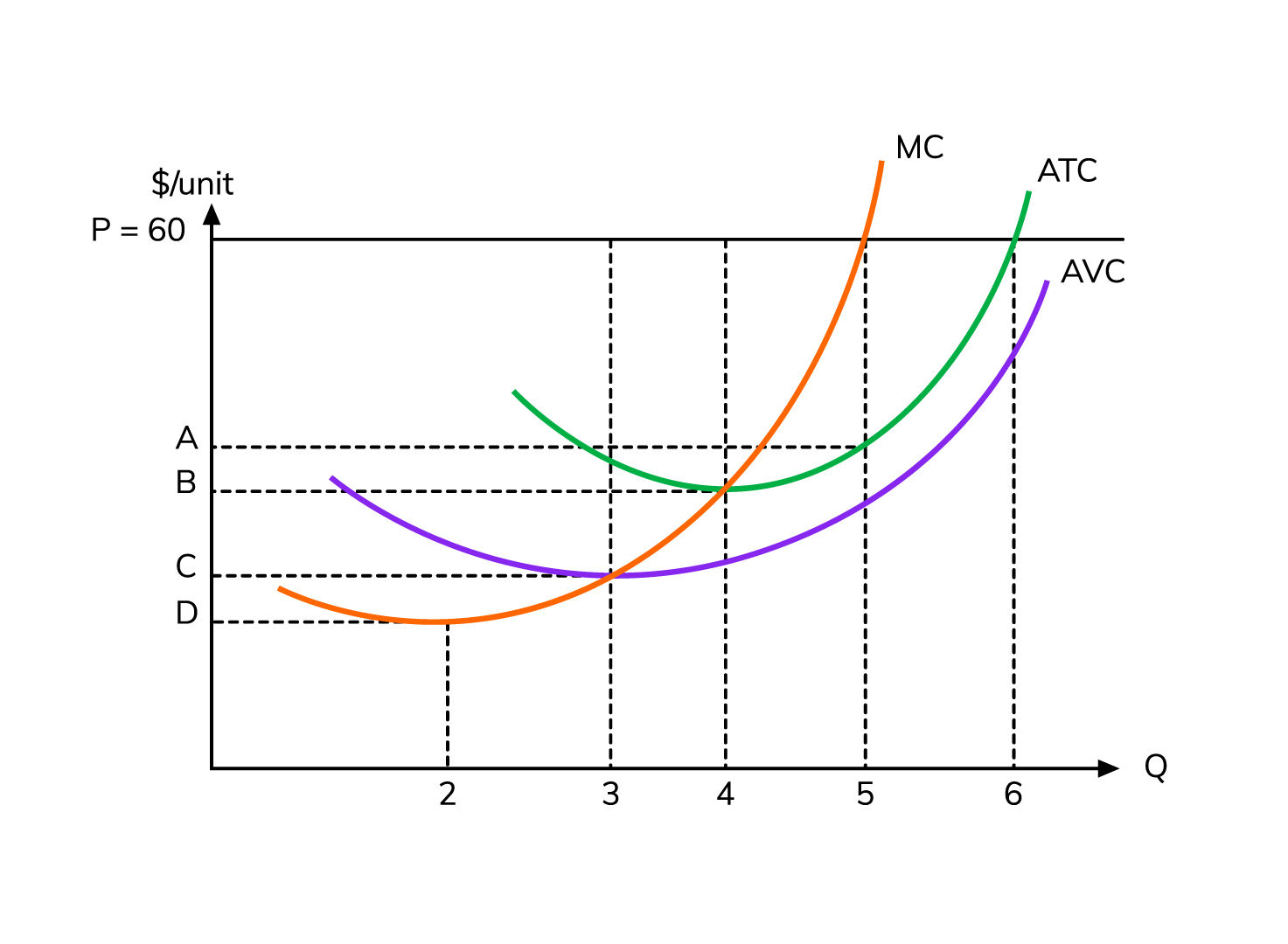
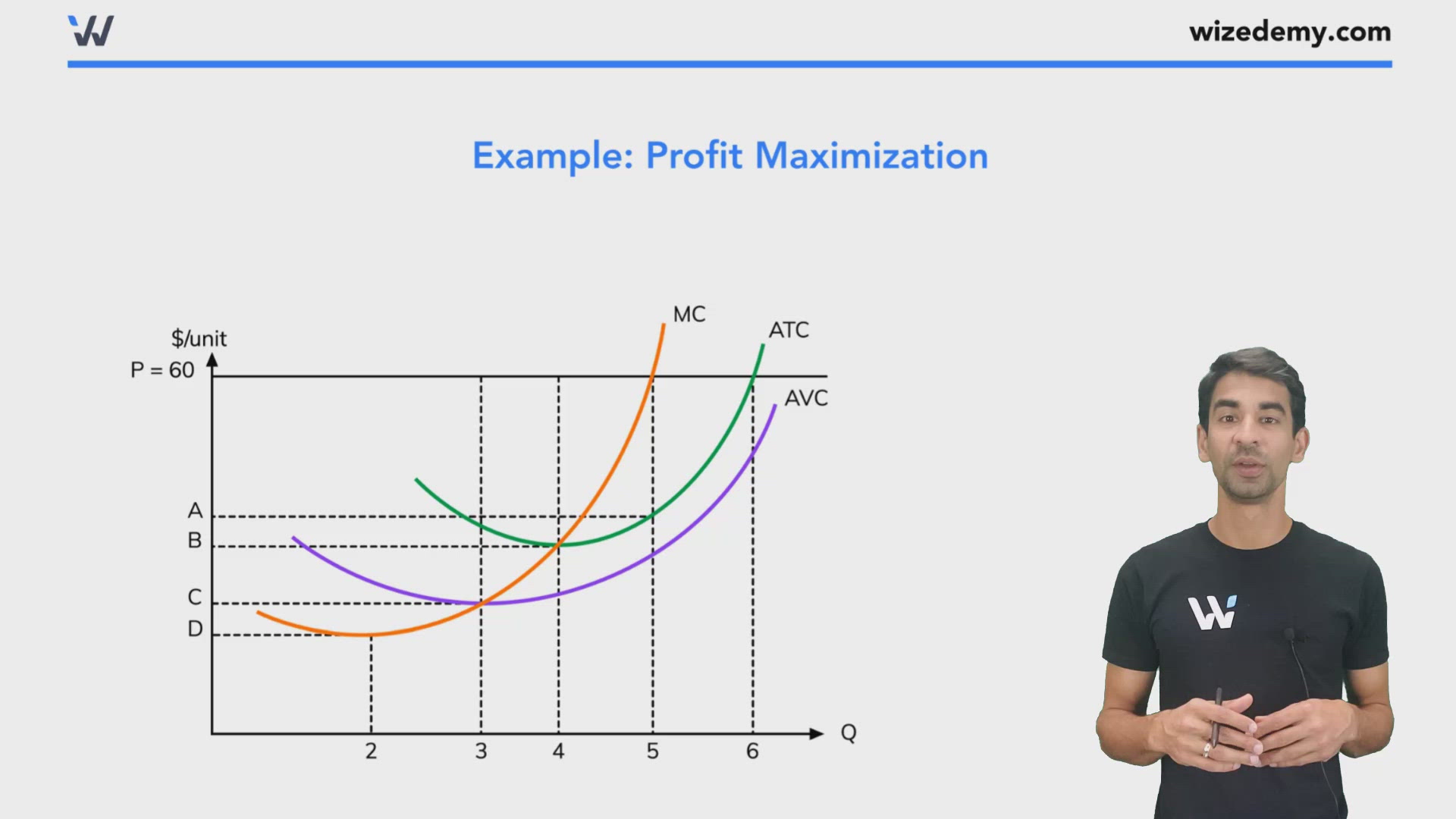
If the price faced by a perfectly competitive firm is equal to $60, then the maximum profit this firm will earn is:
A) $(60 - D)x2
B) $(60 - C)x3
C) $(60 - B)x4
D) $(60 - B)x5
E) $(60 - A)x5
E.
Step 1. Find where Price = MC which is an output of 5.
Step 2. Plug that output in ATC which is at A
Step 3. Profit = (P - ATC) * Q = (60 - A) * 5