Wize University Microeconomics Textbook > Oligopoly
Government Policy Towards Oligopolies
Popular Courses
ECON 201
Concordia University
ECONOMIC 1021A/B
Western University
Microeconomics
University Study Guides
ECON 201
University of Calgary
ECON 1B03
McMaster University
ECON*1050
University of Guelph
ECON 101
University of Alberta
Microeconomics
General Course
ECO101H1
University of Toronto
Microeconomics
University Study Guides
ECON 208
McGill University
ECON 101
University of Waterloo
ECON 110A
Queen's University
ECN 104
Toronto Metropolitan University
ECO 1104
University of Ottawa
EC120
Wilfrid Laurier University
AP/ECON 1000 3.00
York University
ECON 1101
Dalhousie University
ECON 111
Queen's University
ECON 103
Simon Fraser University
0:00 / 0:00
Government Policy
Restraint of Trade & Anti-Trust Laws
The government can prevent firms in an oligopoly from colluding (agreeing to work together to raise prices), by making secret agreements illegal.
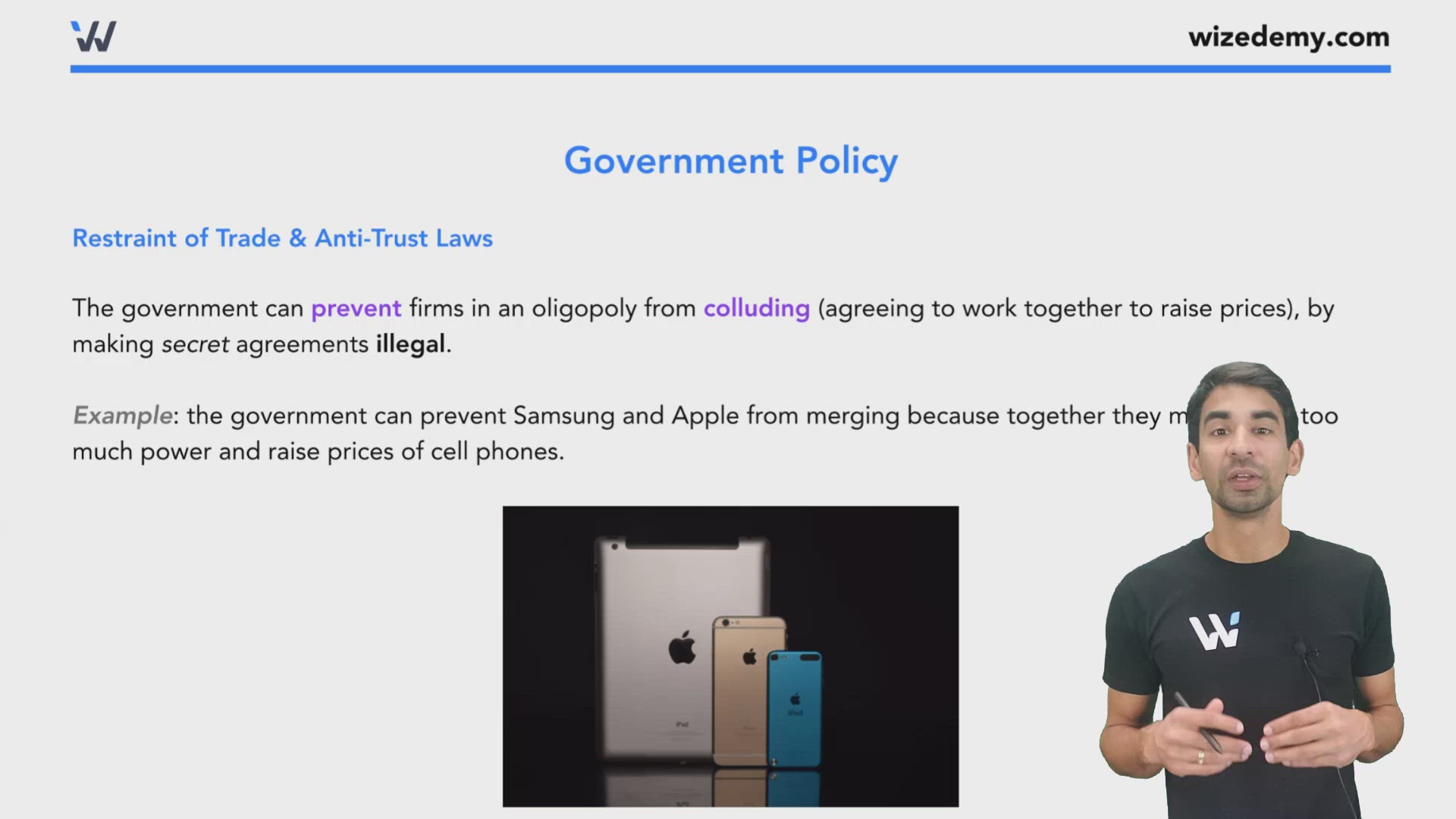
Example: the government can prevent Samsung and Apple from merging because together they might have too much power and raise prices of cell phones.

Resale Price Maintenance
Some people argue that anti-trust laws are not always suitable and they argue that the government should force all retailers to charge the same price for a specific product.
Example: Some clothing companies make retailers charge a certain price for their products to make sure they all keep a certain level of quality. If one retailer charges less and does not give good service and information about a product, customers could get the information from a more expensive retailer and then buy the product from the cheaper retailer. So it's more efficient if they all charge the same price.
Predatory Pricing
When a firm lowers a price so low that it's making a loss just to kill off the competition. Then when the other firms exit the industry, they can start raising their prices since they have no more competition. The government can make this type of activity illegal but it is often hard to prove.
Example: Amazon operated at a loss for years to gather a bigger market share.
Tying
When a firm forces people to buy two products together. Sometimes the government can make this illegal to protect consumers.
Examples:
- Xerox allows companies to lease their photocopy machines, but then they have to use Xerox paper.
- When Microsoft first started selling their software they required everyone to use Internet Explorer with it, which was also a form of tying.
Practice: Government Policy Towards Oligopolies
When a firm forces consumers to pair two of its products together it is known as