Wize University Microeconomics Textbook > Oligopoly
Cartels, Collusion, Output and Price Effect
Popular Courses
ECON 201
Concordia University
ECONOMIC 1021A/B
Western University
Microeconomics
University Study Guides
ECON 201
University of Calgary
ECON 1B03
McMaster University
ECON*1050
University of Guelph
ECON 101
University of Alberta
Microeconomics
General Course
ECO101H1
University of Toronto
Microeconomics
University Study Guides
ECON 208
McGill University
ECON 101
University of Waterloo
ECN 104
Toronto Metropolitan University
ECON 110A
Queen's University
ECO 1104
University of Ottawa
EC120
Wilfrid Laurier University
AP/ECON 1000 3.00
York University
ECON 1101
Dalhousie University
ECON 111
Queen's University
ECON 103
Simon Fraser University

0:00 / 0:00
Cartels, Output and Price Effect
A cartel is when a few firms come together and a act like a monopoly. Instead of competing against each other they collude (work together). This is technically illegal but it is often difficult to prove.
Example: OPEC is believed to be a cartel of the biggest oil producing countries that try to limit supply so that they can raise prices.
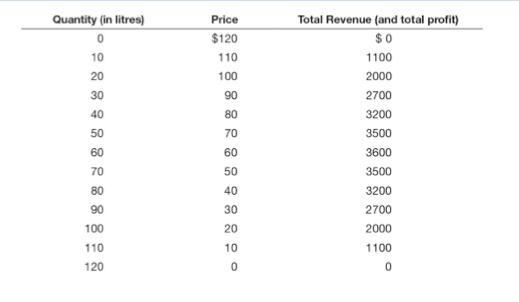
Suppose there is a market for bottled water with the demand schedule above and for each firm the marginal cost = 0.
Perfect Competition
- Remember in perfect competition P = MC.
- Since the MC = 0, the price would be equal to0and the quantity sold would be120litres.
Monopoly
- Remember in a monopoly MR = MC
- Since the MC = 0 we go to the row where MR = 0.
- This would be at a price equal to$60and the quantity sold would be60litres.
- Since there are no costs, the profit for the monopoly would be$60 * 60 = $3600
Duopoly
A duopoly can either collude (form a cartel) or compete
Collude
- Forming a cartel or colluding means acting like a monopoly. They would take the same price as the monopoly and divide the monopoly output by two.
- Each firm in the duopoly would make an output of60/2 = 30, charge a price of$60and profit of3600/2 = $1800each.
- At this output price isgreaterthan marginal cost. So if one firm cheats and increases output to 40 units the total output in the market would now be70units. The market price would fall to$50and profit for the cheating firm would increase to$50 * 40 = $2000while the other firm's profit would fall to$50 * 30 = $1500.
- For the cheating firm the output effect isstrongerthan the price effect because their profit increased.
- If the other firm increases output to 40 units also then the total output would be80units. The profit for each firm would become $40 * 40 = $1600.
- Now if one firm cheats and makes 50 units the total output would be90units and profit for the cheating firm would become $30 * 50 = $1500.
- In this case the output effect isweakerthan the price effect because their profit decreases.
Compete
- If they compete, they will produce at the point where neither firm has an incentive to cheat.
- In the example above this would be when each firm is producing40units of output at a price of$40.
- Profits arehigherfor each firm under collusion rather than competing. But at the collusion outcome there is an incentive to cheat so they both end up at Nash equilibrium producing 40 units each.
Output and Price Effect
- The output effect: Because price is above marginal cost, selling 1 more litre of water at the going price will raise profit.
- The price effect: Raising production will increase the total amount sold, which will lower the price of water and lower the profit on all the other litres sold Example: If the output effect is stronger than the price effect, it will cause the overall profit to increase.
Practice: Output and Price Effect
If a firm in a cartel decides to produce additional units and this causes its profits to go down which of the following are true?