Wize University Microeconomics Textbook > Externalities/Market Failures
Negative Externalities
Popular Courses
ECON 201
Concordia University
ECONOMIC 1021A/B
Western University
Microeconomics
University Study Guides
ECON 201
University of Calgary
ECON 101
University of British Columbia
ECON 1B03
McMaster University
ECON*1050
University of Guelph
ECON 101
University of Alberta
Microeconomics
General Course
Microeconomics
University Study Guides
ECON 208
McGill University
ECON 101
University of Waterloo
ECON 110A
Queen's University
ECO 1104
University of Ottawa
EC120
Wilfrid Laurier University
AP/ECON 1000 3.00
York University
ECON 103
University of Victoria
ECON 1101
Dalhousie University
ECON 111
Queen's University
ECON 103
Simon Fraser University
0:00 / 0:00
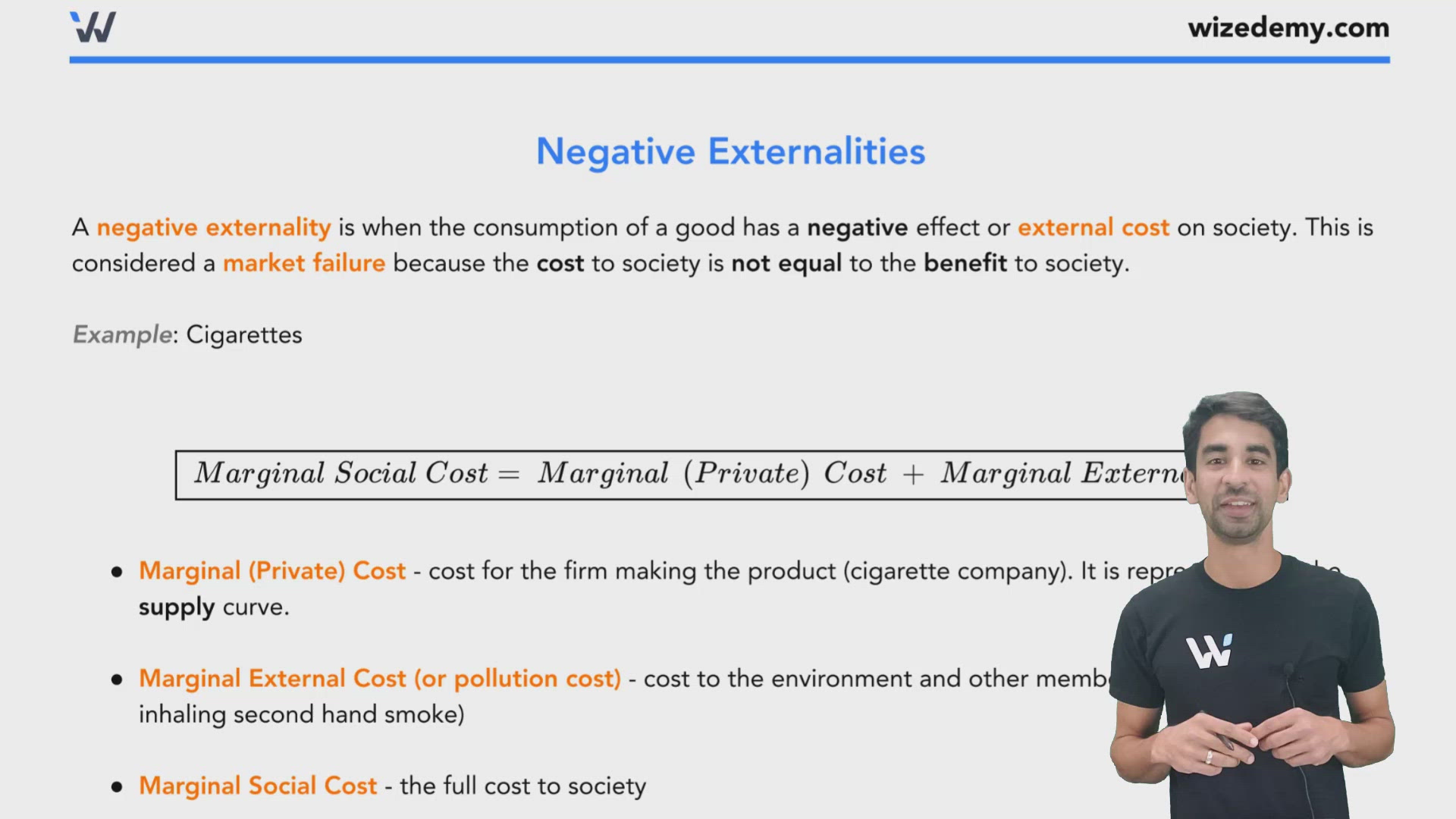
Negative Externalities
A negative externality is when the consumption of a good has a negative effect or external cost on society. This is considered a market failure because the cost to society is not equal to the benefit to society.
Example: Cigarettes
- Marginal (Private) Cost - cost for the firm making the product (cigarette company). It is represented by the supply curve.
- Marginal External Cost (or pollution cost) - cost to the environment and other members of society (people inhaling second hand smoke)
- Marginal Social Cost - the full cost to society
- Private Value or Benefit - this the benefit to the consumer from consuming the product. It is represented by the demand curve.

- The total surplus is the consumer surplus plus the producer surplus.
- The consumer surplus is the area above the price but below the demand.
- Normally, producer surplus is the area below the price but above the supply. However, when there's externalities, to find the producer surplus we use the following formula:
Private Equilibrium Socially Optimal Quantity (Allocative Efficiency)
Consumer Surplus
A+B+C+D
D
Amount Received by Producers
E+F+G
A+E+B+F
Social Cost to Society
F+G+B+C+H
B+F
Producer Surplus
+E-B-C-H
A+E
Total Surplus
A+D+E-H
D+A+E
- Benefit by moving to socially optimal quantity =H
- Negative externalities areoverproduced andunderpriced at the private equilibrium.
0:00 / 0:00
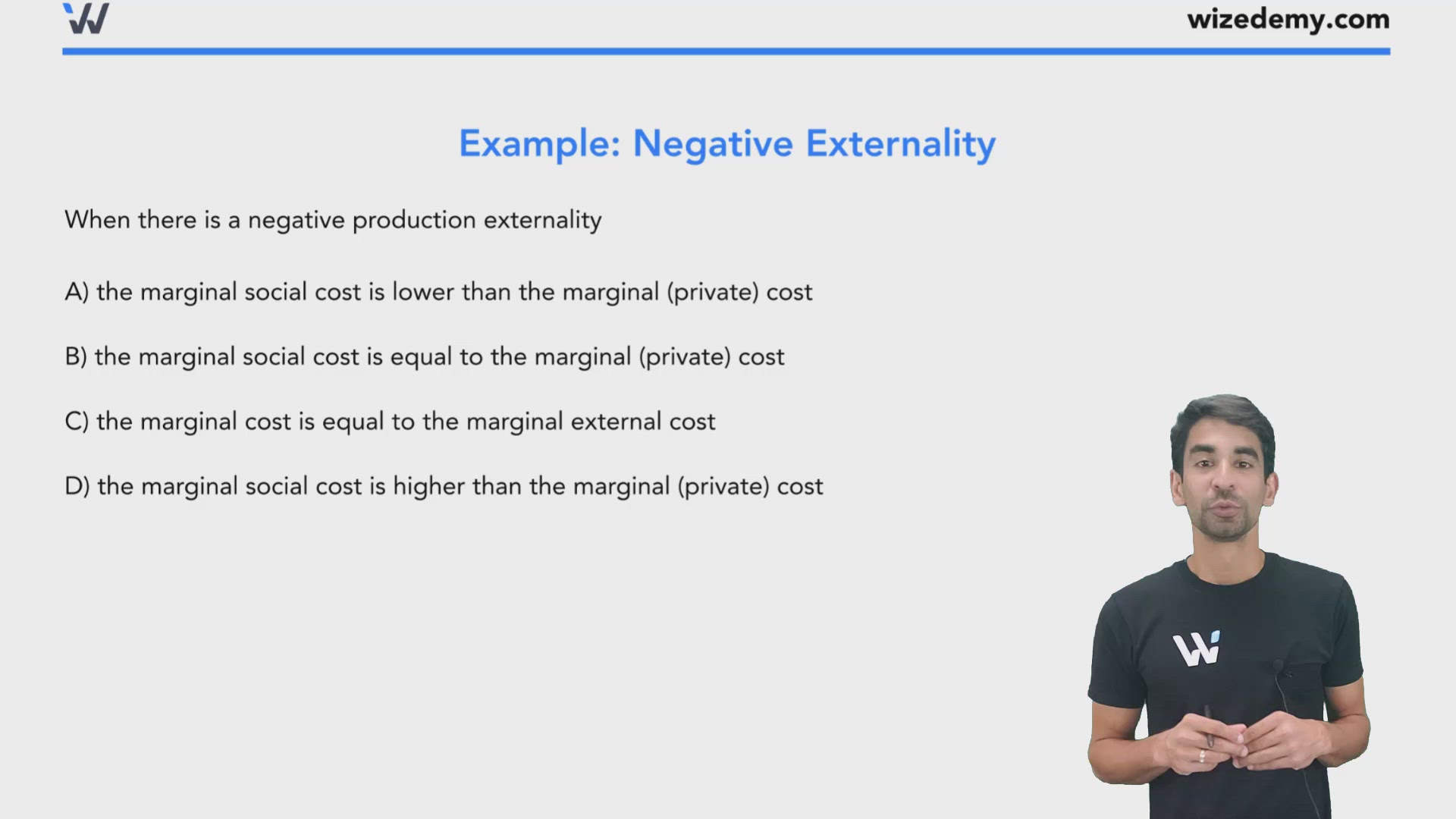
Example: Negative Externality
When there is a negative production externality
A) the marginal social cost is lower than the marginal (private) cost
B) the marginal social cost is equal to the marginal (private) cost
C) the marginal cost is equal to the marginal external cost
D) the marginal social cost is higher than the marginal (private) cost
D
Marginal social cost = marginal cost + marginal external cost
Therefore marginal social cost will always be higher.
Practice: Negative Externality
An example of a negative externality is