Wize University Microeconomics Textbook > Externalities/Market Failures
Correcting Negative Externalities
Popular Courses
ECONOMIC 1021A/B
Western University
Microeconomics
University Study Guides
ECON 201
University of Calgary
ECON 101
University of British Columbia
ECON 1B03
McMaster University
ECON*1050
University of Guelph
ECON 101
University of Alberta
Microeconomics
General Course
Microeconomics
University Study Guides
ECON 208
McGill University
ECON 101
University of Waterloo
ECON 110A
Queen's University
ECO 1104
University of Ottawa
EC120
Wilfrid Laurier University
AP/ECON 1000 3.00
York University
ECON 103
University of Victoria
ECON 1101
Dalhousie University
ECON 111
Queen's University
ECON 103
Simon Fraser University
COMM 171
Queen's University
0:00 / 0:00
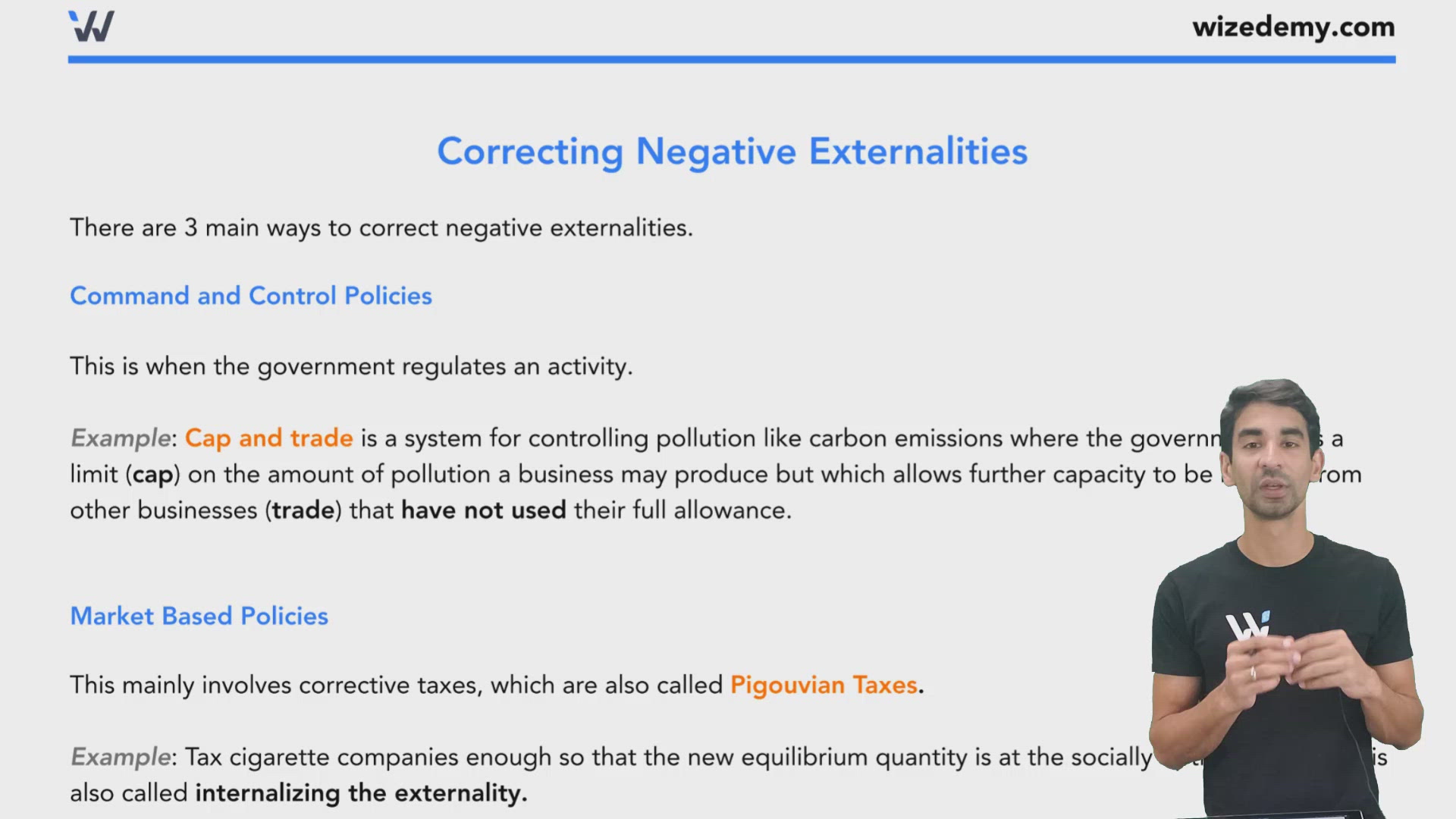
Correcting Negative Externalities
There are 3 main ways to correct negative externalities.
Command and Control Policies
This is when the government regulates an activity.
Example: Cap and trade is a system for controlling pollution like carbon emissions where the government puts a limit (cap) on the amount of pollution a business may produce but which allows further capacity to be bought from other businesses (trade) that have not used their full allowance.
Market Based Policies
This mainly involves corrective taxes, which are also called Pigouvian Taxes.
Example: Tax cigarette companies enough so that the new equilibrium quantity is at the socially optimal level. This is also called internalizing the externality.
Private Solutions
Social Policing
This is when people help to reduce activities that are frowned upon by society
Example: It is frowned upon to litter or smoke outside the entrance of a restaurant or building.
Coase Theorem
- When there are a few parties involved and they bargain with each other to come up with a solution to negotiate away the externality.
- It occurs where there are competitive markets with low transactions costs. An efficient outcome will be reached, regardless of how property rights are divided. Example: A bar playing loud music is subject to a noise complaint by neighboring households. If the revenue generated by the noise ($300) exceeds the value of the damage ($100) that the noise causes to the neighbors, then the efficient outcome is that the bar can continue to produce the noise. The bar can compensate the neighbors (let's say $200) out of the revenue generated and keep any extra revenue in excess of the damages. If the revenue generated by the noise ($100) is less than the value of the damage ($300) that the noise causes to the neighbors, then the the efficient outcome is that the neighbors can pay the bar enough not to make the noise (let's say $200) to compensate for the lost revenue of the business, but less than the value they place on the absence of the noise.
Charities
Charities like Greenpeace can help to reduce the pollution.
Practice: Correcting Negative Externalities
When there is a negative externality due to pollution the government can intervene to