Popular Courses
Microeconomics
University Study Guides
ECON 201
University of Calgary
ECON 101
University of Alberta
Microeconomics
General Course
Microeconomics
University Study Guides
ECON 110A
Queen's University
ECON 111
Queen's University
ECON 103
Simon Fraser University
ECON-1100
University of Windsor
MET EC 101
Boston University
ECON-B 251
Indiana University - Bloomington
ECN 101
Toronto Metropolitan University
EC 201
Michigan State University
ECON 102
University of Illinois at Urbana - Champaign
ECON 1010
University of Manitoba
ECON 1001
Carleton University
ECON 101
University of Delaware
ECON 1101
University of Minnesota
ECON 101
University of Wisconsin - Madison
ECON 1P91
Brock University
0:00 / 0:00
Public Policy
In this section we look at some of the problems the government faces in the voting system and serving its people.
- Transitivity - our behavior follows a logical order. Example: If you like KitKat more than Twix, and Twix more than Mars, then we can say you like KitKat more than Mars..
Condorcet Voting Paradox
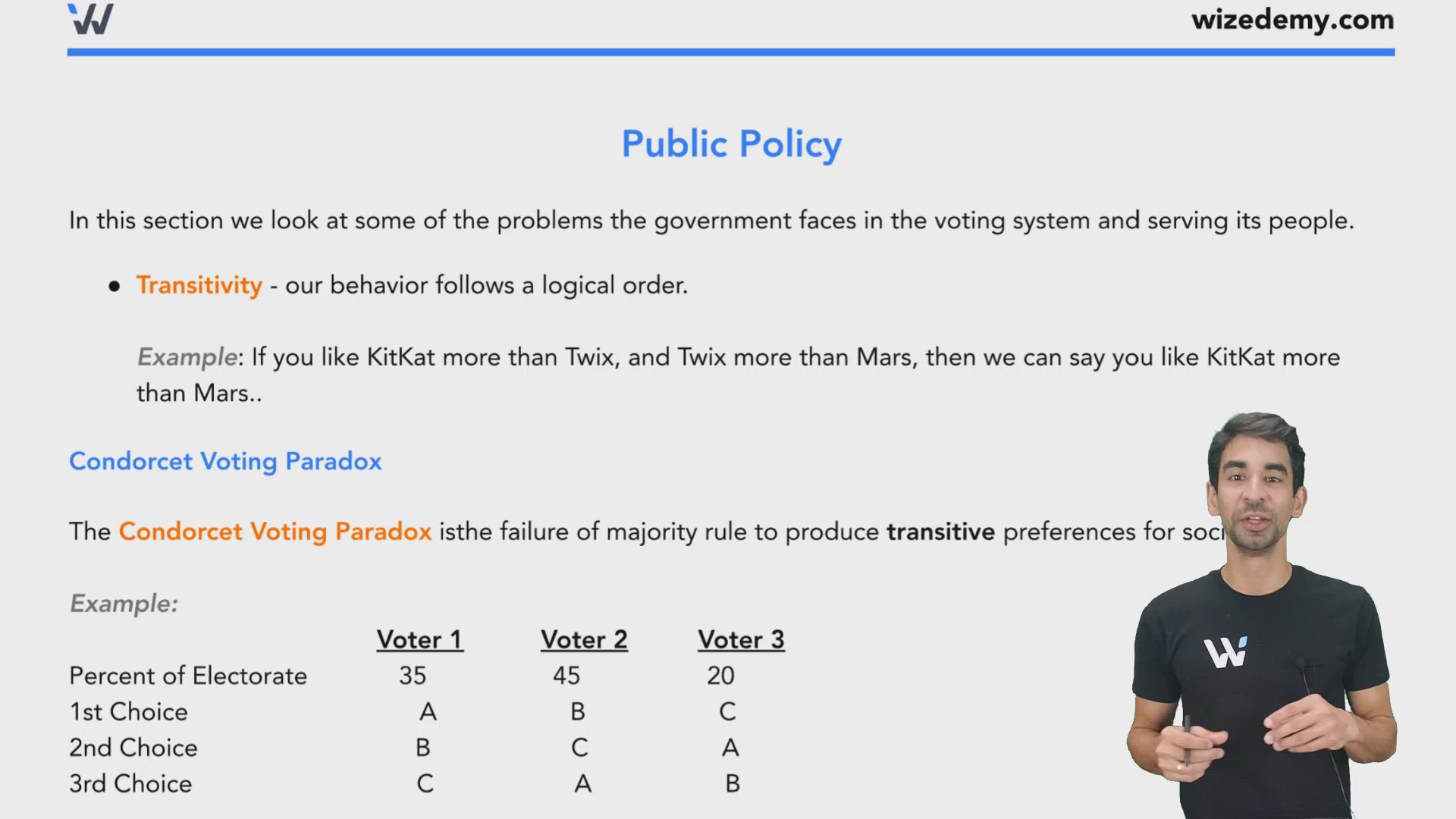
The Condorcet Voting Paradox is the failure of majority rule to produce transitive preferences for society.
Example:
Voter 1 Voter 2 Voter 3
Percent of Electorate 35 45 20
1st Choice A B C
2nd Choice B C A
3rd Choice C A B
- If a politician asks voters to pick between B and C, voter 1 and 2 both would pickB
- If she asks to pick between A and B, voter 1 and 3 would both pickA
- Since A beats B and B beats C, she would assume A is the best option. This method is called pairwise.
- However, what if she asks them to pick between A and C? Voter 2 and 3 would pickC
- The preferences are not transitive because different people in society value things differently.
- Borda Count - Assigning points to each preference. Let's say first choice is worth 3 points, second choice is worth 2 points and last choice is worth 1 point. The choice with the highest total points wins.
Conclusion of Condorcet Paradox
- When there are more than two options, setting the agenda (deciding the order in which items are voted on) can have a big influence over the outcome of a democratic election.
- The majority voting by itself does not tell us what outcome a society really wants.
Arrow's Impossibility Theorem
An economist called Arrow created a theory that assumes that society wants a voting system to choose among these outcomes that satisfies several properties:
- Unanimity: If everyone prefers A to B, then A should beat B.
- Transitivity: If A beats B, and B beats C, then A should beat C. This was disproved in the paradox example above.
- Independence of irrelevant alternatives: The ranking between any two outcomes A and B should not depend on whether some third outcome C is also available. This was disproved with the Borda count. With that system of points mentioned above, B should win. But if we take out option C, then A would win.
- No dictators: There is no person who always gets his way, regardless of everyone else’s preferences.
- Arrow proved that no voting system can satisfy all these properties. He found there is no scheme for aggregating individual preferences into a valid set of social preferences. This shows that no matter what voting system we use, it will be flawed in some way for social choice.
Median Voter Theorem
The median voter theorem is a mathematical result showing that the majority rule will pick the most preferred point of the median voter (the person that's right in the middle of the population).
Example 1: if 40% of the population wants a lot of money spent on parks and 60% wants no money spent on parks. The median voter would pick no money spent on parks and that's the option that would be picked.
Example 2: In a group of 10 voters, 4 people want to spend $30 million on military, 3 people want to spend $10 million and 3 people want to spend $0. The median voter would pick $10 million and that's the option that would win.
0:00 / 0:00
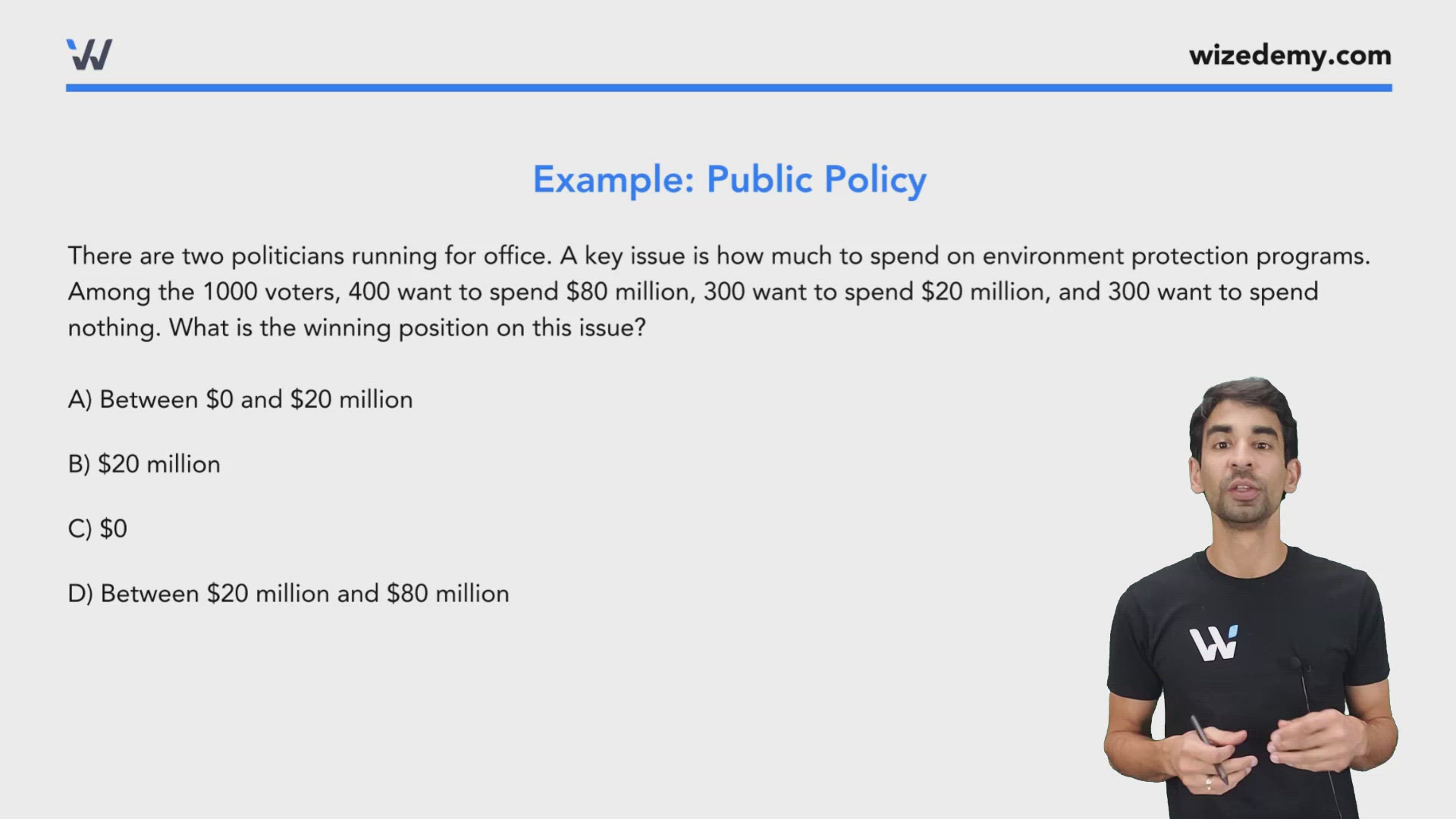
Example: Public Policy
There are two politicians running for office. A key issue is how much to spend on environment protection programs. Among the 1000 voters, 400 want to spend $80 million, 300 want to spend $20 million, and 300 want to spend nothing. What is the winning position on this issue?
A) Between $0 and $20 million
B) $20 million
C) $0
D) Between $20 million and $80 million
B
In this population there are 400+300+300 = 1000 people. The median voter would be 1000/2 = 500th person. That person would fall in the second group which prefers $20 million.
Practice: Condorcet Paradox
The Condorcet paradox shows Arrow’s impossibility theorem by showing that pairwise majority voting
Practice: Borda Count
The Borda count illustrates Arrow’s impossibility theorem by showing that majority voting: