0:00 / 0:00
Hydrostatics

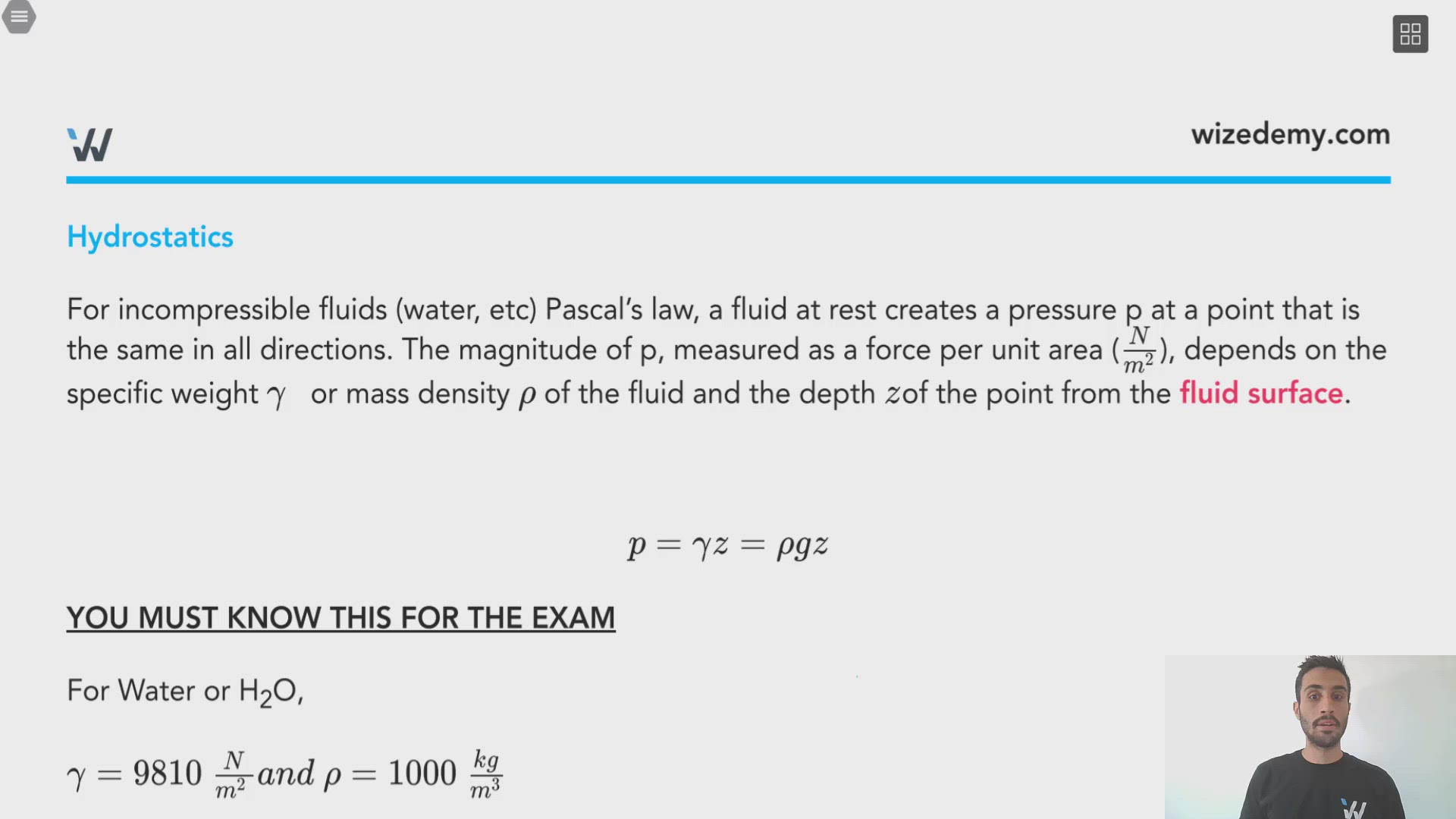
For incompressible fluids (water, etc) Pascal’s law, a fluid at rest creates a pressure p at a point that is the same in all directions. The magnitude of p, measured as a force per unit area (Nm2\frac{N}{m^2}), depends on the specific weight γ\gamma or mass density ρ\rho of the fluid and the depth zzof the point from the fluid surface.


p=γz=ρgzp=\gamma z=\rho gz
YOU MUST KNOW THIS FOR THE EXAM

For Water or H2O,

γ=9810 Nm2 and ρ=1000 kgm3\gamma=9810\ \frac{N}{m^{2\ }}and\ \rho=1000\ \frac{kg}{m^3}


Solving Problems

The process of solving problems if we consider the following example where we want to find the hydrostatic force acting on the plate AB in the figure below:

1) Draw Free Body Diagram showing pressure distribution,
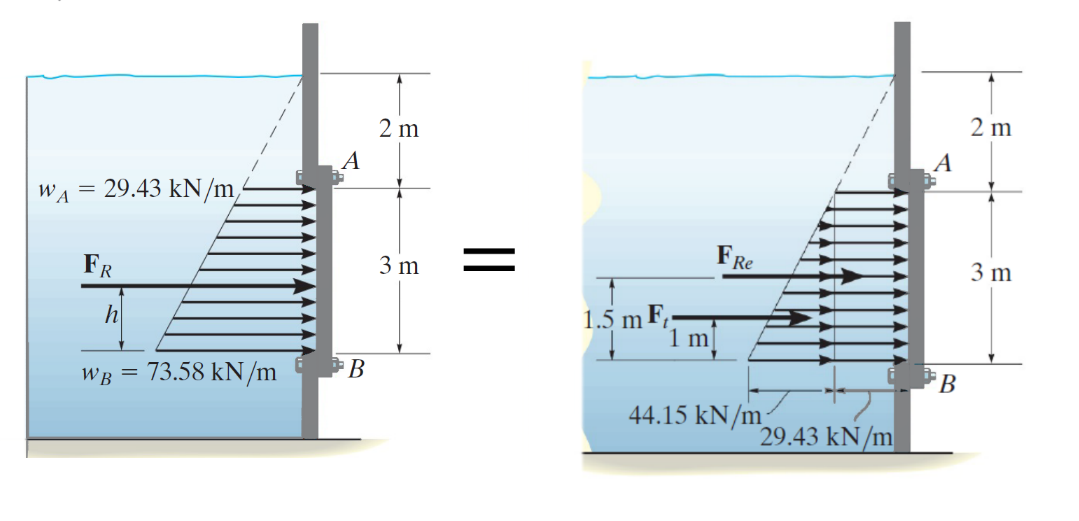

2) Determine the water pressures at appropriate depths,

pA=ρwgzA=(1000kg/m3)(9.81m/s2)(2m)=19.62kPapB=ρwgzB=(1000kg/m3)(9.81m/s2)(5m)=49.05kPa\begin{array}{l}{p_{A}=\rho_{w} g z_{A}=\left(1000 \mathrm{kg} / \mathrm{m}^{3}\right)\left(9.81 \mathrm{m} / \mathrm{s}^{2}\right)(2 \mathrm{m})=19.62 \mathrm{kPa}} \\ {p_{B}=\rho_{w} g z_{B}=\left(1000 \mathrm{kg} / \mathrm{m}^{3}\right)\left(9.81 \mathrm{m} / \mathrm{s}^{2}\right)(5 \mathrm{m})=49.05 \mathrm{kPa}}\end{array}

3) Determine the intensities wwby multiplying the width times the water pressure values. Note: if the width of the gate (w) is not given, assume a value of 1m.

wA=bpA=(1.5m)(19.62kPa)=29.43kN/mwB=bpB=(1.5m)(49.05kPa)=73.58kN/m\begin{aligned} w_{A} &=b p_{A}=(1.5 \mathrm{m})(19.62 \mathrm{kPa})=29.43 \mathrm{kN} / \mathrm{m} \\ w_{B} &=b p_{B}=(1.5 \mathrm{m})(49.05 \mathrm{kPa})=73.58 \mathrm{kN} / \mathrm{m} \end{aligned}

4) Solve for the forces by taking the area of each component (rectangle and triangle). The force acts through the associated centroid of the shape.

For the rectangle distributed load,

FRe=w (h) = (29.43kN/m)(3m)=88.3kNF_{Re}=w\ \left(h\right)\ =\ (29.43\mathrm{kN}/\mathrm{m})(3\mathrm{m})=88.3\mathrm{kN}

For the triangle distributed load,

Ft=12w(h)=12(44.15kN/m)(3m)=66.2kNF_t=\frac{1}{2}w\left(h\right)=\frac{1}{2}(44.15\mathrm{kN}/\mathrm{m})(3\mathrm{m})=66.2\mathrm{kN}

Total Magnitude Force,

FR=FRe+Ft=88.3+66.2=154.5kNF_{R}=F_{R e}+F_{t}=88.3+66.2=154.5 \mathrm{kN}


PAGE BREAK

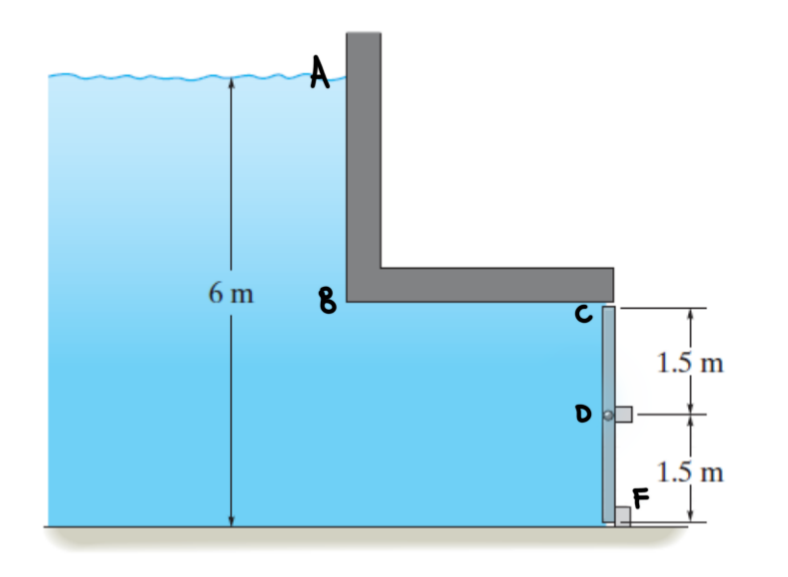
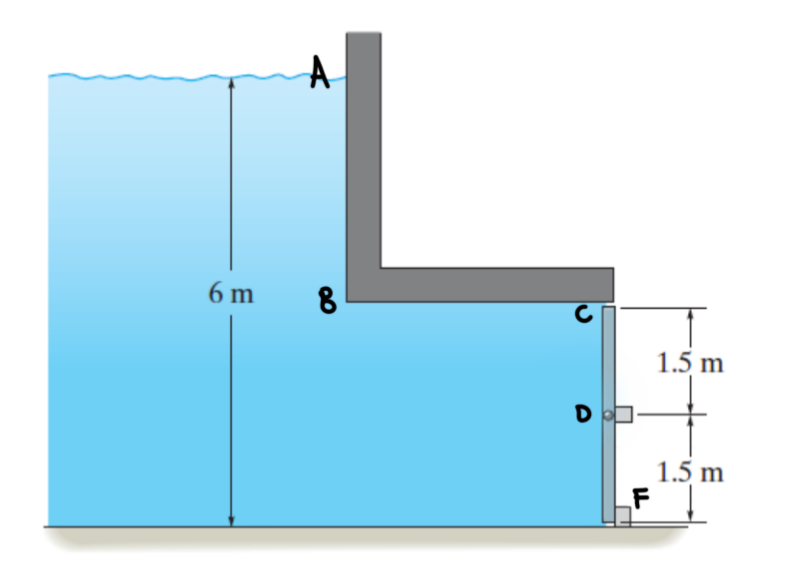
Lets Quickly Practice Drawing Distributed Loads,

1) Draw the Distributed Load Acting on AB.
2) Draw the Distributed Load Acting on CF.


0:00 / 0:00
Example

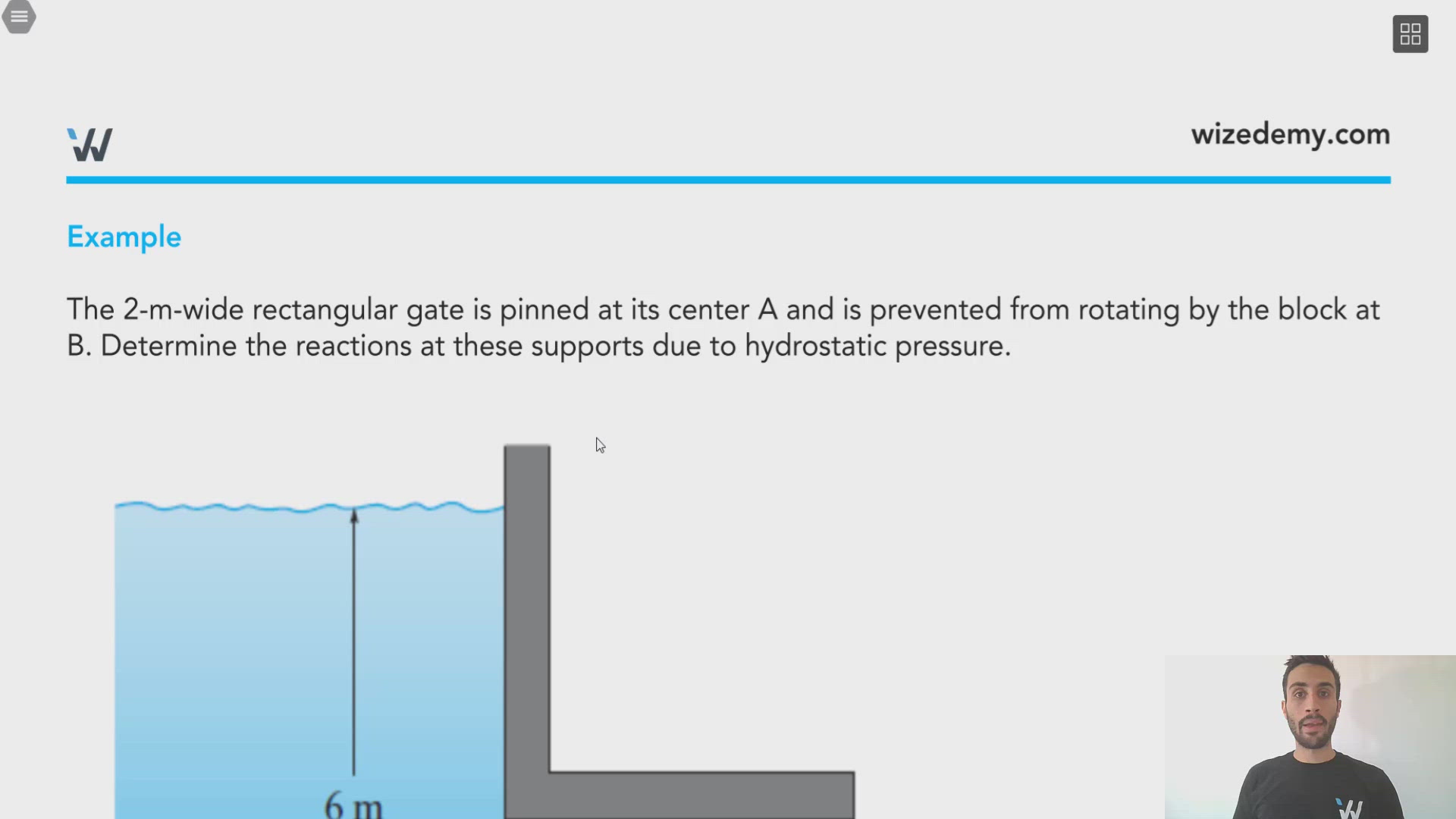
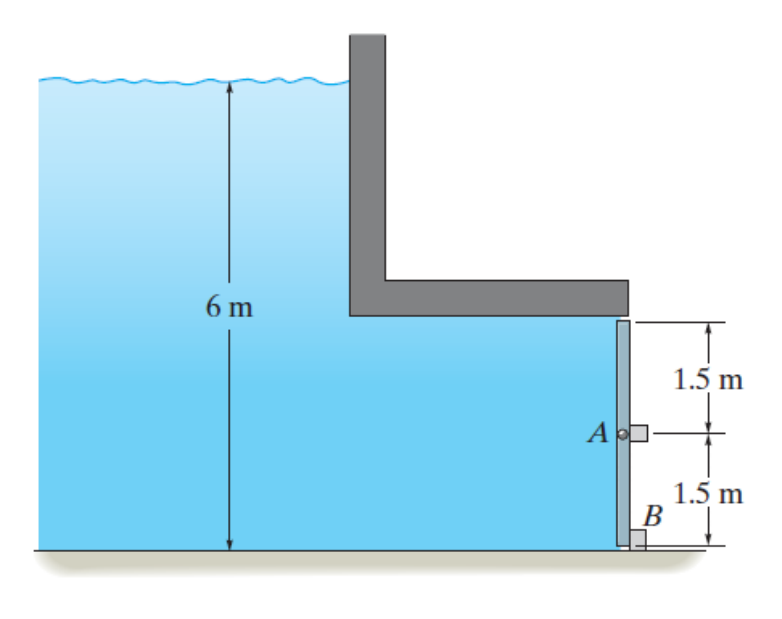
The 2-m-wide rectangular gate is pinned at its center A and is prevented from rotating by the block at B. Determine the reactions at these supports due to hydrostatic pressure.

PAGE BREAK


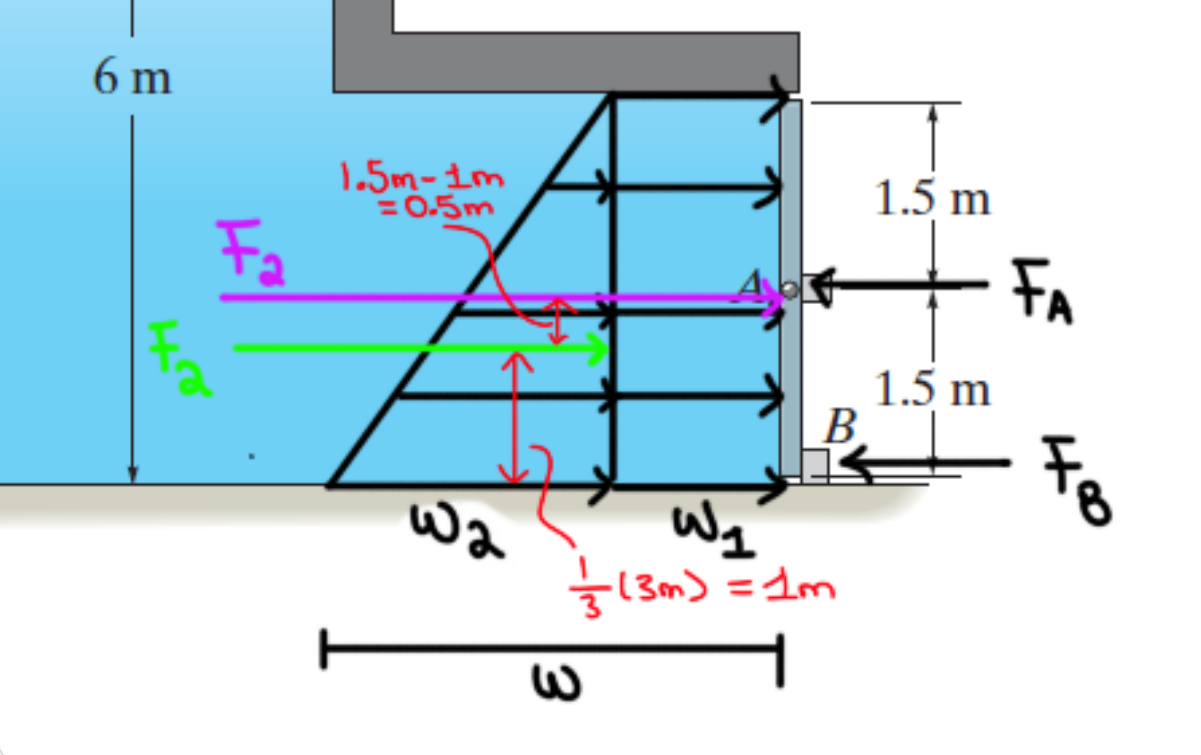
1) Draw Free Body Diagram,


2 - 3) Find pressures and intensitites,

w1=1000(9.81)(3)(2)=58860N/mw2=w    w1  =1000(9.81)(6)(2)58860=11772058860=58860N/m\begin{array}{l}{w_{1}=1000(9.81)(3)(2)=58860 \mathrm{N} / \mathrm{m}} \\ {w_{2}= w \ \ - \ \ w_1 \ \ =1000(9.81)(6)(2) -58860=117720-58860=58860 \mathrm{N} / \mathrm{m}}\end{array}

4) Solve for hydrostatic forces,

F1=12(3)(58860)=88290  NF2=(58860)(3)=176580  N\begin{array}{l}{F_{1}=\frac{1}{2}(3)(58860)=88290 \ \ N} \\ {F_{2}=(58860)(3)=176580 \ \ N}\end{array}

5) Apply Equations of Equilibrium,

CCW(+) ΣMA=0;88290(0.5)FB(1.5)=0FB=29430N=29.4kN\begin{aligned}CCW(+)\ \Sigma M_{A}=0 ; & 88290(0.5)-F_{B}(1.5)=0 \\ & F_{B}=29430 \mathrm{N}=29.4 \mathrm{kN} \end{aligned}

+ΣFx=0;88290+17658029430FA=0\stackrel{+}{\rightarrow} \Sigma F_{x}=0 ; \quad 88290+176580-29430-F_{A}=0

FA=235440N=235kNF_{A}=235440 \mathrm{N}=235 \mathrm{kN}


0:00 / 0:00
Example (Similar to 2017 Winter Final Question 3)

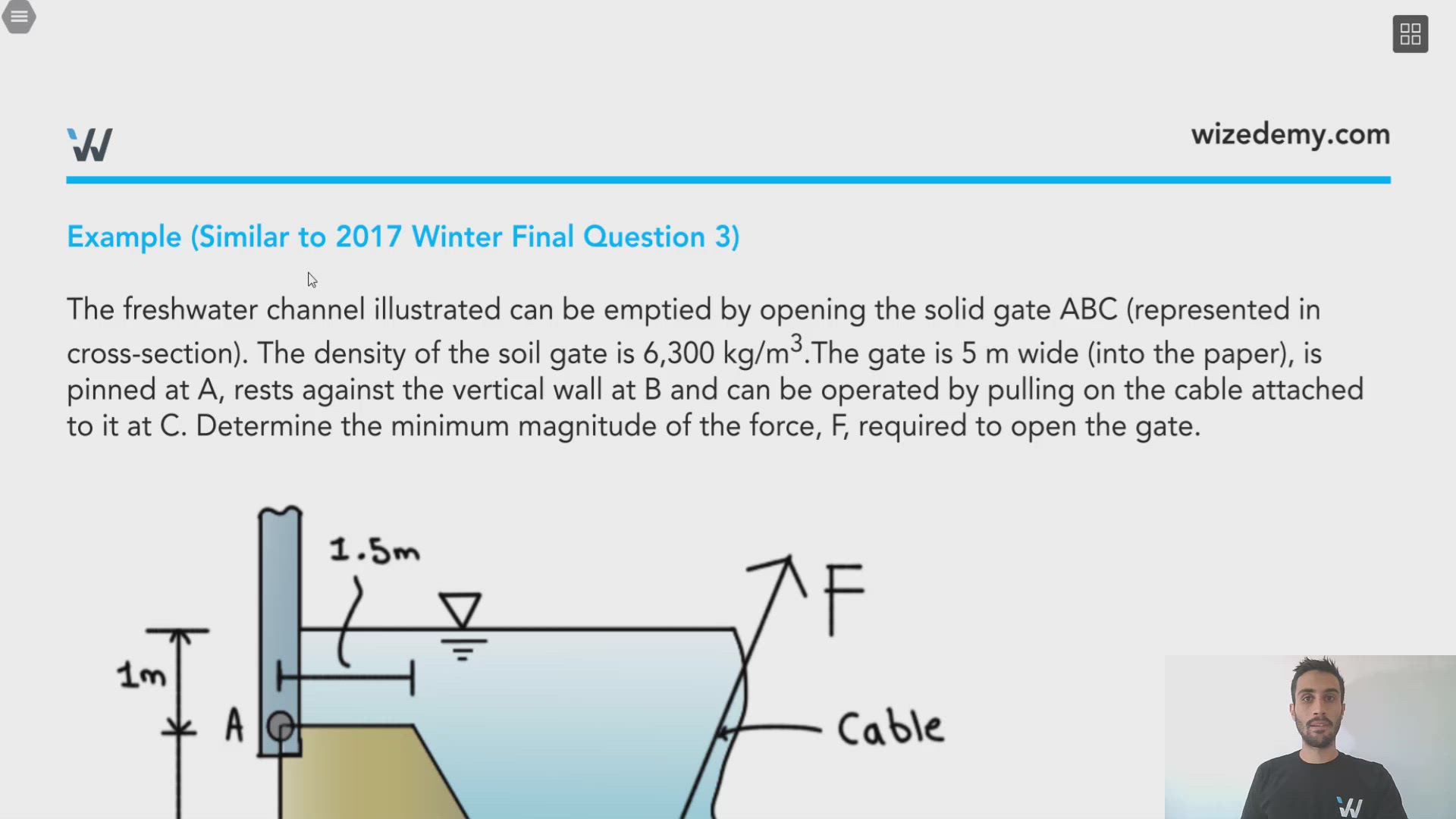
The freshwater channel illustrated can be emptied by opening the solid gate ABC (represented in cross-section). The density of the soil gate is 6,300 kg/m3.The gate is 5 m wide (into the paper), is pinned at A, rests against the vertical wall at B and can be operated by pulling on the cable attached to it at C. Determine the minimum magnitude of the force, F, required to open the gate.
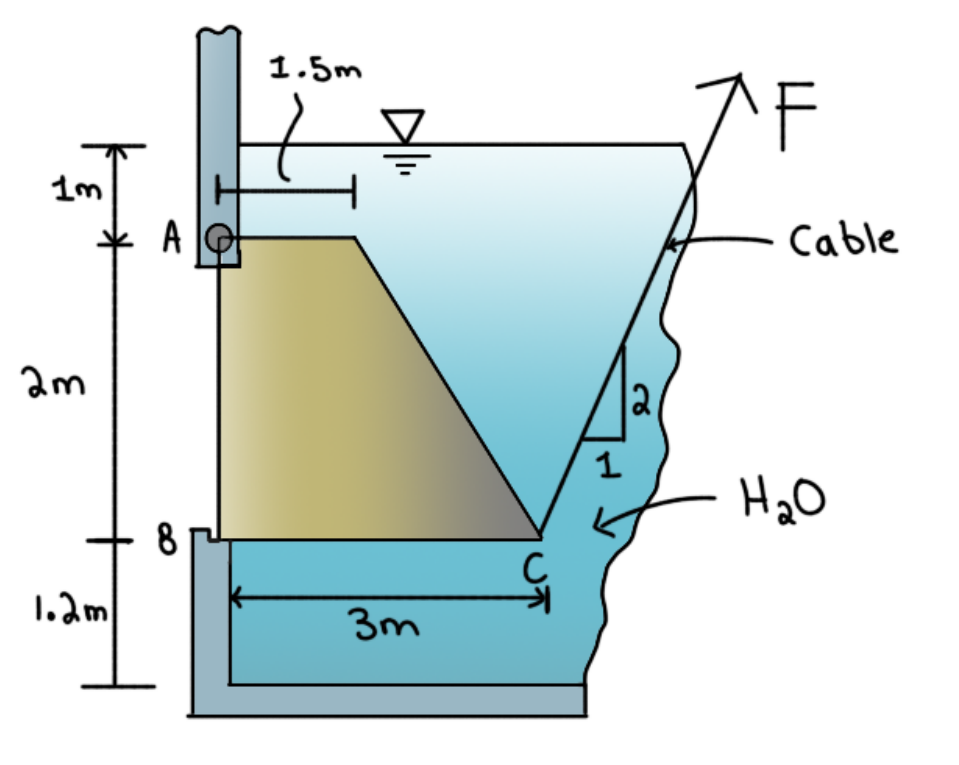


1) Draw Free Body Diagram
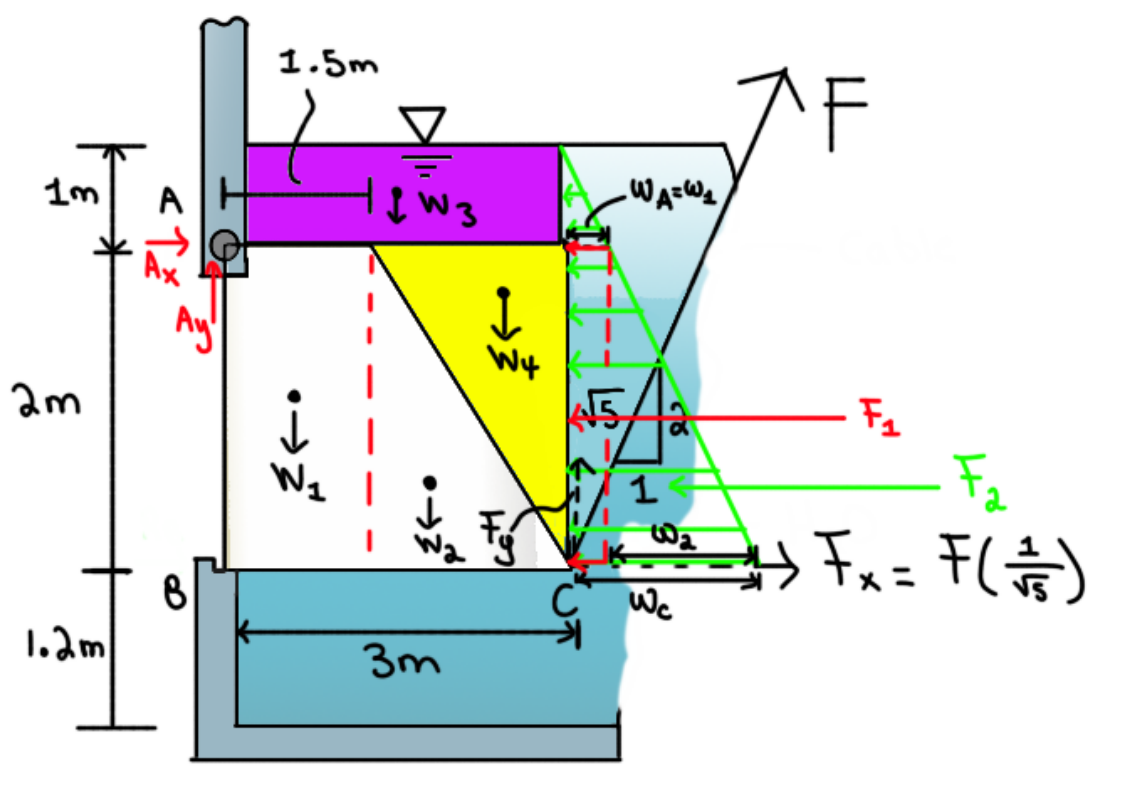


First, we will find the weight forces,

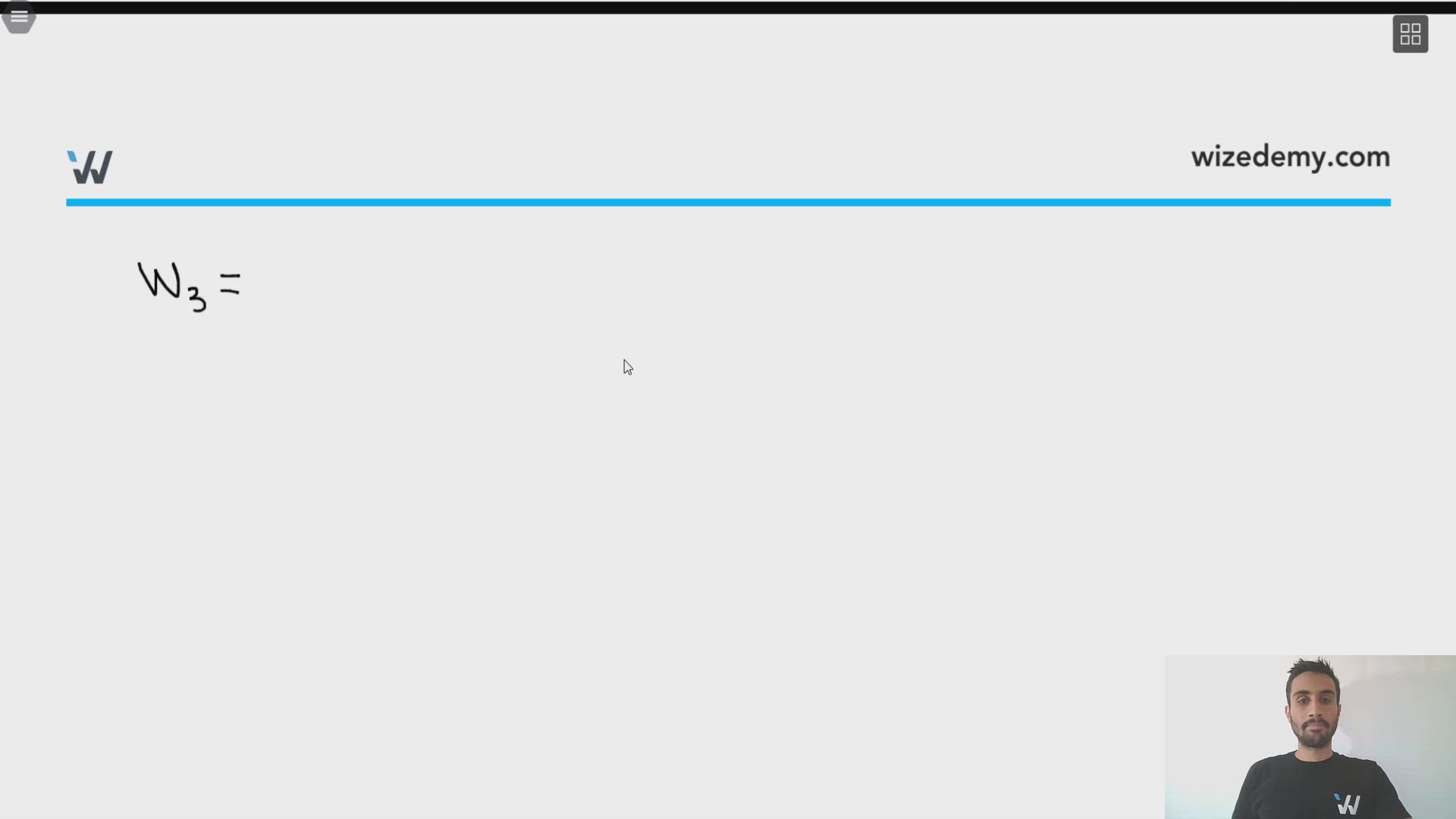
W1=ρVg=6300kg/m3(1.5m×2m×5m)(9.81)=927045N=927kNW2=ρVg=6300kg/m3(12(1.5m×2m)×5m)(9.81)=463523N=464kNW3=ρVg=1000kg/m3(3m×1m×5m)(9.81)=147150N=147kNW4=ρVg=1000kg/m3(12(1.5m×2m)×5m)(9.81)=73575N=73.6kN\begin{aligned} W_{1}=\rho V g=6300 \mathrm{kg} / \mathrm{m}^{3}(1.5 \mathrm{m} \times 2 \mathrm{m} \times 5 \mathrm{m})(9.81)=927045 \mathrm{N}=927 \mathrm{kN} \\ W_{2}=\rho \mathrm{Vg}=6300 \mathrm{kg} / \mathrm{m}^{3}\left(\frac{1}{2}(1.5 \mathrm{m} \times 2 \mathrm{m}) \times 5 \mathrm{m}\right)(9.81)=463523 \mathrm{N}=464 \mathrm{kN} \\ W_{3}=\rho \mathrm{Vg}=1000 \mathrm{kg} / \mathrm{m}^{3}(3 \mathrm{m} \times 1 \mathrm{m} \times 5 \mathrm{m})(9.81)=147150 \mathrm{N}=147 \mathrm{kN} \\ W_{4}=\rho \mathrm{Vg}=1000 \mathrm{kg} / \mathrm{m}^{3}\left(\frac{1}{2}(1.5 \mathrm{m} \times 2 \mathrm{m}) \times 5 \mathrm{m}\right)(9.81)=73575 \mathrm{N}=73.6 \mathrm{kN} \end{aligned}

Secondly, we can determine the resultant forces due to triangular varying distributed load, we need the intensities at A and C.

Intensity at A,

ω1=ωA=b×P1=b×ρwgzAω1=5m×(1000kgm3)(9.81)(1m)ω1=49050N/m=49.05kN/m\begin{aligned} \omega_{1}=\omega_{A}=b \times P_{1}=b \times \rho_{w} g z_{A} \\ \omega_{1}=5 m \times\left(1000 \frac{k g}{m^{3}}\right)(9.81)(1 m) \\ \omega_{1}=49050 N / m=49.05 \mathrm{kN} / \mathrm{m} \end{aligned}

Intensity at C,

ωC=b×Pc=b×ρwgzcωC=5m×(1000kgm3)(9.81)(3m)ωC=147150N/m=147kN/m\begin{array}{c}{\omega_{C}=b \times P_{c}=b \times \rho_{w} g z_{c}} \\ {\omega_{C}=5 m \times\left(1000 \frac{k g}{m^{3}}\right)(9.81)(3 m)} \\ {\omega_{C}=147150 \mathrm{N} / m=147 \mathrm{kN} / \mathrm{m}}\end{array}

Resultant force for the rectangular area F1,

F1=ω1(h)=49.05kNm(2m)=98.1kNF_{1}=\omega_{1}(h)=49.05 \frac{k N}{m}(2 m)=98.1 \mathrm{kN}

Resultant force for the triangular area F2,

F2=12(ωCωA)(h)=12(147kNm49.05kNm)(2m)=97.95kN=98.1kNF_{2}=\frac{1}{2}\left(\omega_{C}-\omega_{A}\right)(h)=\frac{1}{2}\left(147 \frac{k N}{m}-49.05 \frac{k N}{m}\right)(2 m)=97.95 k N=98.1 k N

Apply Equations of Equilibrium,

CCW(+)ΣMA=0:W1(1.52)W2(13(1.5)+1.5)W3(1.5)W4(23(1.5)+1.5)F1(1)F2(23(2))+Fy(3)+Fx(2)=0\operatorname{CCW}(+) \Sigma M_{A}=0:-W_{1}\left(\frac{1.5}{2}\right)-W_{2}\left(\frac{1}{3}(1.5)+1.5\right)-W_{3}(1.5)-W_{4}\left(\frac{2}{3}(1.5)+1.5\right)-F_{1}(1)-F_{2}\left(\frac{2}{3}(2)\right)+F_{y}(3)+F_{x}(2)=0

927(1.52)464(13(1.5)+1.5)147(1.5)76.3(23(1.5)+1.5)98.1(1)98.1(23(2))+F(25)(3)+F(15)(2)=0-927\left(\frac{1.5}{2}\right)-464\left(\frac{1}{3}(1.5)+1.5\right)-147(1.5)-76.3\left(\frac{2}{3}(1.5)+1.5\right)-98.1(1)-98.1\left(\frac{2}{3}(2)\right)+F\left(\frac{2}{\sqrt{5}}\right)(3)+F\left(\frac{1}{\sqrt{5}}\right)(2)=0

F(25)(3)+F(15)(2)=2263.43.58F=2263.4\begin{array}{l}{F\left(\frac{2}{\sqrt{5}}\right)(3)+F\left(\frac{1}{\sqrt{5}}\right)(2)=2263.4} \\ {3.58 F=2263.4}\end{array}

F=632.2kN=632kN(  ans)F=632.2 \mathrm{kN}=632 \mathrm{kN}(\mathrm \ \ {ans})
0:00 / 0:00
Example (Similar to 2017 Winter Final Question 3)

The freshwater channel illustrated can be emptied by opening the solid gate ABC (represented in cross-section). The density of the soil gate is 6,300 kg/m3.The gate is 5 m wide (into the paper), is pinned at A, rests against the vertical wall at B and can be operated by pulling on the cable attached to it at C. Determine the minimum magnitude of the force, F, required to open the gate.


1) Draw Free Body Diagram


First, we will find the weight forces,

W1=ρVg=6300kg/m3(1.5m×2m×5m)(9.81)=927045N=927kNW2=ρVg=6300kg/m3(12(1.5m×2m)×5m)(9.81)=463523N=464kNW3=ρVg=1000kg/m3(3m×1m×5m)(9.81)=147150N=147kNW4=ρVg=1000kg/m3(12(1.5m×2m)×5m)(9.81)=73575N=73.6kN\begin{aligned} W_{1}=\rho V g=6300 \mathrm{kg} / \mathrm{m}^{3}(1.5 \mathrm{m} \times 2 \mathrm{m} \times 5 \mathrm{m})(9.81)=927045 \mathrm{N}=927 \mathrm{kN} \\ W_{2}=\rho \mathrm{Vg}=6300 \mathrm{kg} / \mathrm{m}^{3}\left(\frac{1}{2}(1.5 \mathrm{m} \times 2 \mathrm{m}) \times 5 \mathrm{m}\right)(9.81)=463523 \mathrm{N}=464 \mathrm{kN} \\ W_{3}=\rho \mathrm{Vg}=1000 \mathrm{kg} / \mathrm{m}^{3}(3 \mathrm{m} \times 1 \mathrm{m} \times 5 \mathrm{m})(9.81)=147150 \mathrm{N}=147 \mathrm{kN} \\ W_{4}=\rho \mathrm{Vg}=1000 \mathrm{kg} / \mathrm{m}^{3}\left(\frac{1}{2}(1.5 \mathrm{m} \times 2 \mathrm{m}) \times 5 \mathrm{m}\right)(9.81)=73575 \mathrm{N}=73.6 \mathrm{kN} \end{aligned}

Secondly, we can determine the resultant forces due to triangular varying distributed load, we need the intensities at A and C.

Intensity at A,

ω1=ωA=b×P1=b×ρwgzAω1=5m×(1000kgm3)(9.81)(1m)ω1=49050N/m=49.05kN/m\begin{aligned} \omega_{1}=\omega_{A}=b \times P_{1}=b \times \rho_{w} g z_{A} \\ \omega_{1}=5 m \times\left(1000 \frac{k g}{m^{3}}\right)(9.81)(1 m) \\ \omega_{1}=49050 N / m=49.05 \mathrm{kN} / \mathrm{m} \end{aligned}

Intensity at C,

ωC=b×Pc=b×ρwgzcωC=5m×(1000kgm3)(9.81)(3m)ωC=147150N/m=147kN/m\begin{array}{c}{\omega_{C}=b \times P_{c}=b \times \rho_{w} g z_{c}} \\ {\omega_{C}=5 m \times\left(1000 \frac{k g}{m^{3}}\right)(9.81)(3 m)} \\ {\omega_{C}=147150 \mathrm{N} / m=147 \mathrm{kN} / \mathrm{m}}\end{array}

Resultant force for the rectangular area F1,

F1=ω1(h)=49.05kNm(2m)=98.1kNF_{1}=\omega_{1}(h)=49.05 \frac{k N}{m}(2 m)=98.1 \mathrm{kN}

Resultant force for the triangular area F2,

F2=12(ωCωA)(h)=12(147kNm49.05kNm)(2m)=97.95kN=98.1kNF_{2}=\frac{1}{2}\left(\omega_{C}-\omega_{A}\right)(h)=\frac{1}{2}\left(147 \frac{k N}{m}-49.05 \frac{k N}{m}\right)(2 m)=97.95 k N=98.1 k N

Apply Equations of Equilibrium,

CCW(+)ΣMA=0:W1(1.52)W2(13(1.5)+1.5)W3(1.5)W4(23(1.5)+1.5)F1(1)F2(23(2))+Fy(3)+Fx(2)=0\operatorname{CCW}(+) \Sigma M_{A}=0:-W_{1}\left(\frac{1.5}{2}\right)-W_{2}\left(\frac{1}{3}(1.5)+1.5\right)-W_{3}(1.5)-W_{4}\left(\frac{2}{3}(1.5)+1.5\right)-F_{1}(1)-F_{2}\left(\frac{2}{3}(2)\right)+F_{y}(3)+F_{x}(2)=0

927(1.52)464(13(1.5)+1.5)147(1.5)76.3(23(1.5)+1.5)98.1(1)98.1(23(2))+F(25)(3)+F(15)(2)=0-927\left(\frac{1.5}{2}\right)-464\left(\frac{1}{3}(1.5)+1.5\right)-147(1.5)-76.3\left(\frac{2}{3}(1.5)+1.5\right)-98.1(1)-98.1\left(\frac{2}{3}(2)\right)+F\left(\frac{2}{\sqrt{5}}\right)(3)+F\left(\frac{1}{\sqrt{5}}\right)(2)=0

F(25)(3)+F(15)(2)=2263.43.58F=2263.4\begin{array}{l}{F\left(\frac{2}{\sqrt{5}}\right)(3)+F\left(\frac{1}{\sqrt{5}}\right)(2)=2263.4} \\ {3.58 F=2263.4}\end{array}

F=632.2kN=632kN(  ans)F=632.2 \mathrm{kN}=632 \mathrm{kN}(\mathrm \ \ {ans})
Practice (Similar to Final 2016 Q2)

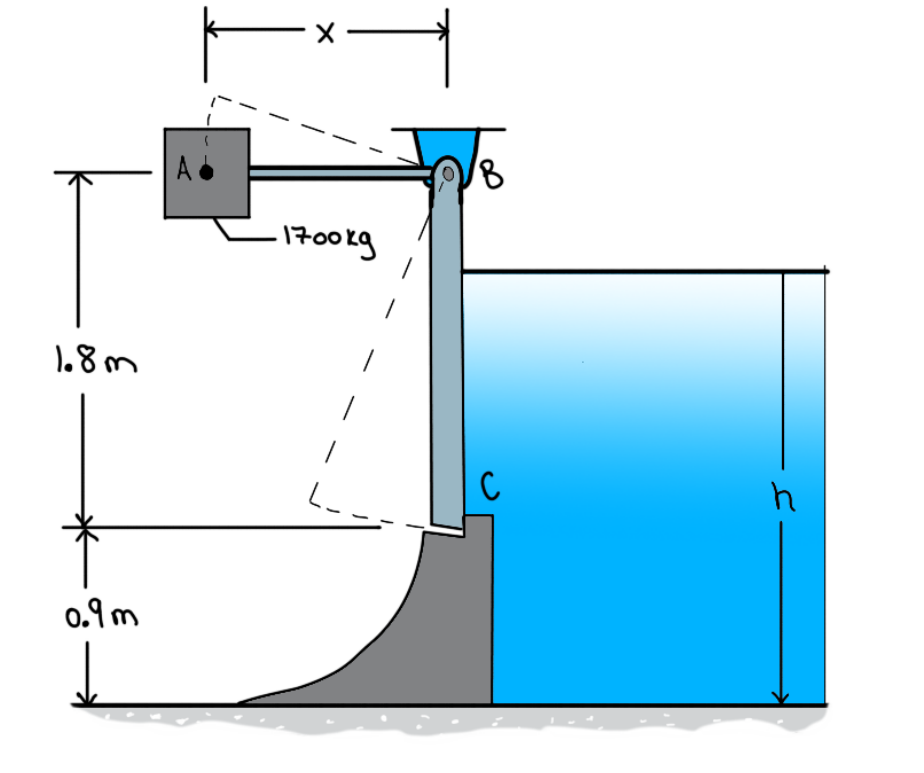
The self-regulating, long floodgate ABC, pinned at B , is pressed against the lip of the spillway at C by the action of the weight at A . If, for safety considerations, the gate has to open when the freshwater level reaches a height h=1.8 metres, determine the distance x, where the weight at A must be located. Neglect the weight of the gate.


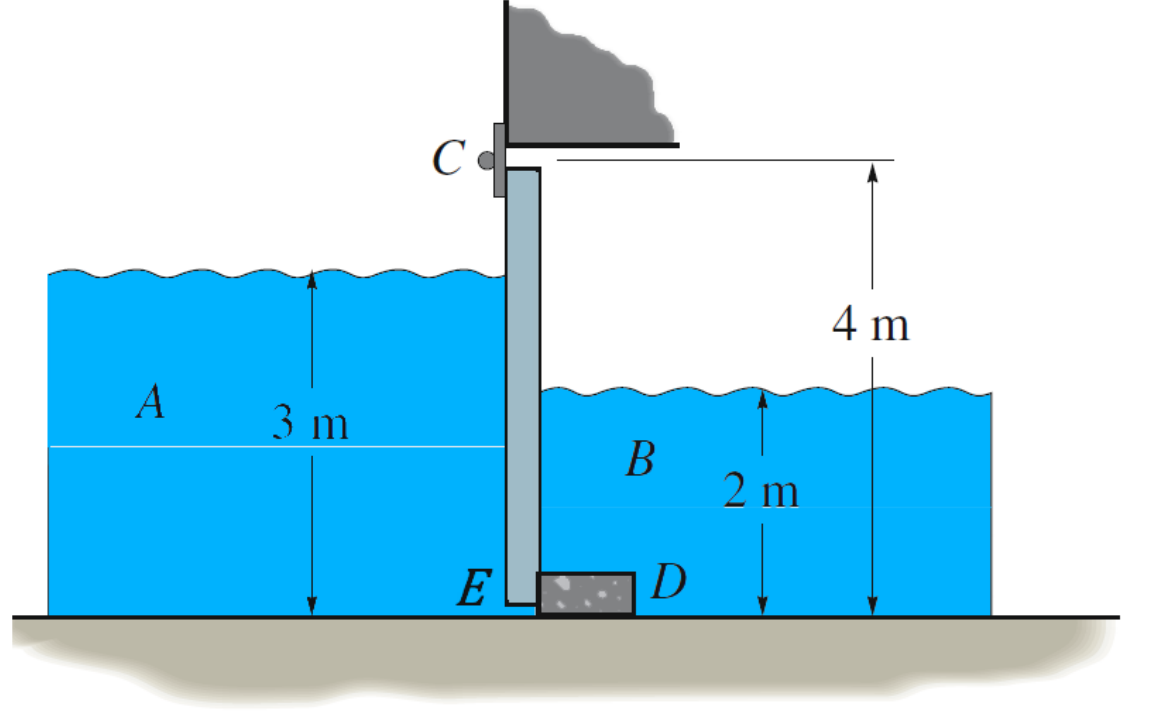
When the tidewater at A subsides, the tide gate automatically swings open to drain the marsh B. For the condition of high tide shown, determine the horizontal reactions developed at the hinge C and stop block D. The length of the gate is 6 m and its height is 4 m.


PAGE BREAK