Wize University Statics Textbook (Master) > Introduction
Conversion of Units
0:00 / 0:00
Unit Conversion: multiplying by "one"
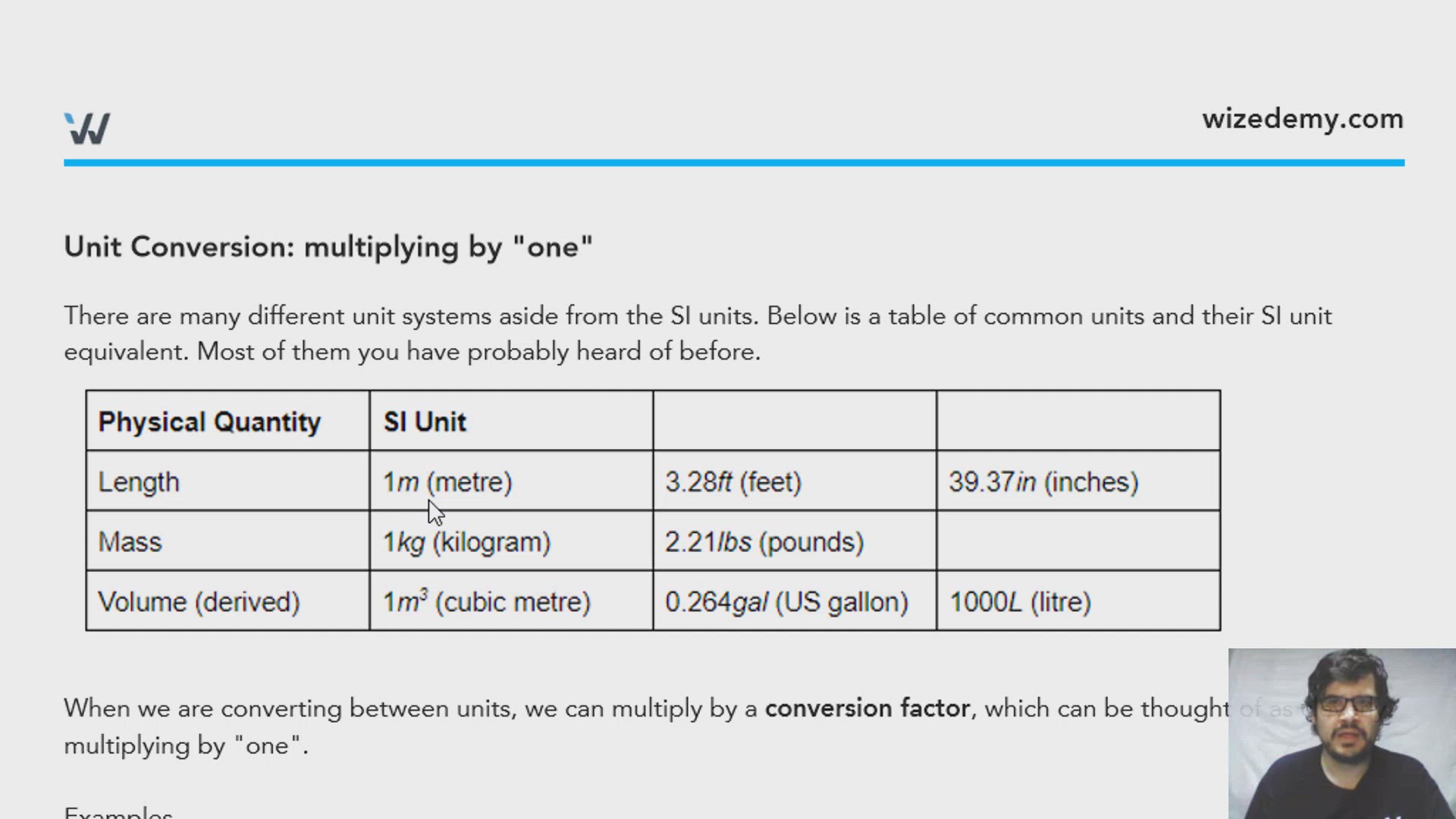
There are many different unit systems aside from the SI units. Below is a table of common units and their SI unit equivalent. Most of them you have probably heard of before.
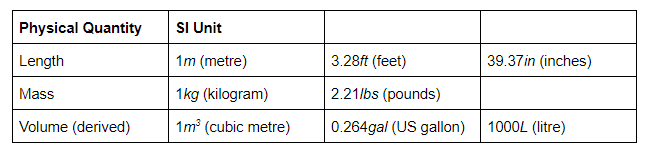
When we are converting between units, we can multiply by a conversion factor, which can be thought of as cleverly multiplying by "one".
Examples
1. We have defined that , then and must both be equal to 1. If I am tall, how tall am I in metres?
Notice how the unit of cancel with the denominator, and we are left with our answer in . And when we multiply by one, we don't change the actual quantity of , we only change the units. This is how we do unit conversions.
Wize Tip
Try to always write out the conversion units, and cancel out the units as you go. It is a super common mistake to accidentally flip the conversion units.
2. My phone has a 5.9in screen. How big is that in millimetres? (1m = 39.37in)
Here, I multiply by two conversion factors. One to get from inches to metres, and another to get from metres to millimetres.
Exam Tip
Think about if your answer makes physical sense! If your object is 5.2mm big, and you get a final number of 52000km... you probably made a mistake in your conversion.
0:00 / 0:00
Here is some practise for unit conversion!
1. How many seconds are in a year?
2. The speedometer in your car is in km/h. You go on a road trip to the US, where speed limits are posted in mph (miles per hour). You're on a highway with a 70 mph speed limit. If you are driving 110 km/h, are you speeding? (1 mile is 1.61 km.)
We need to convert our speed to mph.
This is less than the posted speed limit. We are not going to get a ticket!
3. I have a giant balloon. And it can hold up to 54100 human brains. Now a human brain is actually a measure of volume (1 human brain = ). There are , so what is the volume of the giant balloon in ?
Convert to cubed feet first, and then convert to metres.
Here, notice how we scale our length (feet and metres) into volumes (feet3 and metres3).

0:00 / 0:00
If a car is travelling at 72 km/h, what is its speed in m/s?
We need to change km->m and hr->s
It doesn't matter which one we change first, let's do km->m
Now let's change h->s
=20m/s
How many times does your heart beat in a year?