Wize University Statics Textbook (Master) > Introduction
Estimation and Order of Magnitude
0:00 / 0:00
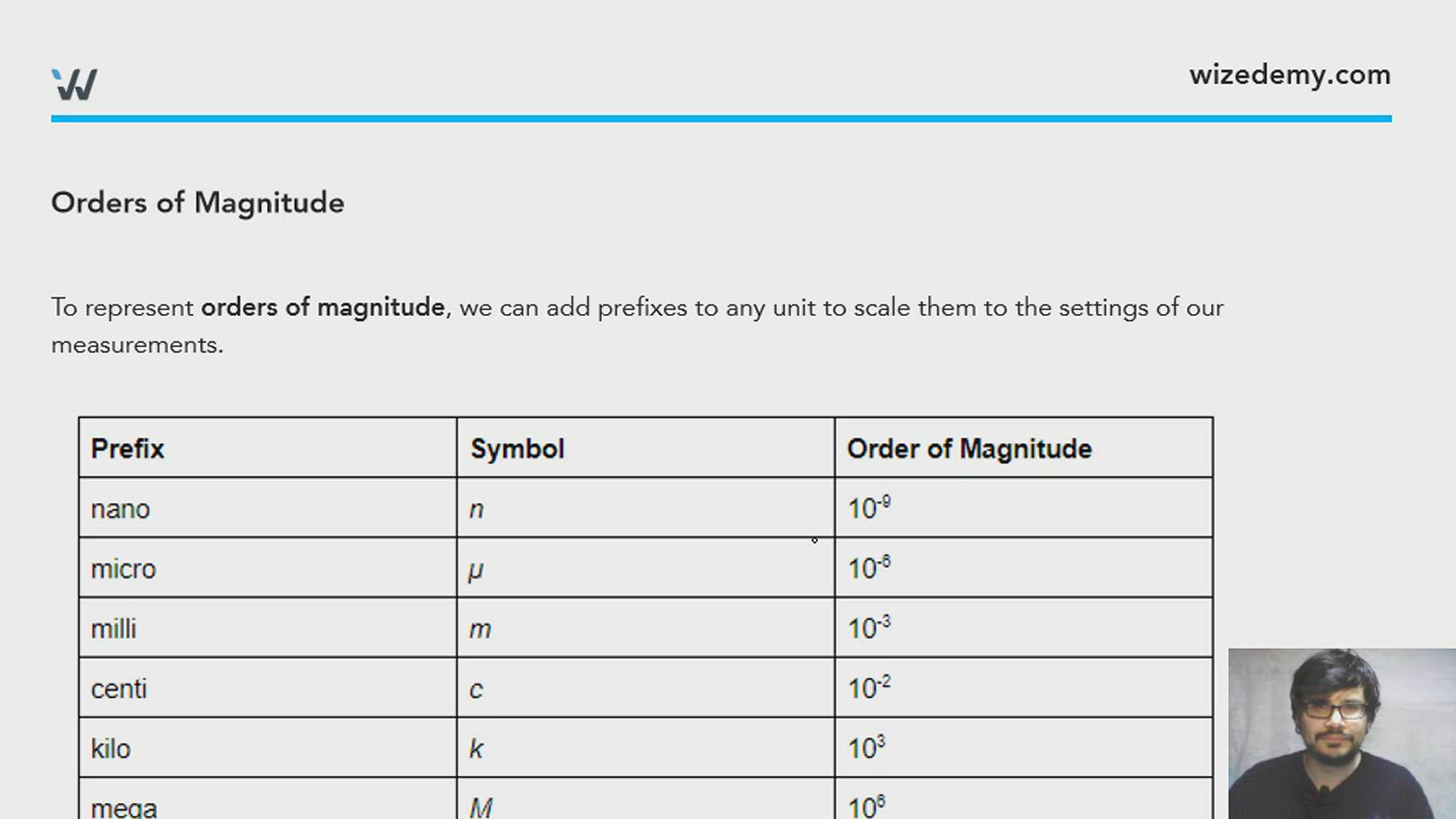
Orders of Magnitude
To represent orders of magnitude, we can add prefixes to any unit to scale them to the settings of our measurements.

For example, . Or in your computer, you might have of storage space. Plenty of space for cat pictures.
Hints for estimating within an order of magnitude:
1. Express the number you are using in scientific notation.
2. If the multiplier is < 3.2 (), the order of magnitude of the number is the power of 10. If the multiplier is > than 3.2, the order of magnitude is the power of 10 plus 1.