Wize University Dynamics Textbook (Master) > Kinematics of a Particle
Curvilinear Motion of Particles

0:00 / 0:00
Projectile motion refers to the motion of an object (typically in 2D) under the influence of the earth's gravity. This is a type of uniformly accelerated motion with an acceleration of 9.81 m/s2 or 32.2 ft/s2 downwards. Because this is a type of uniformly accelerated motion, we are able to use the equations of constant acceleration as follows:
Using this equation is fairly straightforward, and is done as follows:
- Motion along the x-axis usually occurs at a constant velocity
- Motion along the y-axis is controlled by the acceleration of the earth's gravity
- Time is the common parameter between the two dimensions - we can these parametric equations
Question tip: in cases where the projectile is to land on a non-horizontal surface, the equation of the surface provides a relationship between the x and y displacement values at the end of the projectile trajectory.
Some of the assumptions of projectile motion include the assumption of constant gravitational acceleration and negligible air resistance.
Some guidelines to keep in mind:
- The y-component of velocity is zero at the peak of the flight trajectory (maximum height)
- The flight trajectory is typically parabolic - this means that there are two mirror points for time and velocity at every elevation, except for the maximum elevation
- The maximum achievable range (horizontally) for any projectile motion with zero vertical displacement occurs at 45° launch angle for any given velocity
0:00 / 0:00
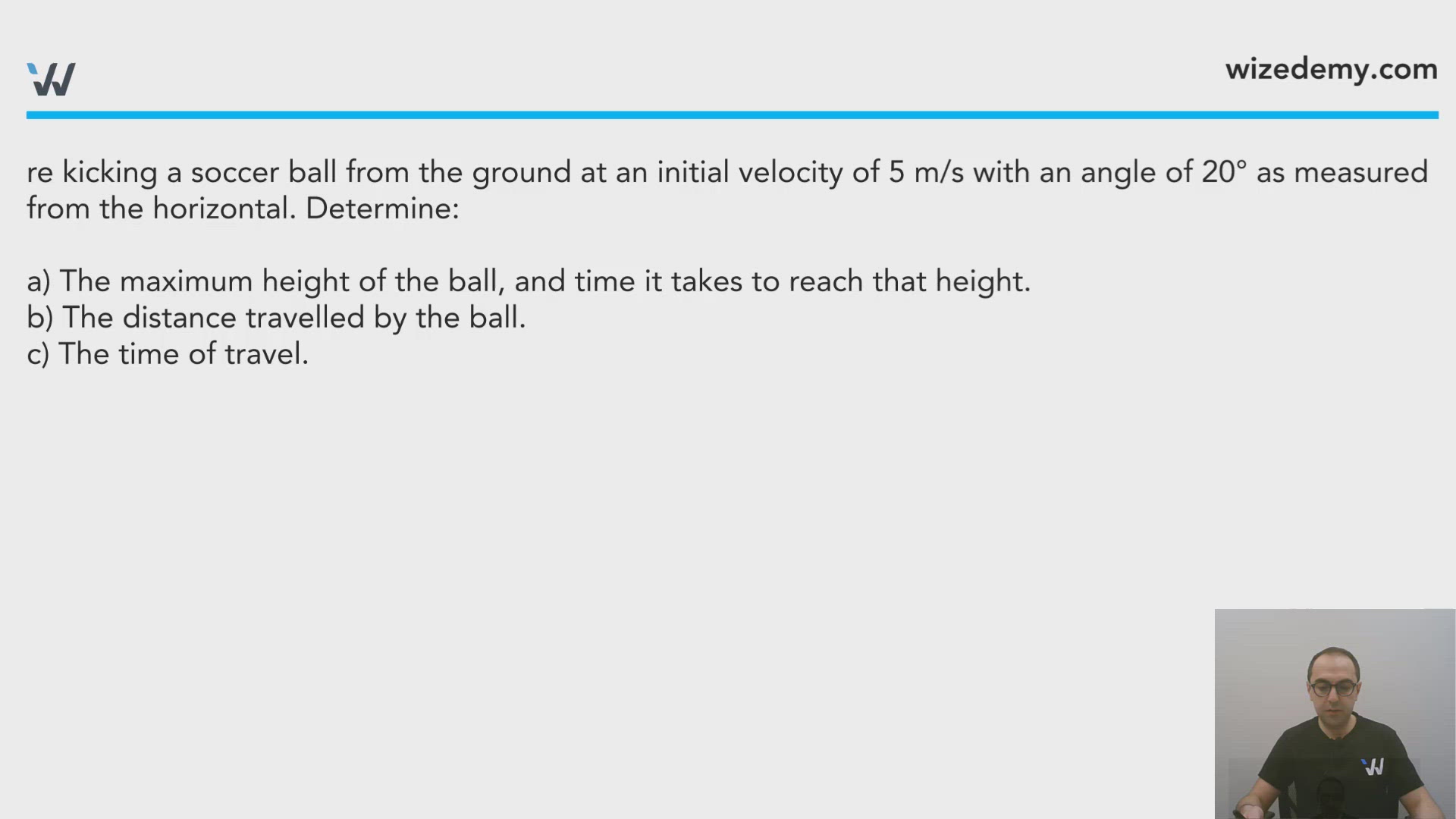
you are kicking a soccer ball from the ground at an initial velocity of 5 m/s with an angle of 20° as measured from the horizontal. Determine:
a) The maximum height of the ball, and time it takes to reach that height.
b) The distance travelled by the ball.
c) The time of travel.
a)
b)
c)
You are throwing a baseketball from a height of 2 m with an initial velocity of 20 m/s with an angle of 35° as measured from the horizontal. At this instance (t = 0), your teammate is 3 m away from you, and running away from you at a velocity of 4 m/s. At what time should you throw the ball so that you friend catches it at a height of 1 m?

Mark Yourself Question
- Grab a piece of paper and try this problem yourself.
- When you're done, check the "I have answered this question" box below.
- View the solution and report whether you got it right or wrong.
You are throwing a baseball at a speed of 30 m/s at an angle of 30° to the horizontal, from a height of 2 m, while standing 20 m from the base of a hill. The hill can be approximated as an inclined surface with a 15° incline. Determine how far the ball travels and how long it will be in the air for.

0:00 / 0:00
So far, we've dealt with a conventional x-y (cartesian) coordinate system to solve most problems. It is sometimes more practical to rotate this coordinate system based on the motion of the particle. This leads us to the idea of a normal-tangential (NT) coordinate system.
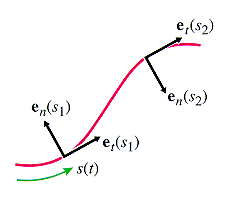
An NT coordinate system, uses the path of motion of a particle to define its axis, and those axis are constantly changing as the particle moves through its trajectory. The normal component is towards the inside of the curvature while the tangential component is tangential with respect to the particle's motion.
This is particularly common when considering the motion of a particle along a curved path when observed from above. For example, a car going around a track, or a roller coaster turning around its track. When using an NT coordinate system, the velocity and acceleration equations become as follows:
There are a few important ideas to keep in mind:
- The velocity of a particle will always be tangential to its path in direction
- The tangential component of acceleration is what causes a change in speed - this is used for purposes of relating distance travelled to velocity and acceleration
- The following formula is particular useful in determining where a particle is along a curved path:
- Where 's' is the distance travelled (arc length), calculated the same way we would for rectilinear motion, and Θ is the angle travelled around the curved path in radians
- The normal component for acceleration accounts for the change in direction of the velocity
- Acceleration is not necessarily zero if velocity is not changing - there's still a normal acceleration component
- Rectilinear motion can be thought of as a special case of curvilinear motion where the radius of curvature approaches infinity, and hence normal acceleration approaches 0
- Some questions will require an answer in an x-y (cartesian) system - this is an additional geometric step you may have to do at the end
0:00 / 0:00
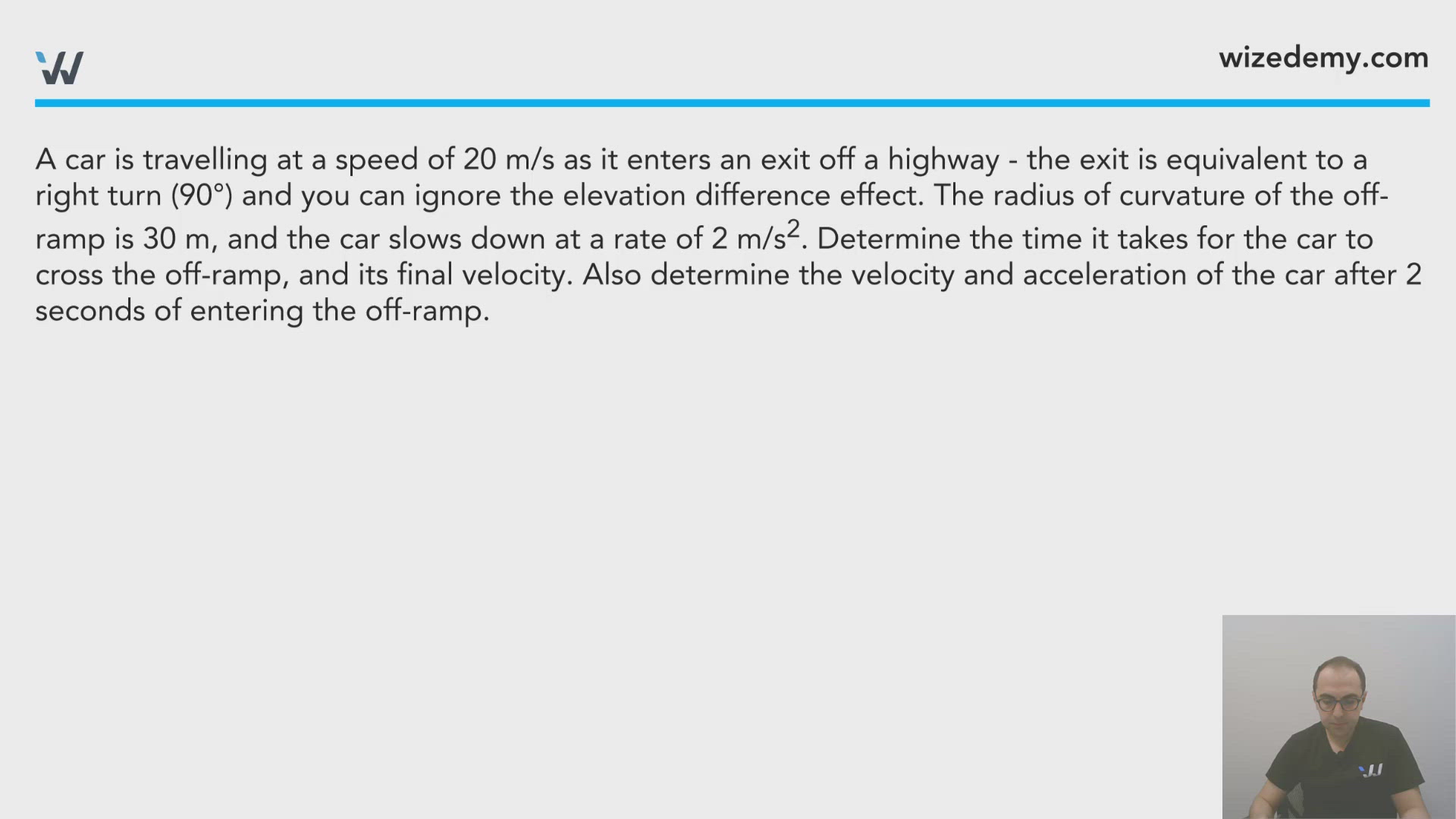
A car is travelling at a speed of 20 m/s as it enters an exit off a highway - the exit is equivalent to a right turn (90°) and you can ignore the elevation difference effect. The radius of curvature of the off-ramp is 30 m, and the car slows down at a rate of 2 m/s2. Determine the time it takes for the car to cross the off-ramp, and its final velocity. Also determine the velocity and acceleration of the car after 2 seconds of entering the off-ramp.
Mark Yourself Question
- Grab a piece of paper and try this problem yourself.
- When you're done, check the "I have answered this question" box below.
- View the solution and report whether you got it right or wrong.
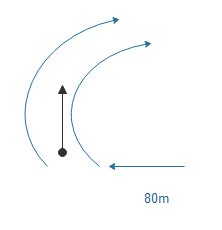
A car starts from rest at point A and increases its speed at a rate of 2 m/s2. Determine:
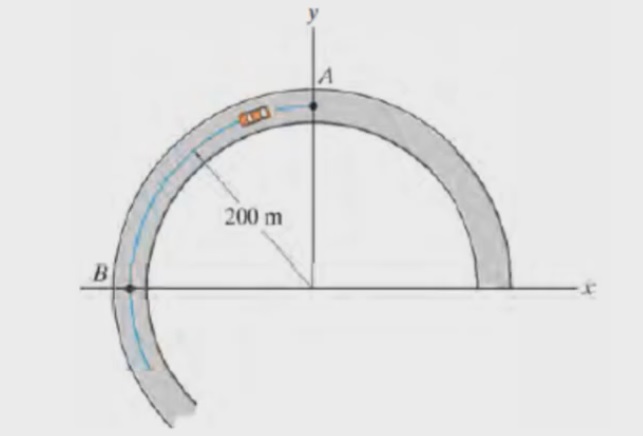
a) How long does it take the car to reach point B?
b) How fast is the car going at point B?
c) What is the velocity of the car after 20.5 seconds along the x and y-axis?
d) What is the acceleration of the car after 20.5 seconds along the x and y-axis?
e) How long can the car continue accelerating for if its acceleration is not to exceed 12 m/s2