Wize University Dynamics Textbook (Master) > Kinematics: Relative Motion
Simple Relative Motion
0:00 / 0:00
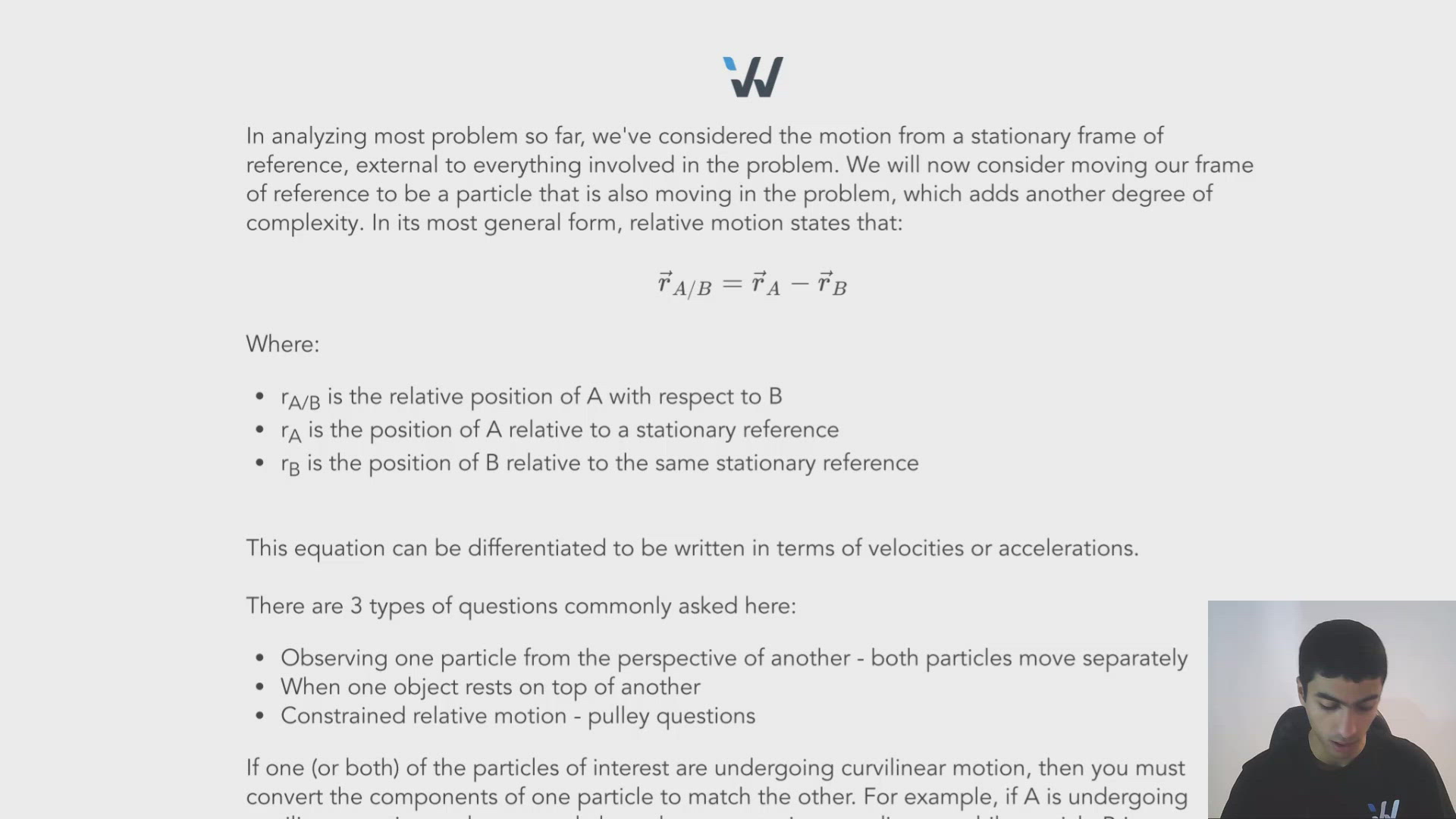
In analyzing most problem so far, we've considered the motion from a stationary frame of reference, external to everything involved in the problem. We will now consider moving our frame of reference to be a particle that is also moving in the problem, which adds another degree of complexity. In its most general form, relative motion states that:
Where:
- rA/B is the relative position of A with respect to B
- rA is the position of A relative to a stationary reference
- rB is the position of B relative to the same stationary reference
This equation can be differentiated to be written in terms of velocities or accelerations.
There are 3 types of questions commonly asked here:
- Observing one particle from the perspective of another - both particles move separately
- When one object rests on top of another
- Constrained relative motion - pulley questions
If one (or both) of the particles of interest are undergoing curvilinear motion, then you must convert the components of one particle to match the other. For example, if A is undergoing rectilinear motion and measured along the x-y cartesian coordinates, while particle B is undergoing curvilinear motion and measured using normal-tangential coordinates, then you must either convert the vector of particle A into the same normal-tangential coordinates, or convert the vector of particle B into x-y cartesian coordinates.
0:00 / 0:00
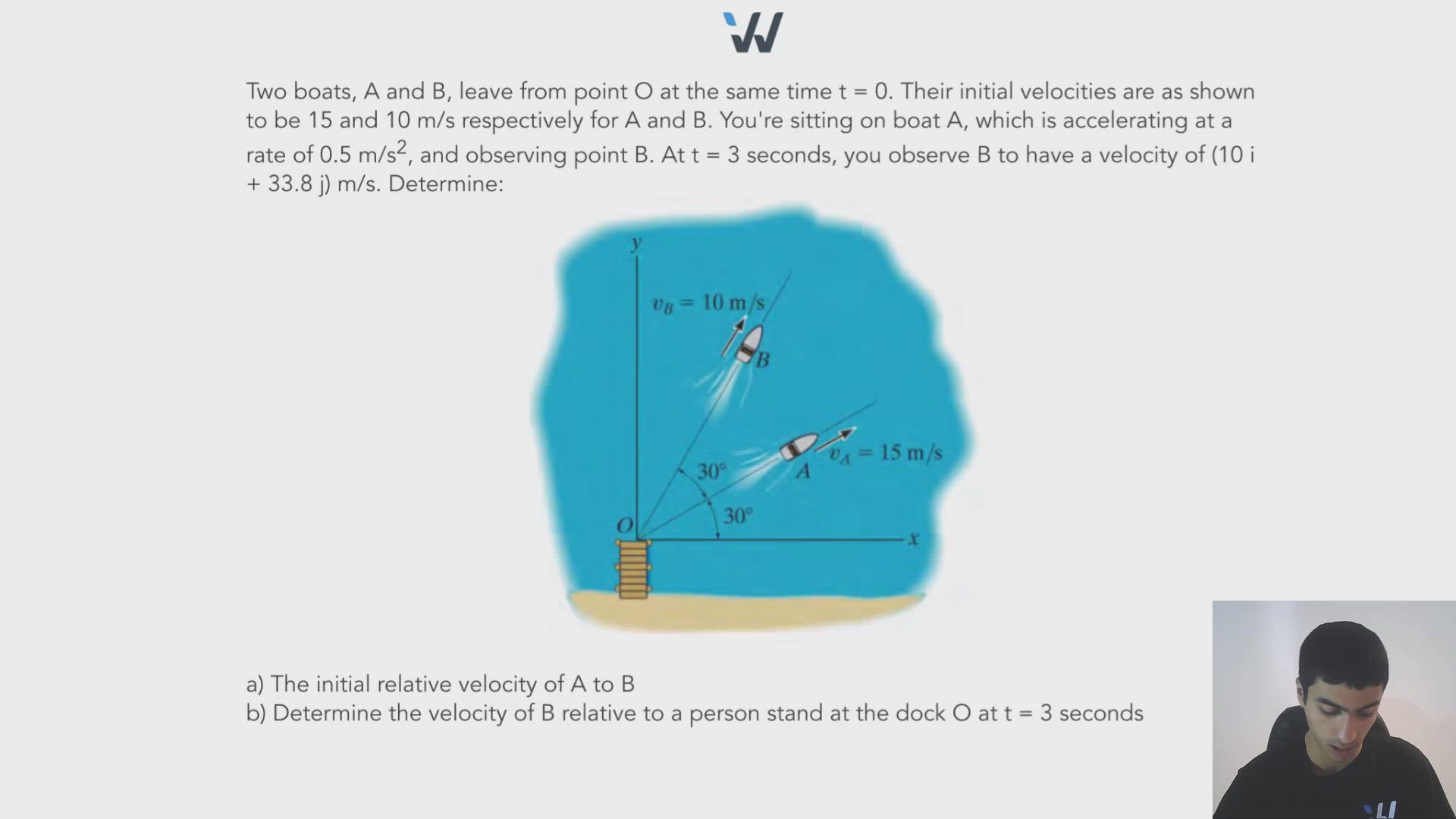
Two boats, A and B, leave from point O at the same time t = 0. Their initial velocities are as shown to be 15 and 10 m/s respectively for A and B. You're sitting on boat A, which is accelerating at a rate of 0.5 m/s2, and observing point B. At t = 3 seconds, you observe B to have a velocity of (10 i + 33.8 j) m/s. Determine:
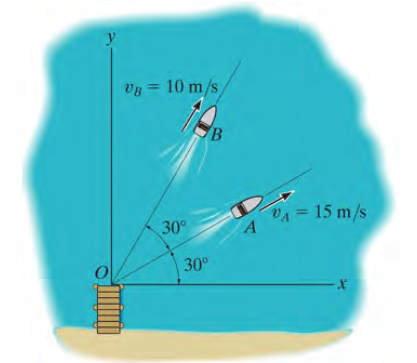
a) The initial relative velocity of A to B
b) Determine the velocity of B relative to a person stand at the dock O at t = 3 seconds
a)
b) first we need velocity of A:
0:00 / 0:00
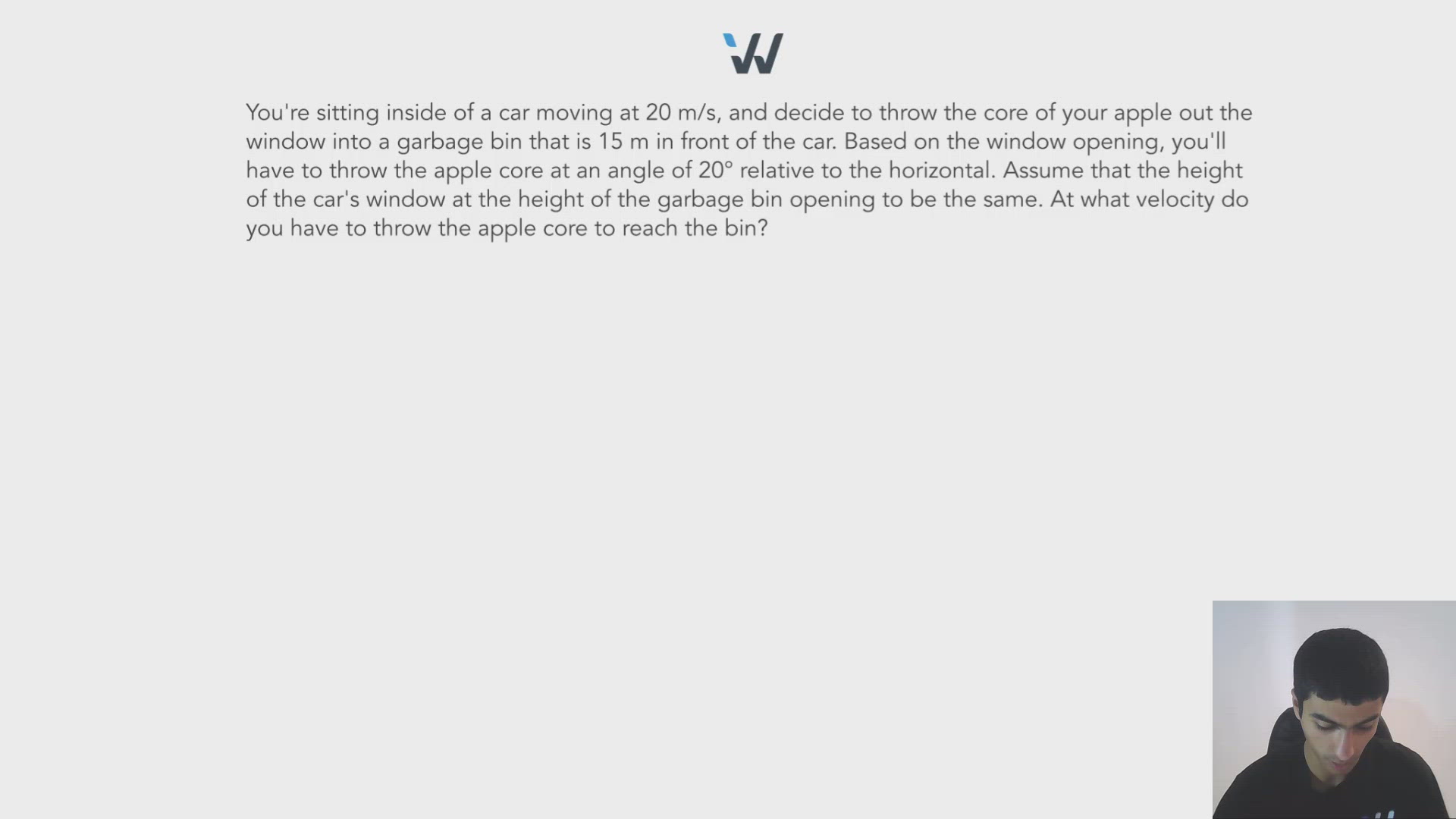
You're sitting inside of a car moving at 20 m/s, and decide to throw the core of your apple out the window into a garbage bin that is 15 m in front of the car. Based on the window opening, you'll have to throw the apple core at an angle of 20° relative to the horizontal. Assume that the height of the car's window at the height of the garbage bin opening to be the same. At what velocity do you have to throw the apple core to reach the bin?
vocar=? @
a = -9.81

Mark Yourself Question
- Grab a piece of paper and try this problem yourself.
- When you're done, check the "I have answered this question" box below.
- View the solution and report whether you got it right or wrong.
You and your friend are both monitoring the motion of a drone you've built to measure how accurately you can control it. You're driving in a car after your drone and your camera indicates that the drone has the following velocity:
Where the positive x and y axis are measured to the East and North respective. Meanwhile, your friend reports observing the velocity of the same drone, but from a different car travelling on a different street to be:
Based on this information, what is your velocity relative to your friend?
If you know that you're travelling north at a speed of 36 km/h, what is the velocity of your friend and what is the velocity of the drone?
Mark Yourself Question
- Grab a piece of paper and try this problem yourself.
- When you're done, check the "I have answered this question" box below.
- View the solution and report whether you got it right or wrong.
Car A and B are on a race track as shown in the figure below:

The speed of car A is decreasing at a rate of 2 m/s2 while the speed of car B is increasing at a rate of 1 m/s2. Car A is 200 m away from the curved portion of the track. Determine:
a) The relative velocity and acceleration of car A with respect to B at the instant shown
b) The relative velocity and acceleration of car A with respect to B after 1 second