Wize University Dynamics Textbook (Master) > Kinematics: Relative Motion
Constrained Relative Motion
0:00 / 0:00
Constrained relative motion problems are really common for dynamics questions and add an extra layer of complexity. The idea of relative motion gives you a relationship between the dynamics variables (position, velocity and acceleration) of the various particles in your system. If you add additional constrains to the problem, then you get more equations and more relationships between the motion of these particles. These constraints are typically in the form of a cable connecting the various particles of the system. To solve questions involving a cable:
- Choose a reference and positive direction
- Identify the cable - you will have a separate equation for each cable
- Write an equation describing the total length of the cable in terms of the positions of all the particles in the system from your reference - this is the relationship between the positions of the particles
- Differentiate the equation above once to obtain a relationship between the velocities of the particles
- Differentiate the equation again to obtain a relationship between the accelerations of the particles
You now have an additional set of equations (position, velocity, and acceleration) for each cable present in your system.
0:00 / 0:00
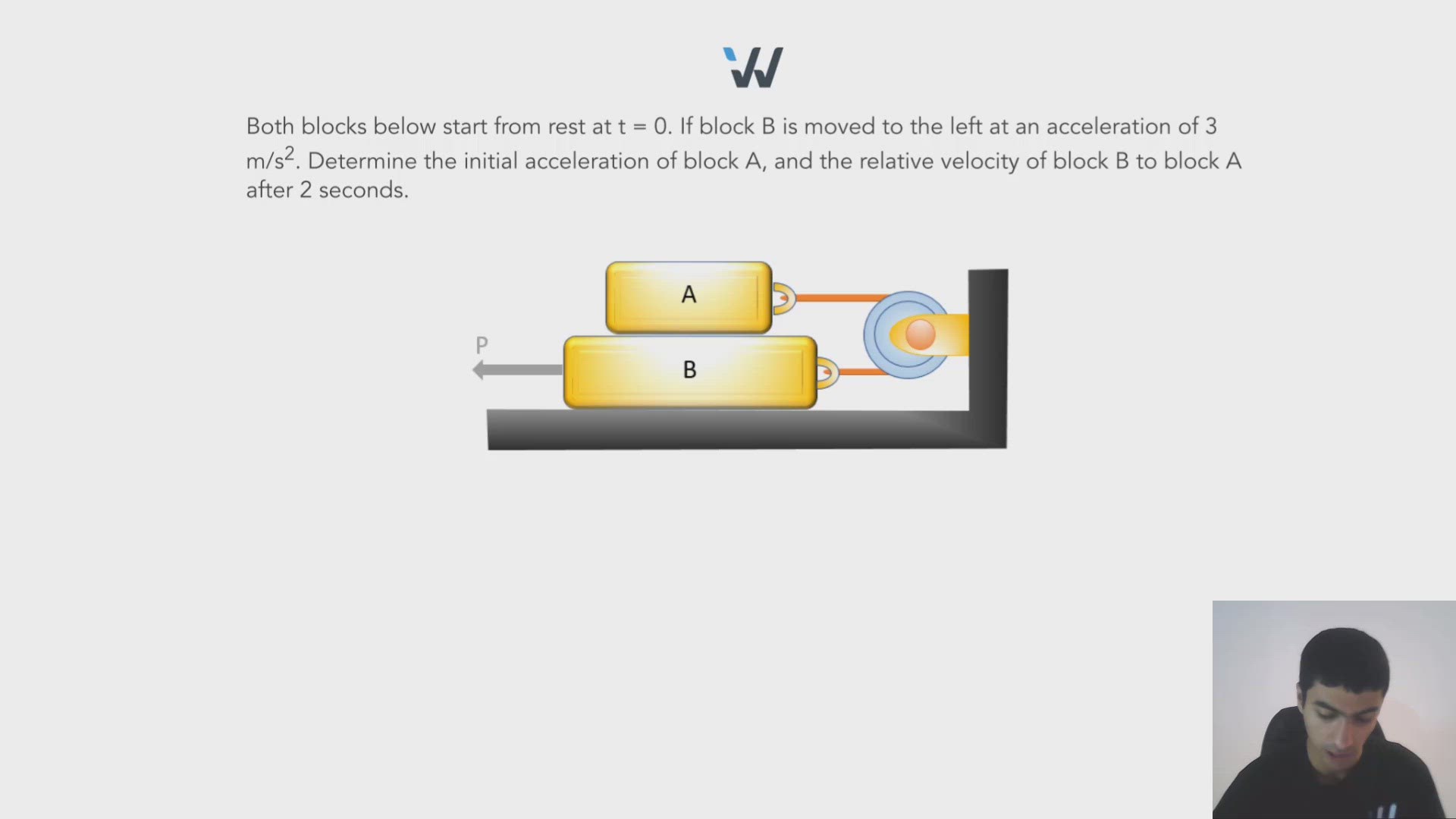
Both blocks below start from rest at t = 0. If block B is moved to the left at an acceleration of 3 m/s2. Determine the initial acceleration of block A, and the relative velocity of block B to block A after 2 seconds.
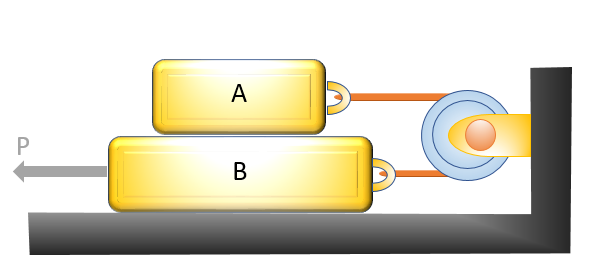
choose datum on the pulley @ the right positive left .
cable equation : xA+xB=l1
vA+vB = 0
t=0 aB=3
aA =3 m/s2
t=2
aB = 3
vBo = 0
t=2
vB =6 m/s

Mark Yourself Question
- Grab a piece of paper and try this problem yourself.
- When you're done, check the "I have answered this question" box below.
- View the solution and report whether you got it right or wrong.
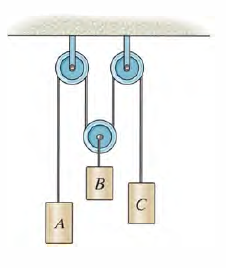
All blocks below start from rest at the same height as shown. Blocks A accelerates downwards at a rate of 0.5 mm/s2. After 2 seconds, block B is 25 mm below C. Blocks B and C move at a constant acceleration. Determine the height difference between A and C after 2 seconds, and the speeds of all particles after 2 seconds.
Mark Yourself Question
- Grab a piece of paper and try this problem yourself.
- When you're done, check the "I have answered this question" box below.
- View the solution and report whether you got it right or wrong.
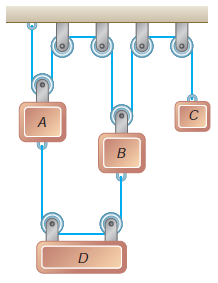
At the instant shown block C is released from rest and accelerates upwards at a rate of 2 m/s2. Meanwhile, block A moves downwards at a constant velocity of 5 m/s. Determine the time when block B is at rest, and when block B and block D have the same velocity.