Wize University Dynamics Textbook (Master) > Planar Kinematics of a Rigid Body
Simple Rigid Body Motion
0:00 / 0:00
Pure Translation and Pure Rotation:
The pure translation is the simplest type of rigid body motion. It occurs when the body remains in the same orientation, or more strictly, the direction of some vector rAB remains the same during the motion with points A and B being on the body. The overall motion of the body may be rectilinear or curvilinear, but as long as it travels in the same orientation, it is undergoing pure translation.
In this case, since all points on the body move together, then the velocity and acceleration of all points are equal.
Pure rotational motion occurs when the distance between all points and some point O remains constant. In this case, point O is the center of rotation usually around an axis perpendicular to the plane of analysis. Also, point O may be on or off the body.
Wize Tip
Note: do not confuse rotational and curvilinear transnational motion - they're not the same thing. Also, now that we're dealing with rigid bodies, not all points travel at the same velocity or same acceleration, which complicates the analysis.
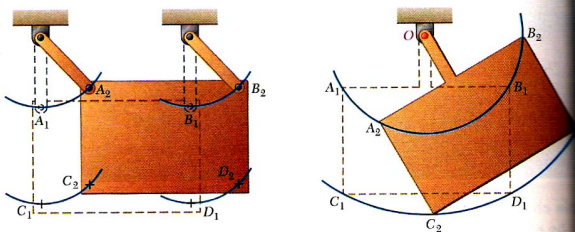
In analyzing rotational motion, we need to define position, velocity and acceleration in an angular or rotational sense. We do this as follows:
These are general equations for rotational motion (in a scalar form), where 'r' is the vector between a specific point and point O - the center of rotation.
Under uniformly accelerated motion (including constant velocity), we can use similar equations as those derived in the particle kinematics section, but in an angular sense:
The vector variation of these equations can be written as:
0:00 / 0:00
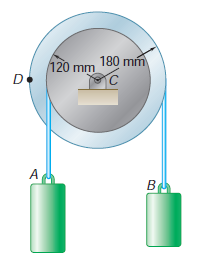
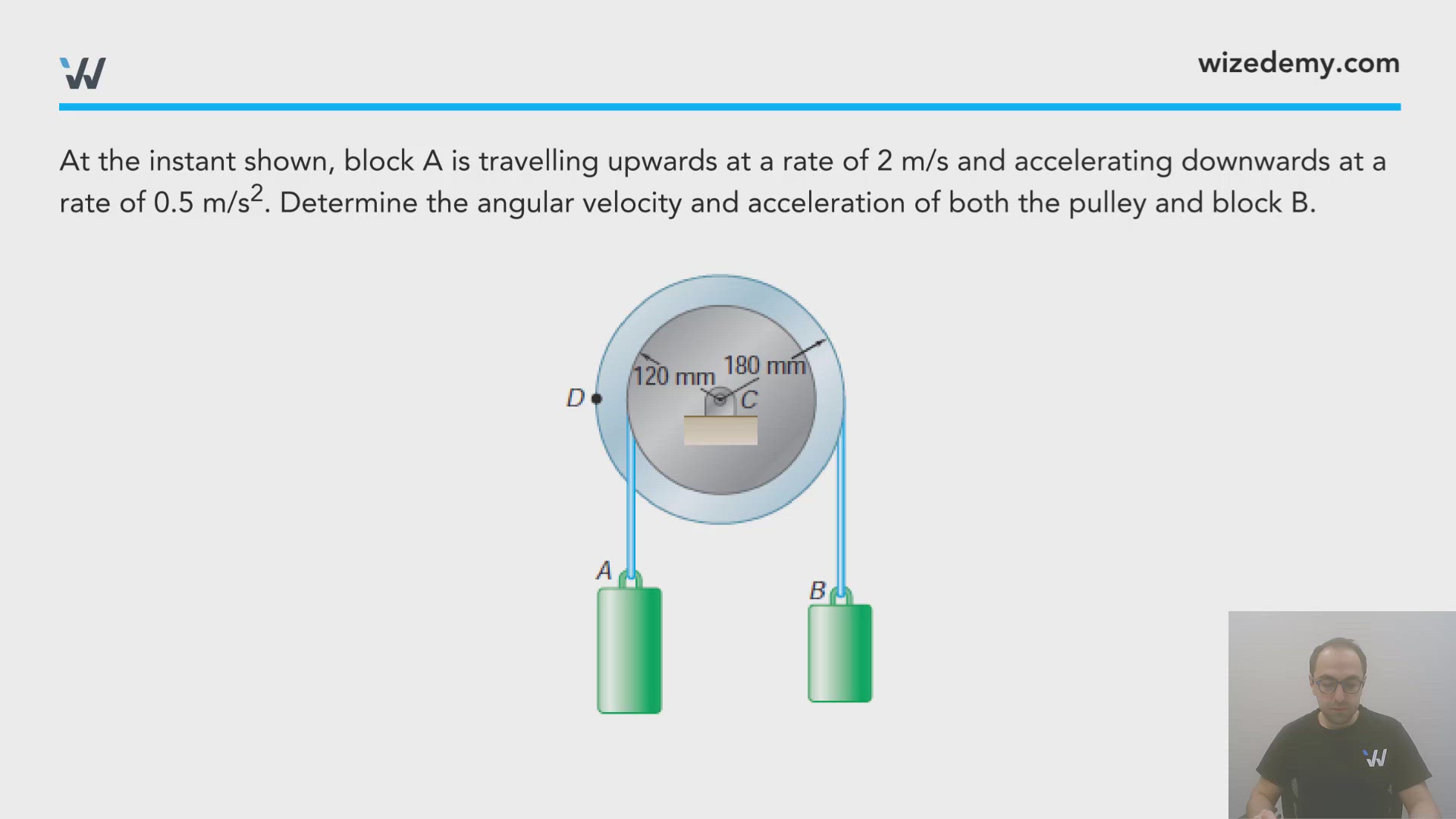
At the instant shown, block A is travelling upwards at a rate of 2 m/s and accelerating downwards at a rate of 0.5 m/s2. Determine the angular velocity and acceleration of both the pulley and block B.