Wize University Dynamics Textbook (Master) > Planar Kinematics of a Rigid Body
General Planar Motion
0:00 / 0:00
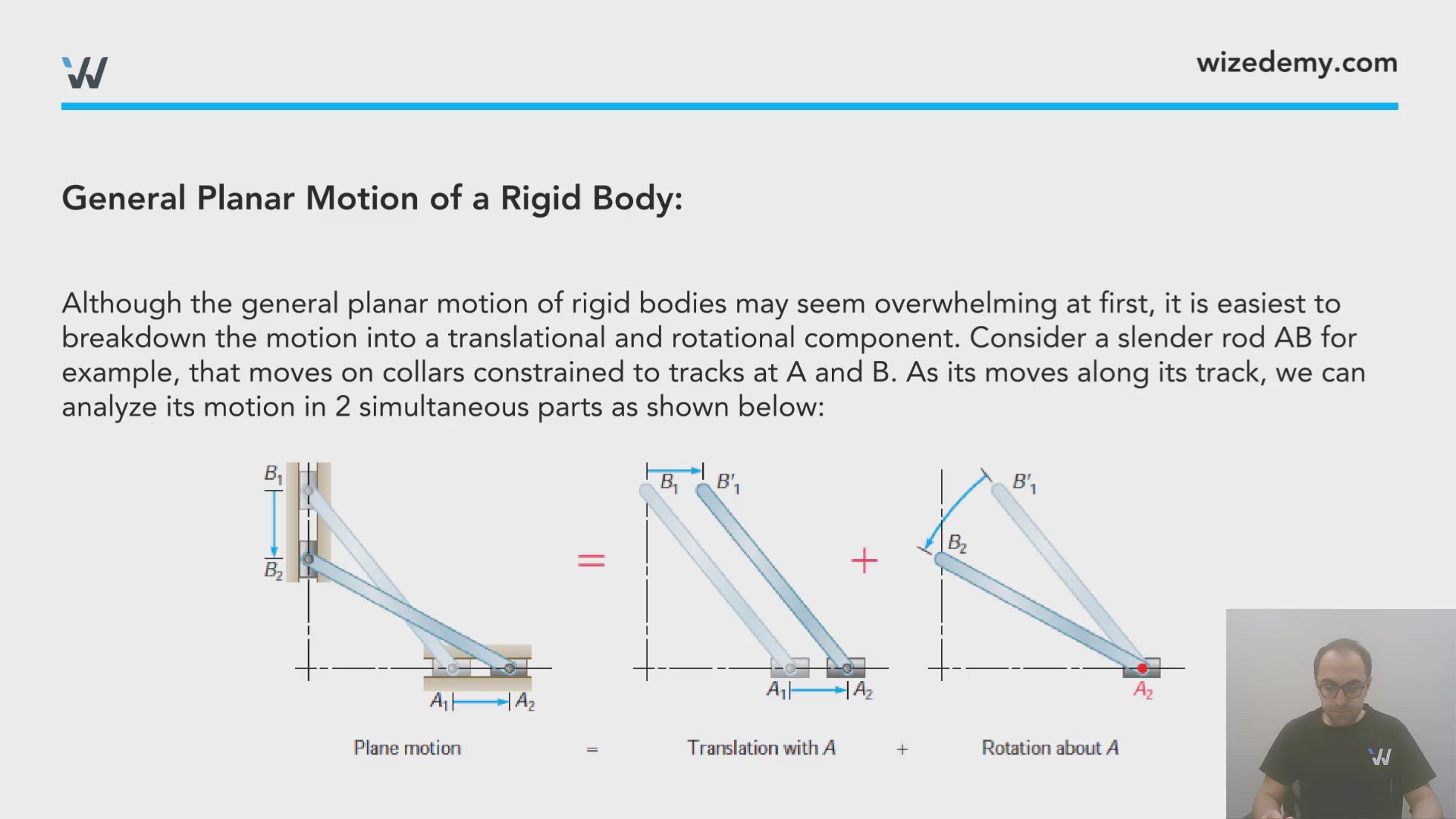
General Planar Motion of a Rigid Body:
Although the general planar motion of rigid bodies may seem overwhelming at first, it is easiest to breakdown the motion into a translational and rotational component. Consider a slender rod AB for example, that moves on collars constrained to tracks at A and B. As its moves along its track, we can analyze its motion in 2 simultaneous parts as shown below:
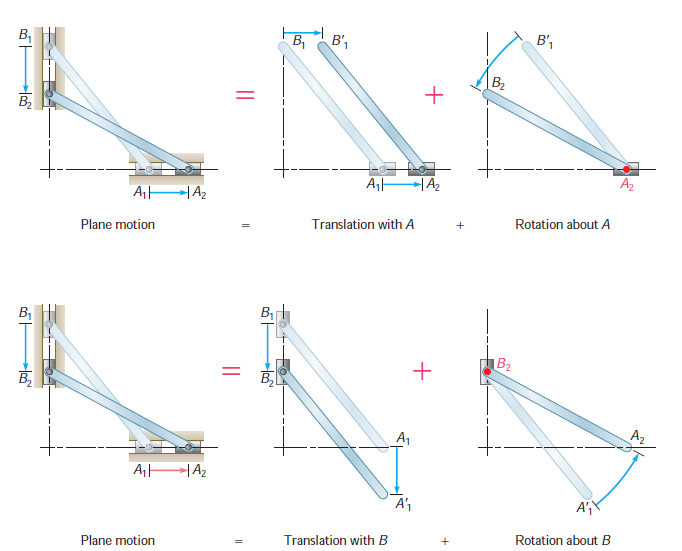
Using this technique, we can represent the motion of any point on the body in terms of another point and their relative velocities. For example, the velocity at B may be written as:
We can also write a similar equation for the acceleration of point B relative to point A:
Based on these two equations, we can determine the velocity and acceleration of any point on the body if we know how fast one point is translating (the translational component) and by knowing its angular velocity and acceleration (the rotational component).
Wize Tip
Keep in mind that these are vector equations, and in 2 dimensions can allow you to solve for up to 2 unknowns. Also notice that is some particular cases, the motion of any given point of the body may be constrained. For example, for the slender rod shown above, points A and B are constrained to only move horizontally and vertically respectively. This provides us with additional information that may allow us to solve the equations we have.
0:00 / 0:00
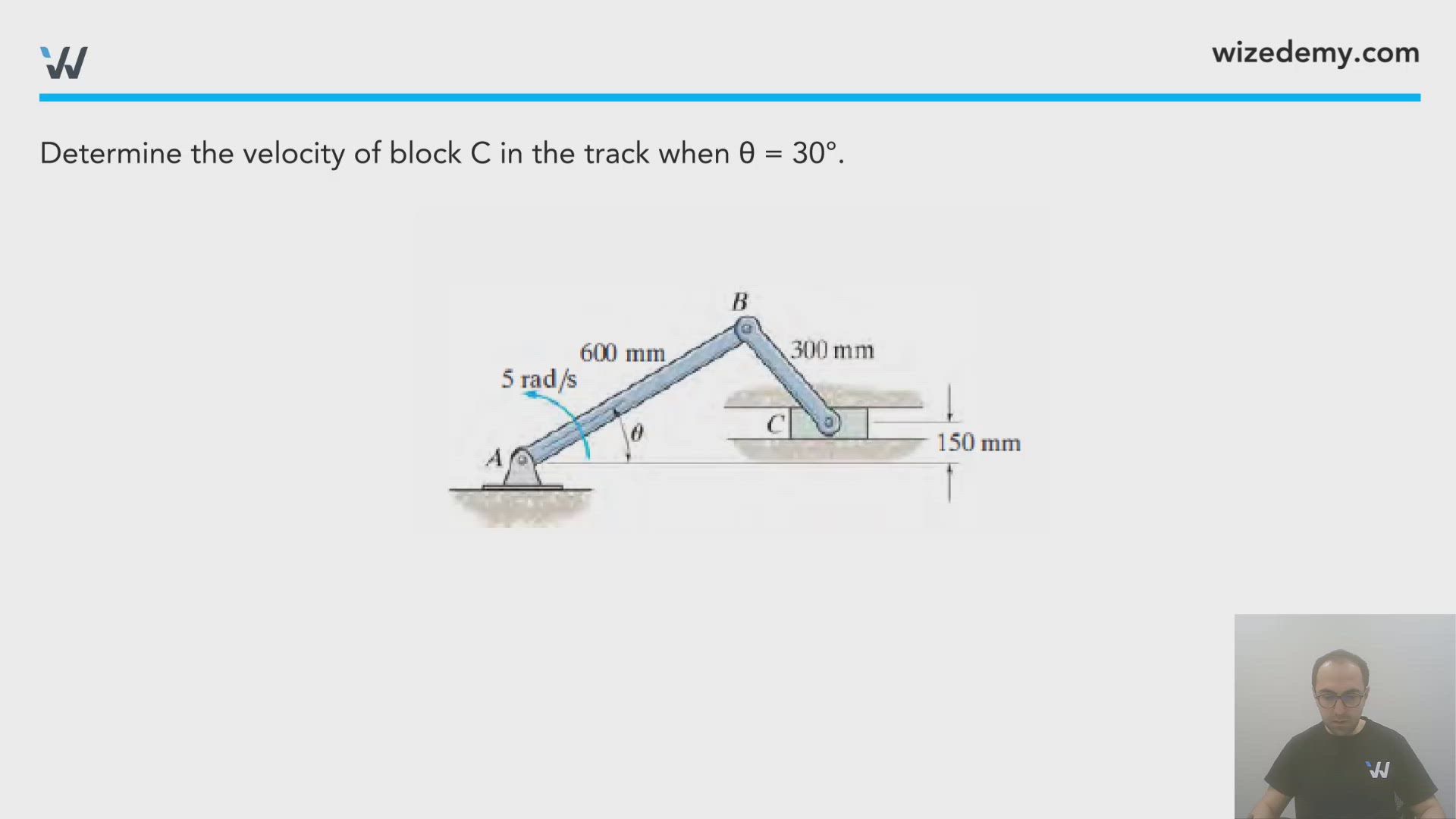
Determine the velocity of block C in the track when θ = 30°.
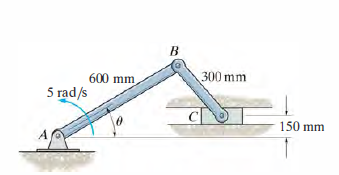
vA= 0
second bar (BC):
Vc = -3
or
vc = 3 m/s
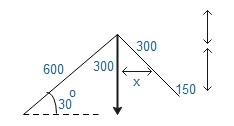
By Pythagorean :
0:00 / 0:00
Instantaneous center (IC) of rotation:
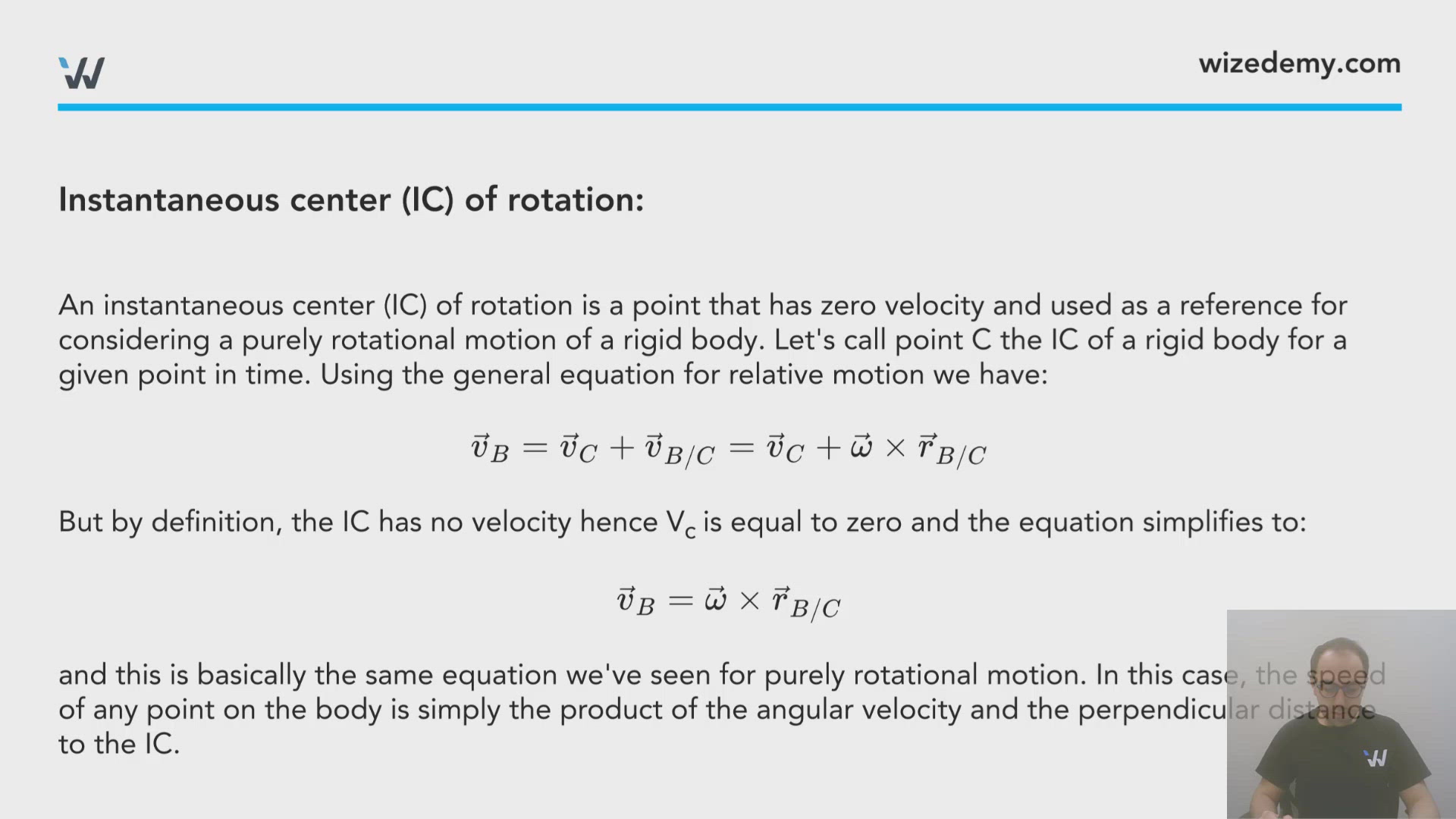
An instantaneous center (IC) of rotation is a point that has zero velocity and used as a reference for considering a purely rotational motion of a rigid body. Let's call point C the IC of a rigid body for a given point in time. Using the general equation for relative motion we have:
But by definition, the IC has no velocity hence Vc is equal to zero and the equation simplifies to:
and this is basically the same equation we've seen for purely rotational motion. In this case, the speed of any point on the body is simply the product of the angular velocity and the perpendicular distance to the IC.
Wize Tip
It's really important to understand that an IC is a point at a given instant, and may be constantly changing as the body undergoes its motion. In fact, two curves are known as the space centroid and body centroid defines the path of the IC over the motion of the body.
Another really important idea is in regard to the acceleration of the IC. The velocity at the IC is zero at a given point in time but is non-zero at a later time. This implies that because the velocity at the IC will change over time, the acceleration at the IC is not zero.
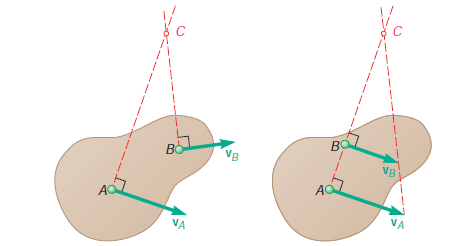
To determine the location of the IC, you will need to know the direction of the velocity vectors for at least two points on the rigid body. Draw lines perpendicular to the velocity vector, and the point of intersection of those lines is the IC. In the case where the lines are parallel, you will need to set up similar triangles where the peak of those triangles represents the IC.
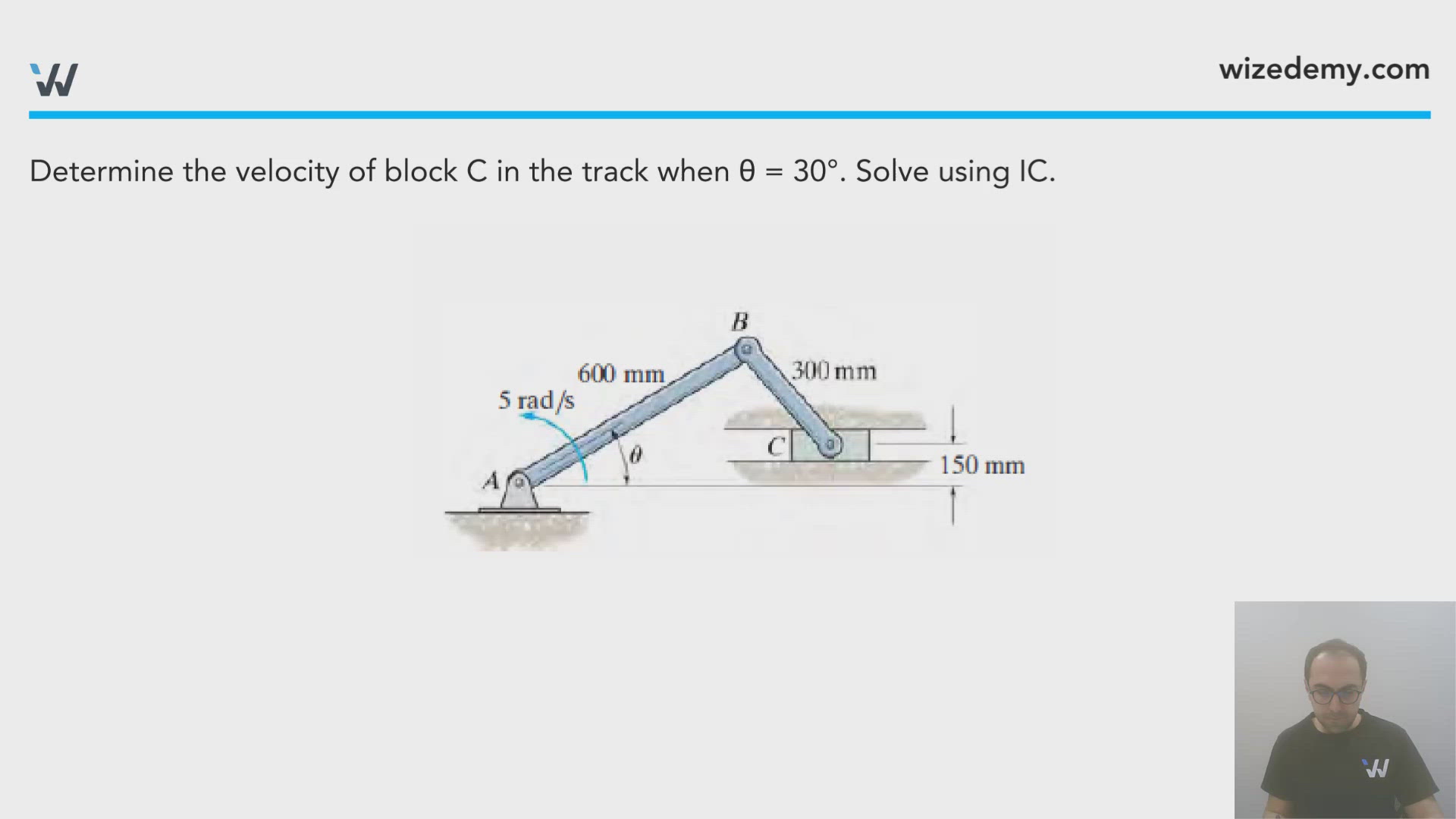
0:00 / 0:00
Determine the velocity of block C in the track when θ = 30°. Solve using IC.
Solve for VB using IC of AB,
IC @ A → VB =(0.6)(5)=3 m/s > 60o
then for the bar BC :
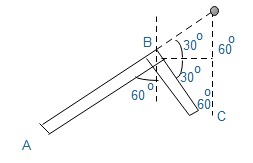
VB = wr
Vc = wr =10(0.3)= 3 m/s

Mark Yourself Question
- Grab a piece of paper and try this problem yourself.
- When you're done, check the "I have answered this question" box below.
- View the solution and report whether you got it right or wrong.
Determine the velocity of collar B if collar A is dropping with a velocity of 2 m/s downwards when the angle θ is 15°
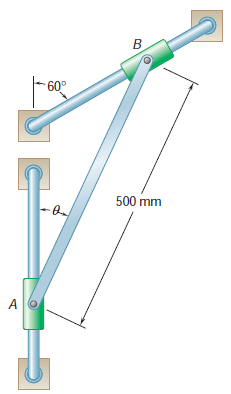
Mark Yourself Question
- Grab a piece of paper and try this problem yourself.
- When you're done, check the "I have answered this question" box below.
- View the solution and report whether you got it right or wrong.
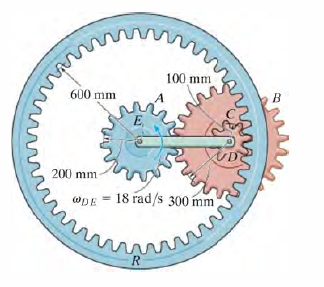
Determine the angular velocity of all gears given that the angular velocity of rod DE is 18 rad/s. The outer gear remains stationary.