Wize University Dynamics Textbook (Master) > Planar Kinetics of a Rigid Body
General Planar Motion
0:00 / 0:00
Rigid Body Kinetics:
Rigid body kinetics is one of the most difficult concepts for a dynamics course because it brings together everything learned so far. We use everything learned in particle kinetics, where we drew a free body diagram (FBD) and kinetic body diagram (KBD) to show the forces and accelerations of the body.
For rigid bodies, however, we take things a step further. Below is a general example:
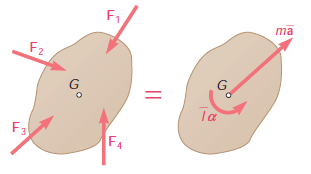
We now not only need to consider forces causing translational acceleration, we must also consider the moment which the forces cause about the mass center G and the angular acceleration caused by those forces. Notice that the acceleration is labeled to be on the mass center of the body on the KBD - this is important. The diagram above is a graphical representation of the two following vector equations:
It is possible to draw the KBD with the acceleration about a different point on the body (and its sometimes convenient to do so), but we must do this carefully. The easiest way to apply this is to treat it as a moment summation on the KBD about some point A, and treat the Ia term as a couple moment. We will see this is an example as it is very case-specific and can vary significantly from problem to problem.
Wize Concept
Also note that it is possible to determine the moment of inertia of the body either based on formulas provided for common shapes, or a radius of gyration provided for uncommon shapes to be used as follows:
0:00 / 0:00
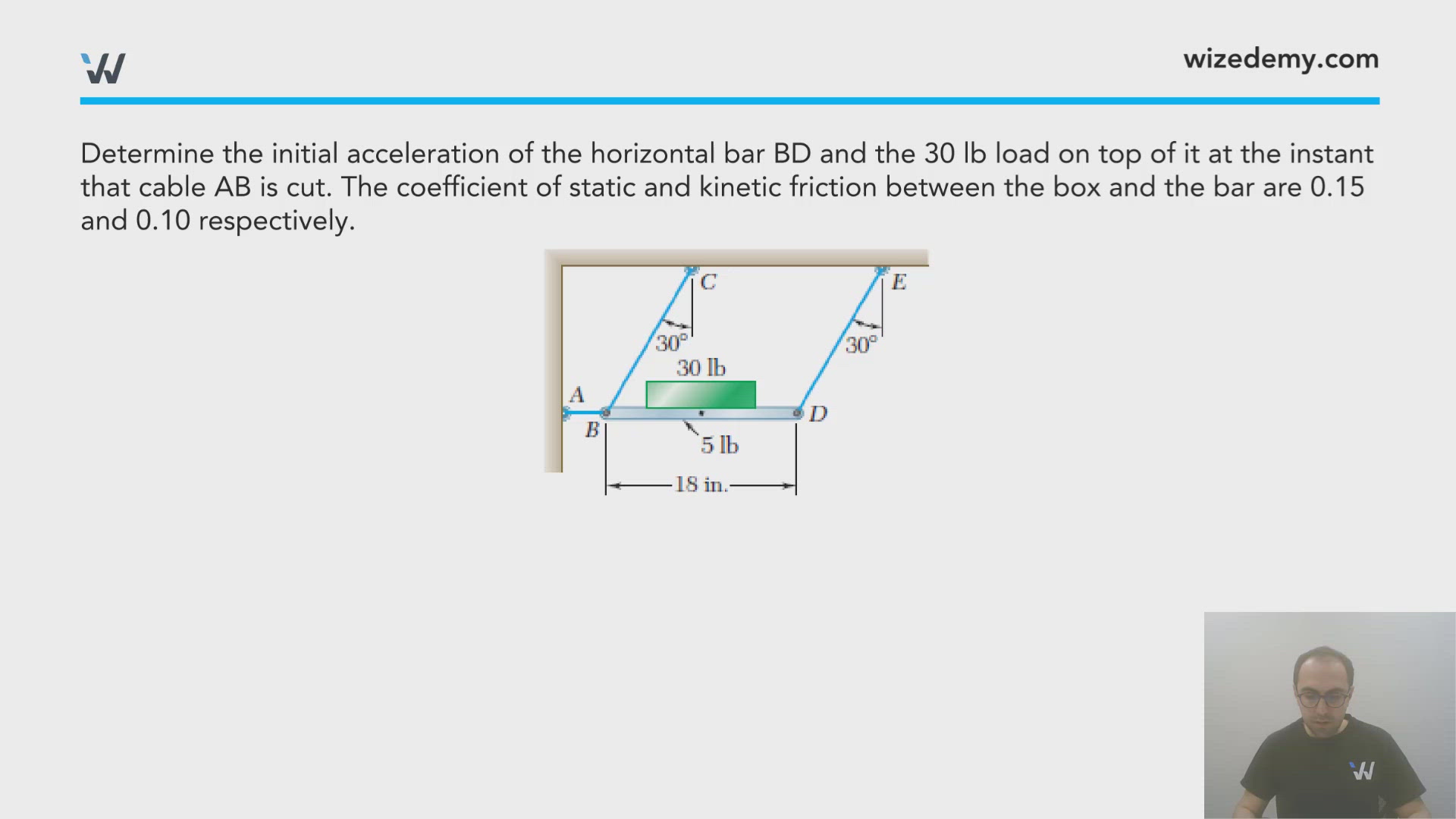
Determine the initial acceleration of the horizontal bar BD and the 30 lb load on top of it at the instant that cable AB is cut. The coefficient of static and kinetic friction between the box and the bar are 0.15 and 0.10 respectively.
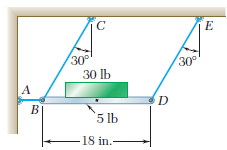
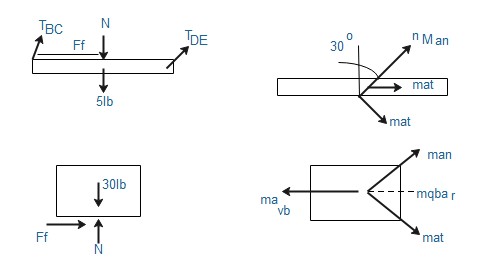
Treat system as a whole:
analyze block on its own :
from bar only:
Ff=2.165 lb
Ff<Ffmax =22.5(0.15)=3.375 no relative motion will occur
at = 16.1 ft /s2