Wize University Dynamics Textbook (Master) > Planar Kinetics of a Rigid Body
Constrained Motion
0:00 / 0:00
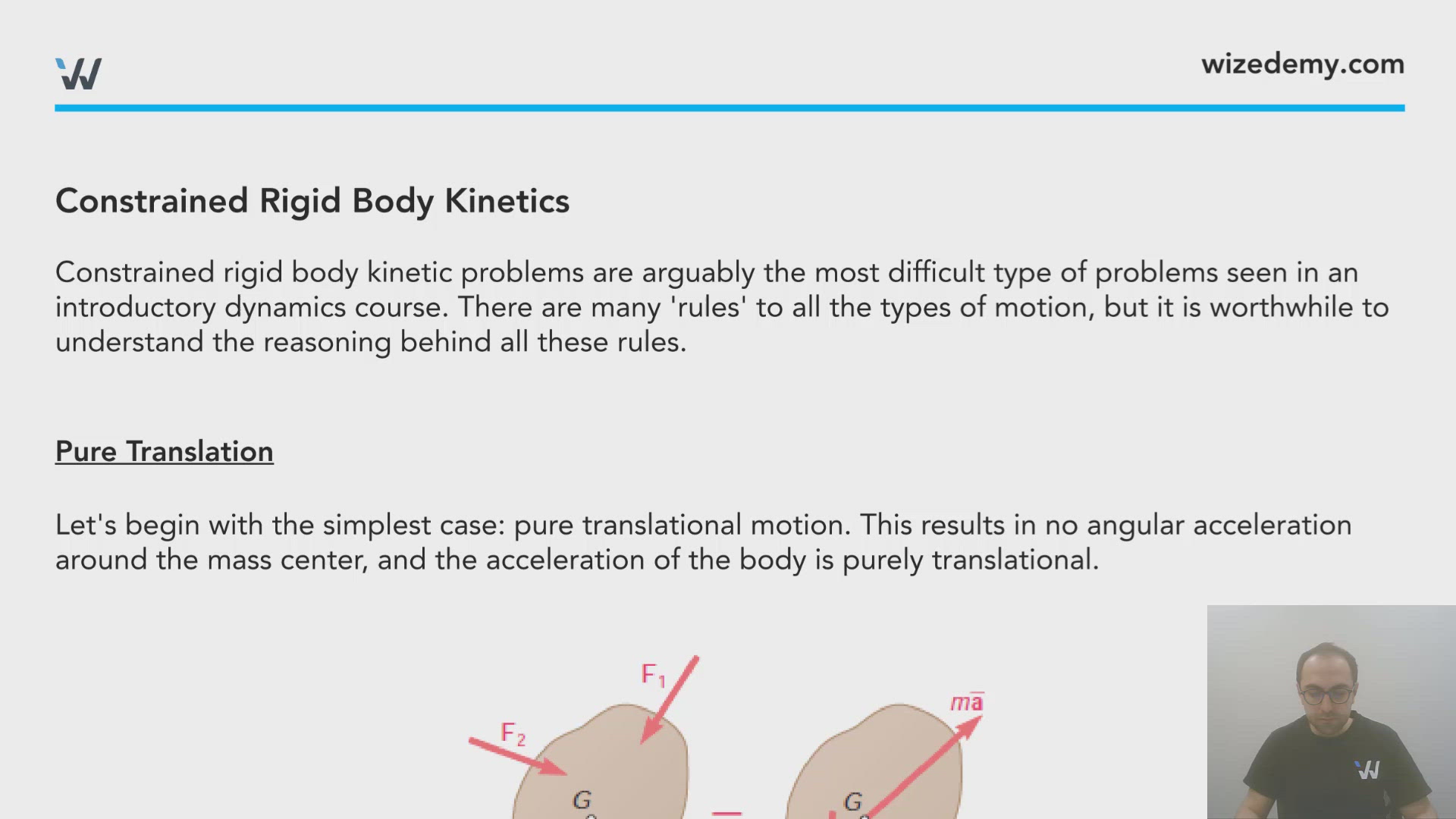
Constrained Rigid Body Kinetics
Constrained rigid body kinetic problems are arguably the most difficult type of problems seen in an introductory dynamics course. There are many 'rules' to all the types of motion, but it is worthwhile to understand the reasoning behind all these rules.
Pure Translation
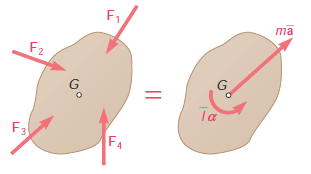
Let's begin with the simplest case: pure translational motion. This results in no angular acceleration around the mass center, and the acceleration of the body is purely translational.
Centroidal Rotation
The second simplest case is centroidal rotation. This is purely rotational motion about the center G of the body, resulting in no linear acceleration (a = 0).
Non-Centroidal Rotation
Another variation of rotational motion is non-centroidal rotation. This is also a purely rotational motion, but it doesn't occur around the centroid G and occurs around some other point O - which may be on or off the body. In this case, we can use the kinematic equation to come up with the acceleration terms:
Wize Concept
Then, we can determine the moment summation using the parallel axis theorem to be:
0:00 / 0:00
Common Constrained Problems:
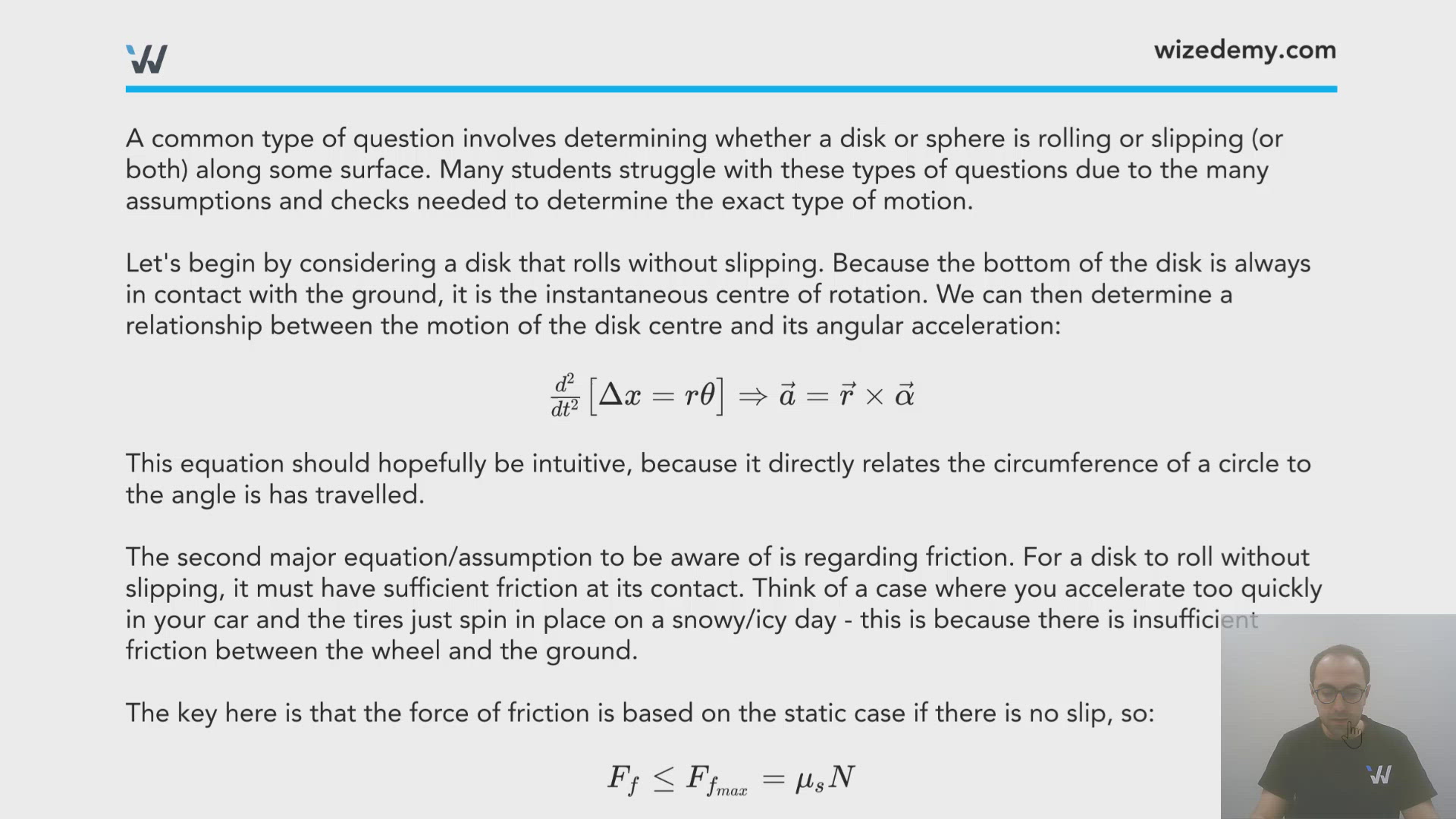
A common type of question involves determining whether a disk or sphere is rolling or slipping (or both) along some surface. Many students struggle with these types of questions due to the many assumptions and checks needed to determine the exact type of motion.
Let's begin by considering a disk that rolls without slipping. Because the bottom of the disk is always in contact with the ground, it is the instantaneous centre of rotation. We can then determine a relationship between the motion of the disk centre and its angular acceleration:
This equation should hopefully be intuitive, because it directly relates the circumference of a circle to the angle is has traveled.
The second major equation/assumption to be aware of is regarding friction. For a disk to roll without slipping, it must have sufficient friction at its contact. Think of a case where you accelerate too quickly in your car and the tires just spin in place on a snowy/icy day - this is because there is insufficient friction between the wheel and the ground.
The key here is that the force of friction is based on the static case if there is no slip, so:
This is the same as learned in statics - the force of friction and the normal force are independent unless the system is at impending motion (in this case, impending slip). At the boundary between slipping and rolling, the force of friction is at its maximum, and the relationship between the translational and rotational acceleration still holds.
Once the disk begins to slip, then the relationship between the translational and rotational accelerations is no longer valid. The friction force also changes in direction and becomes equal to the kinetic friction:
When solving questions in general, it's easiest to assume that a disk rolls without slipping and solves the question accordingly. We do this because its the most defined equation. We check this assumption by comparing the frictional force needed with the maximum frictional force available. If that assumption turns out to be wrong, we must resolve the question using the kinetic friction.
0:00 / 0:00
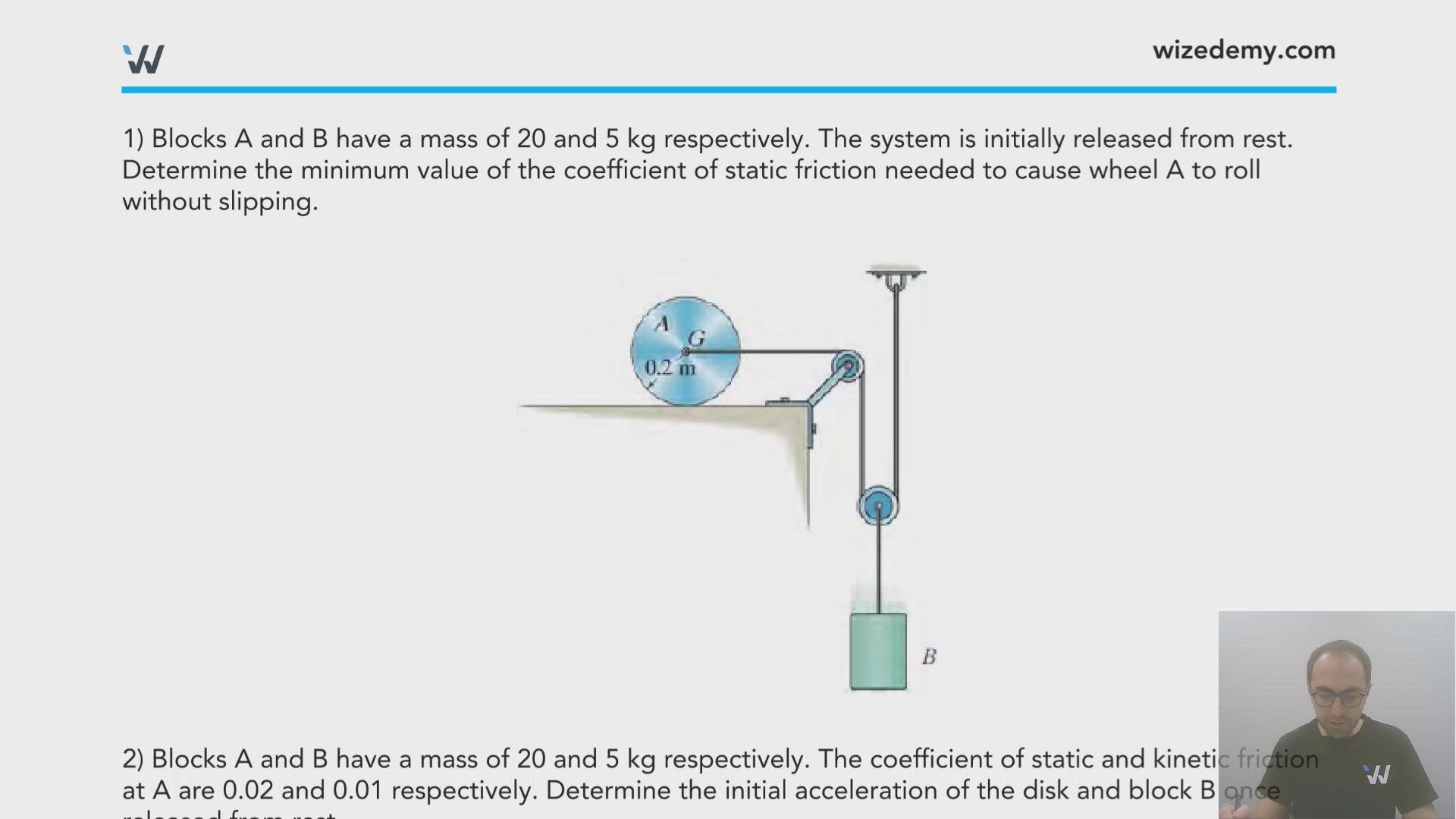
1) Blocks A and B have a mass of 20 and 5 kg respectively. The system is initially released from rest. Determine the minimum value of the coefficient of static friction needed to cause wheel A to roll without slipping.
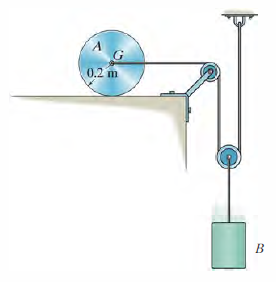
2) Blocks A and B have a mass of 20 and 5 kg respectively. The coefficient of static and kinetic friction at A are 0.02 and 0.01 respectively. Determine the initial acceleration of the disk and block B once released from rest.
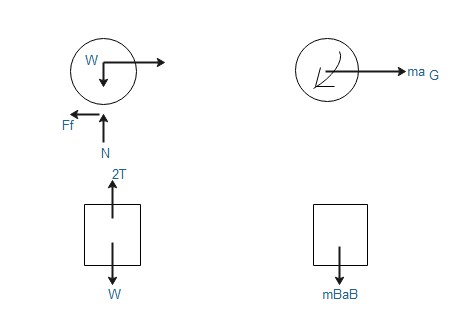
equations @ B: 2T-W=-MBaB (1)
constant eqn : 2xB - xA = l
2aB =aA (2)
equations @ A :
other eqns : aG =
Ff=VsN (6)
unknowns : T, aB, aA ,Ff,,, 6 eqns , 6 unknowns solveable
eqn (1) /(3)/(2) T =
24.525 = 31.25aA
Ff= 7.85 N
From previous question :
now
Re-write equations : IG = 0.4
N = wA =196.2 N
T=-Ff=mAaA (3)
-0.2Ff = IG (4)
T=

Mark Yourself Question
- Grab a piece of paper and try this problem yourself.
- When you're done, check the "I have answered this question" box below.
- View the solution and report whether you got it right or wrong.
A 2 kg bowling ball, with a 10 cm radius, is rolled with an initial horizontal velocity of 4 m/s. The ball initially slides without rolling with a kinetic friction coefficient of 0.10. Determine how far the ball will travel before it begins to spin, and how long will that take?