Wize University Dynamics Textbook (Master) > Energy Methods for Rigid Bodies
Conservation of Energy for a Rigid Body

0:00 / 0:00
Conservation of Energy for a Rigid Body:
We can continue to use the same general equation as used for particle equilibrium as shown below, with 2 additional terms to consider:
But now we must also account for the rotational kinetic energy of a body using:
And if an external couple moment is applied on the body, then we account for it by:
0:00 / 0:00
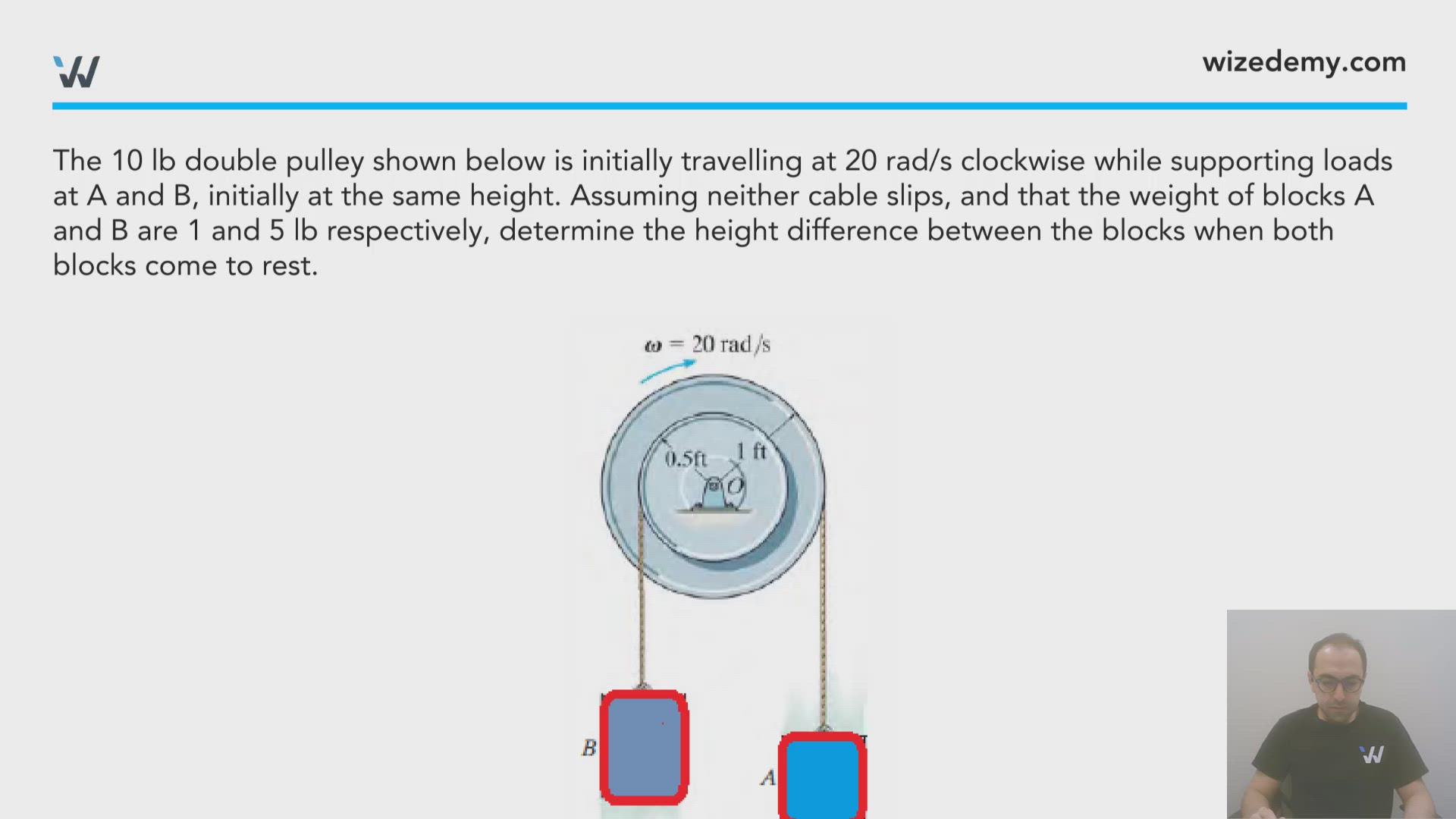
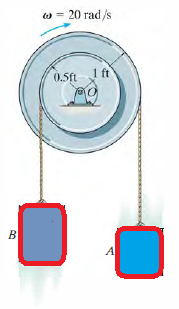
The 10 lb double pulley shown below is initially travelling at 20 rad/s clockwise while supporting loads at A and B, initially at the same height. Assuming neither cable slips, and that the weight of blocks A and B are 1 and 5 lb respectively, determine the height difference between the blocks when both blocks come to rest.
Initially : Block B @ C
Cable Equation :
a) When
set height reference @ xAo
then : T1 = 0
V1 = 0
then :
b)
T1 = 0.3727
0:00 / 0:00
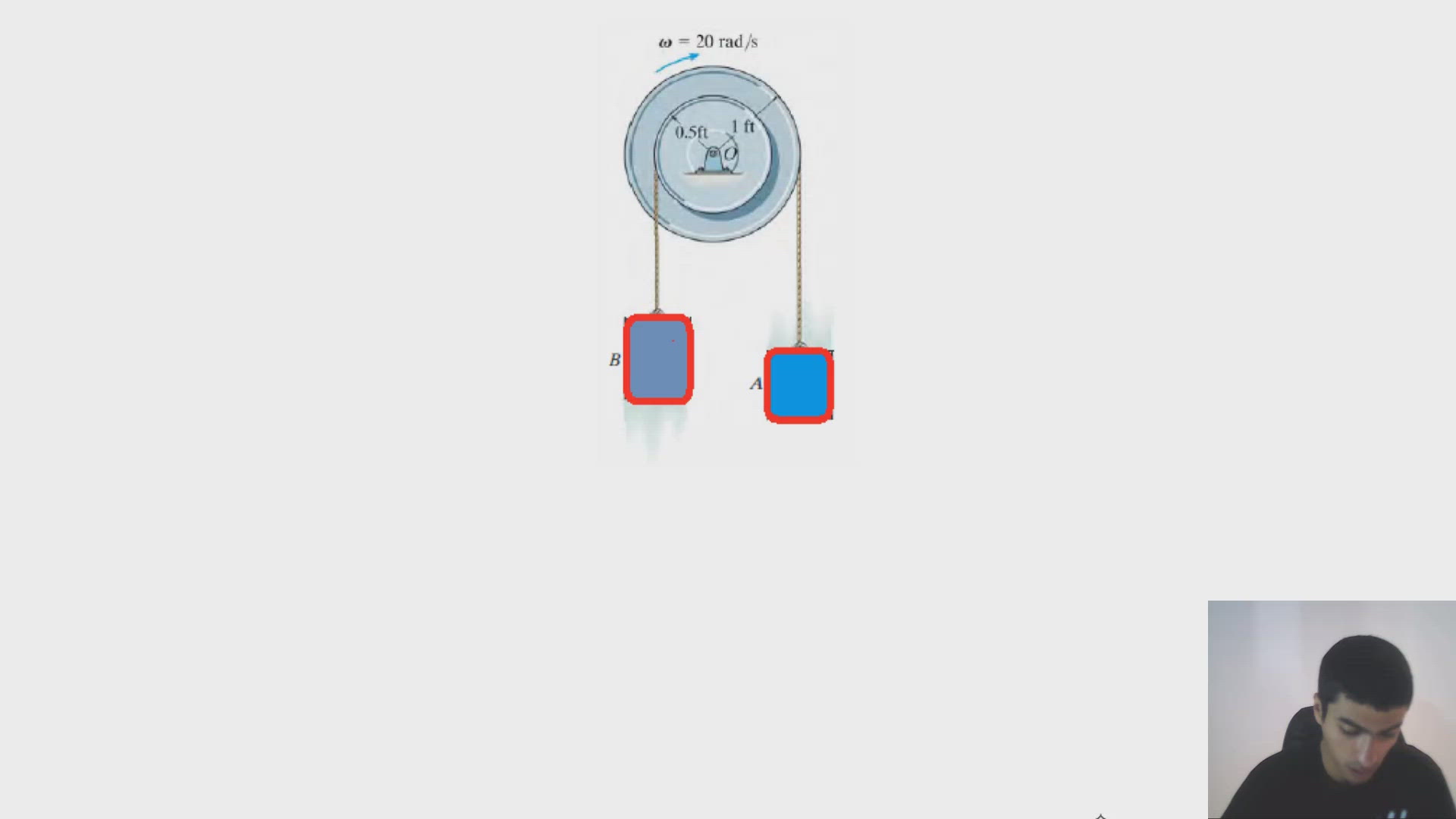
The 10 lb double pulley shown below is initially travelling at 20 rad/s clockwise while supporting loads at A and B, initially at the same height. Assuming neither cable slips, and that the weight of blocks A and B are 1 and 5 lb respectively, determine the height difference between the blocks when both blocks come to rest.
Initially : Block B @ C
Cable Equation :
a) When
set height reference @ xAo
then : T1 = 0
V1 = 0
then :
b)
T1 = 0.3727

Mark Yourself Question
- Grab a piece of paper and try this problem yourself.
- When you're done, check the "I have answered this question" box below.
- View the solution and report whether you got it right or wrong.
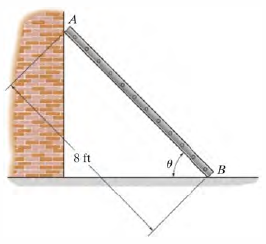
A 20 lb ladder is resting on a smooth wall as shown below, at an angle of 30°. Determine the velocity of A as it hits the ground if the surface at B is smooth. How does your answer change if the coefficient of static and kinetic friction at B were 0.15 and 0.10 respectively? You can treat the ladder as a slender rod.
Mark Yourself Question
- Grab a piece of paper and try this problem yourself.
- When you're done, check the "I have answered this question" box below.
- View the solution and report whether you got it right or wrong.
A 20 lb ladder is resting on a smooth wall as shown below, at an angle of 30°. Determine the velocity of A as it hits the ground if the surface at B is smooth. How does your answer change if the coefficient of static and kinetic friction at B were 0.15 and 0.10 respectively? You can treat the ladder as a slender rod.