Popular Courses
Find My Course
0:00 / 0:00
We can take our analysis a step further and consider impact scenarios where things happen in 2 dimensions. The two equations previously used become as follows:
Now that this equation is in 2 dimensions, each of the velocity vectors has two unknowns. In general, we know the masses (which remain constant), and we know the initial velocities of the particles before impact. This leaves us with four unknowns being the two components of the final velocities of each particle, and only a single equation so far. At this point, we define an important concept for oblique impact questions: the plane of contact and the line of impact.
The plane of contact is the plane that is tangent to the surface at the point of contact. The line of impact is perpendicular to that.
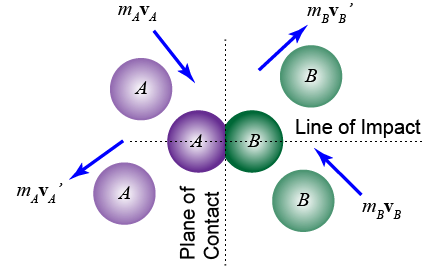
Our second equation comes from the coefficient of restitution can then only be applied for velocities along the line of impact.
We still need another two equations. Those equations come from the conservation of linear momentum along the plane of contact. Neither particle experiences a force along that direction, and therefore their momentum (and velocities), remain unchanged in that direction. This takes care of our last two unknowns.
Solving oblique impact questions is fairly easily mathematically, but most of the difficulty and mistakes are made in the setup of the geometry of the problem. Draw large pictures if you have to, and clearly label and even exaggerate angles to make sure you get the geometry correctly.
0:00 / 0:00
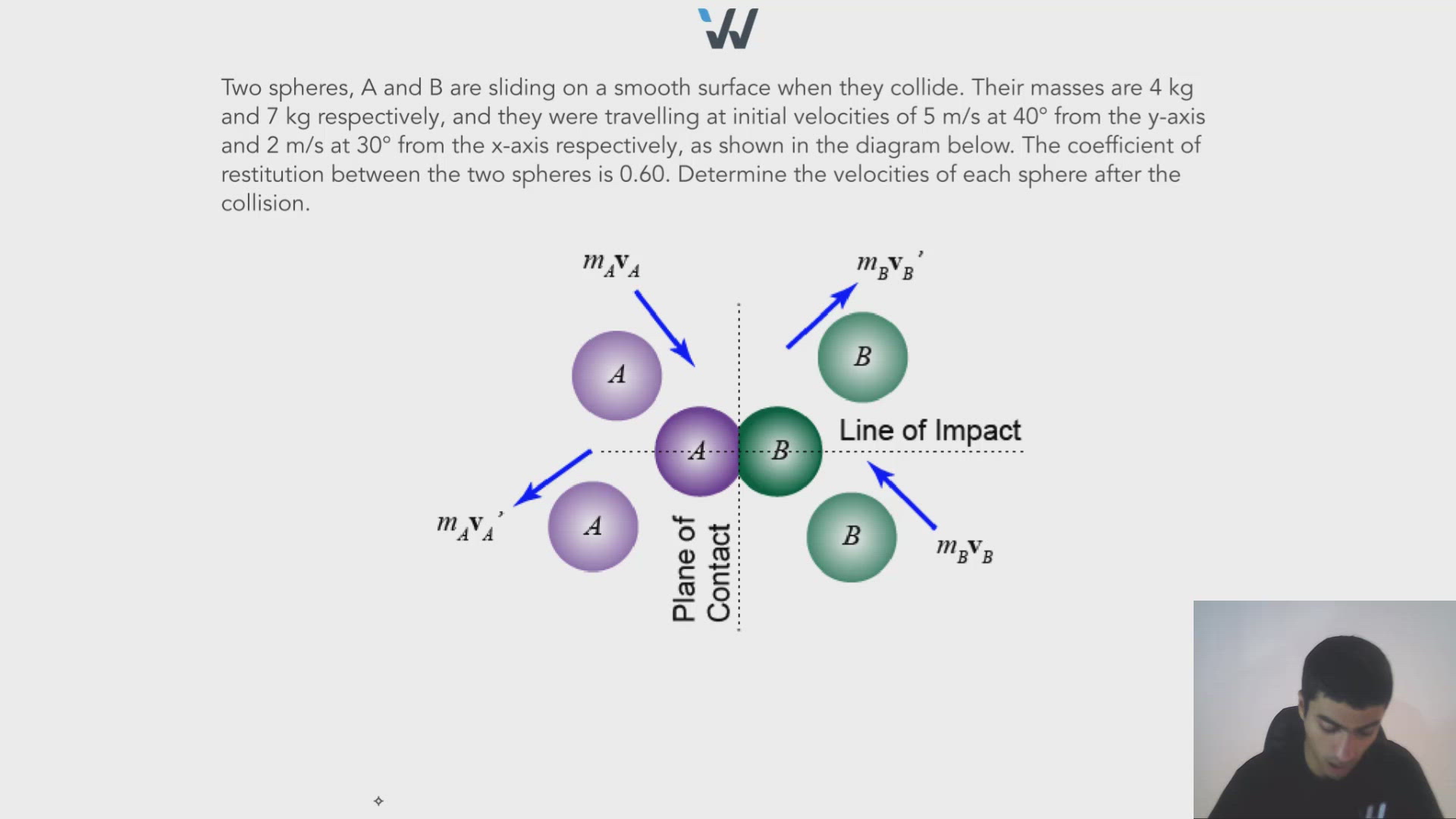
Two spheres, A and B are sliding on a smooth surface when they collide. Their masses are 4 kg and 7 kg respectively, and they were travelling at initial velocities of 5 m/s at 40° from the y-axis and 2 m/s at 30° from the x-axis respectively, as shown in the diagram below. The coefficient of restitution between the two spheres is 0.60. Determine the velocities of each sphere after the collision.
Ball A
mA = 4 kg
vA = 5 m/s at 40o
vAx = 5 sin 40 = 3.214
vAy = -5cos40 = -3.830 = vAv'
Ball B
mB=7kg
no forces /impulse along plane of contact ( y-axis ) momentum unchanged
Momentum Balance :
put in equation
Ball A: Ball B:
vAx = -1.823 m/s vBx = 1.147 m/s
vAy =-3.830 m/s vBy = 1 m/s

Mark Yourself Question
- Grab a piece of paper and try this problem yourself.
- When you're done, check the "I have answered this question" box below.
- View the solution and report whether you got it right or wrong.
You throw a 50 g ball with from a height of 1 m at an initial velocity of 20 m/s at an angle of 60° to the horizontal while standing 20 m away from the base of an inclined ramp which has an angle of inclination of 45°. Determine where the ball will hit the ground. The coefficient of restitution between the ball and the hill is 0.70.