Popular Courses
Find My Course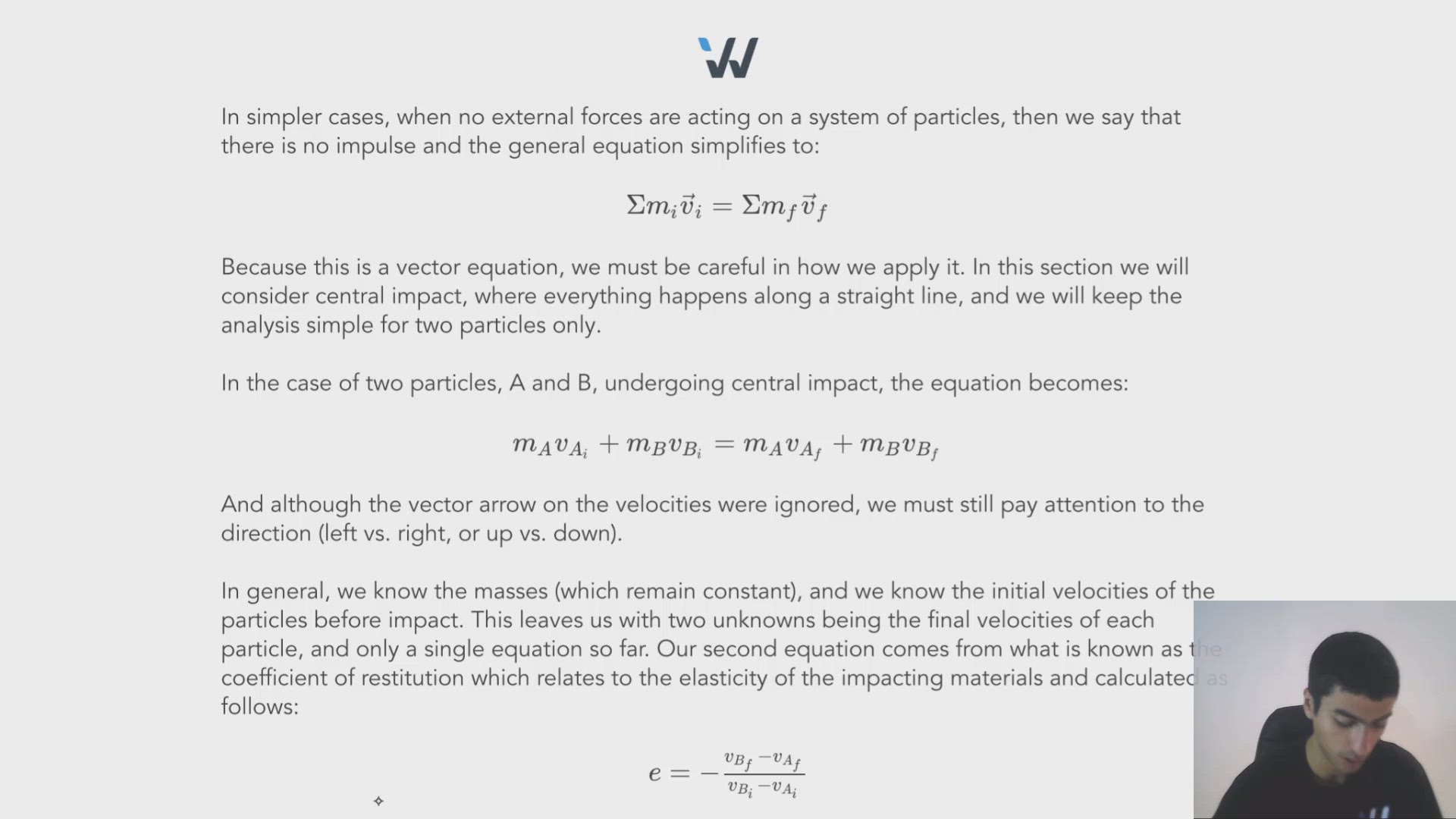
0:00 / 0:00
In simpler cases, when no external forces are acting on a system of particles, then we say that there is no impulse and the general equation simplifies to:
Because this is a vector equation, we must be careful in how we apply it. In this section we will consider central impact, where everything happens along a straight line, and we will keep the analysis simple for two particles only.
In the case of two particles, A and B, undergoing central impact, the equation becomes:
And although the vector arrow on the velocities were ignored, we must still pay attention to the direction (left vs. right, or up vs. down).
In general, we know the masses (which remain constant), and we know the initial velocities of the particles before impact. This leaves us with two unknowns being the final velocities of each particle, and only a single equation so far. Our second equation comes from what is known as the coefficient of restitution which relates to the elasticity of the impacting materials and calculated as follows:
As you may guess, the value of the coefficient of restitution 'e' ranges from 0 to 1. This provides us with two equations and two unknowns enabling us to solve central impact questions.
0:00 / 0:00
Person A is travelling in a vehicle with a mass of 1200 kg at a speed of 50 km/h and doesn't notice that the vehicle ahead of them has stopped. The vehicle in front has a mass of 2000 kg, and is stopping on ice (neglect friction). Determine the speed of the combined vehicles after the impact if the coefficient of restitution is 0.10.
13888.9 = 3200 vA' v'B-v'A=1.389
v'B = 1.389+v'A

Mark Yourself Question
- Grab a piece of paper and try this problem yourself.
- When you're done, check the "I have answered this question" box below.
- View the solution and report whether you got it right or wrong.
A 20 g ball is dropped from rest at a height of 1.5 m. The coefficient of restitution with the ground is 0.80. Determine the height of the ball after exactly 2 seconds.