Popular Courses
Find My Course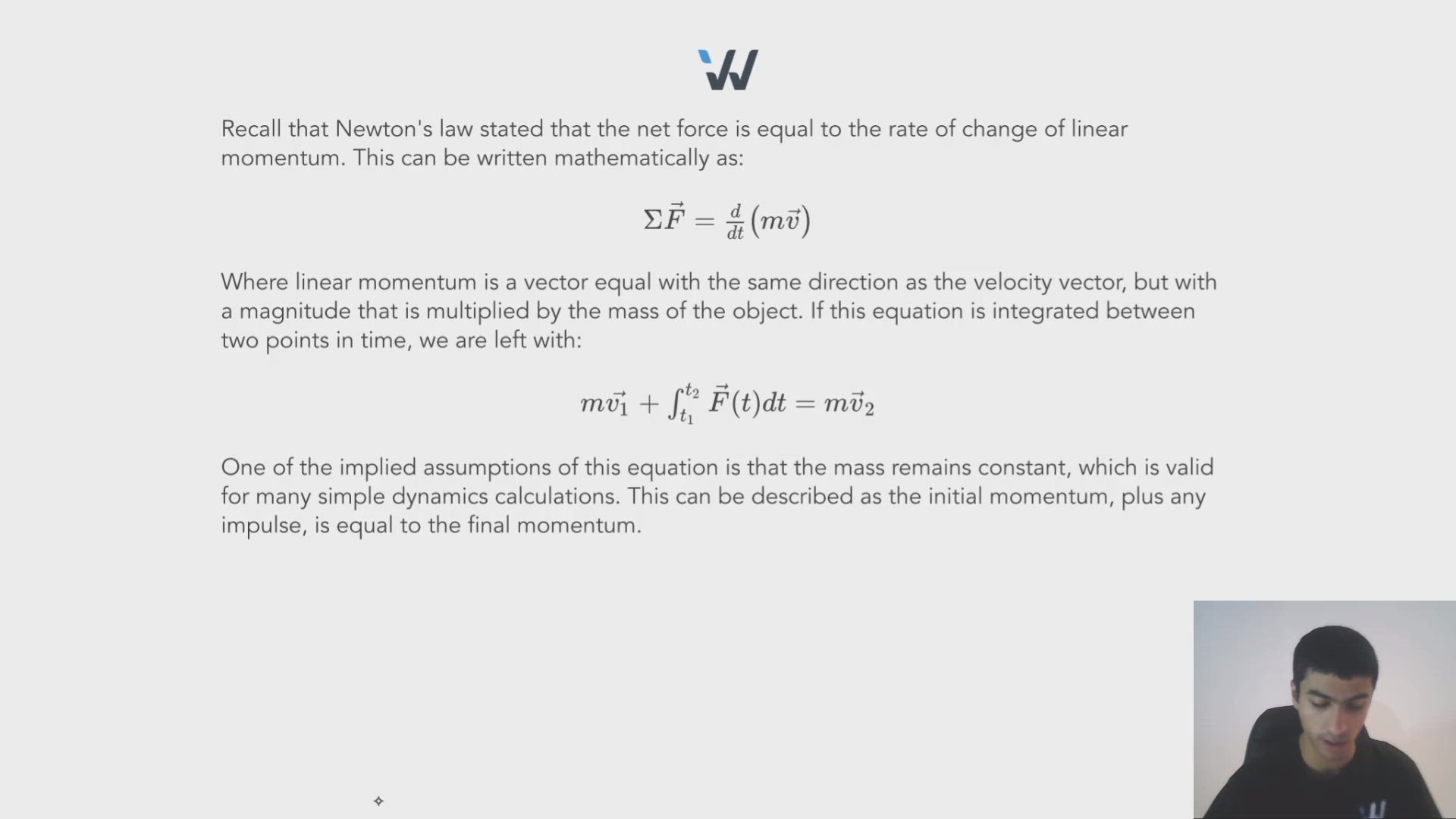
0:00 / 0:00
Recall that Newton's law stated that the net force is equal to the rate of change of linear momentum. This can be written mathematically as:
Where linear momentum is a vector equal with the same direction as the velocity vector, but with a magnitude that is multiplied by the mass of the object. If this equation is integrated between two points in time, we are left with:
One of the implied assumptions of this equation is that the mass remains constant, which is valid for many simple dynamics calculations. This can be described as the initial momentum, plus any impulse, is equal to the final momentum.
0:00 / 0:00
You're in a car travelling at 60 km/h and you throw your water bottle out the window at an initial height of 1 m. The water bottle has a mass of 500 g and faces an air resistance of 5 N horizontally, and 1 N vertically. Determine the speed of the water bottle at the instant it hits the ground.
(1)
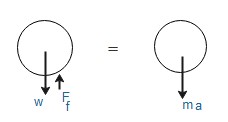
m = 0.5 kg
y-component
yo = 1
y = 0
vo = 0
a= -7.81 m/s2
7.81 m/s2 = a
-1= 1/2(-7.81)t2
t=0.51 seconds vf= 3.95 m/s
x-component
vf= 11.6 m/s

Mark Yourself Question
- Grab a piece of paper and try this problem yourself.
- When you're done, check the "I have answered this question" box below.
- View the solution and report whether you got it right or wrong.
You are teaching kids how to ski at a ski resort, and see a child with a mass of 30 kg coming down the hill. You know that the hill is 10 m high, and has an inclination of 10°, and that the friction can be neglected since the kid still doesn't know how to stop or slow down. You weight 65 kg, and standing at the bottom of the hill in an attempt to stop the kid from falling off an edge behind you. If you can exert 25 N of frictional force against the ground, determine the time it takes for you to be able to stop the kid.