Wize University Dynamics Textbook (Master) > Kinematics: Curvilinear Motion
Radial and Transverse Coordinates
0:00 / 0:00
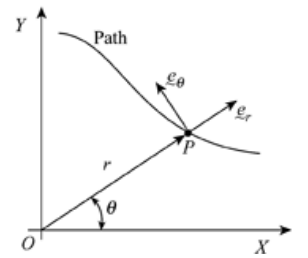
Radial and transverse (RT) coordinates are another useful coordinate system that is used to solve dynamics problems and is based on a polar coordinate system. Recall that in polar coordinates, any location (in a 2D space) is defined by a position vector which measures from an origin to a point in space. The magnitude (r) and direction (Θ) are what we use in polar coordinates.
The most common idea students struggle with in this section is the difference between RT coordinate system and a normal-tangential (NT) coordinate system.
An NT coordinate system as previously described, uses the path of motion of a particle to define its axis, and those axis are constantly changing as the particle moves through its trajectory. The normal component is towards the inside of the curvature while the tangential component is tangential with respect to the particle's motion.
The RT coordinate system however uses another point to define the coordinate system. This point, let's call it 'O' is connected to the position of the particle 'P' to define an OP axis. This is the radial axis, and is not necessarily perpendicular to the particular's motion - not unless point 'O' happens to be the centre of curvature of the path which the particle is following.
In general, when given a time dependent function that describes a length vector and angle, you're probably using polar coordinates. After some derivation, you can show that the velocity and acceleration profiles in polar coordinates can be described by the two following equations:
Note: it is most useful to come up with 6 equations, plug in a value of 't' (if applicable) and set up your 6 variables before substituting into the equation. This is most commonly done is some sort of tabular form.
0:00 / 0:00
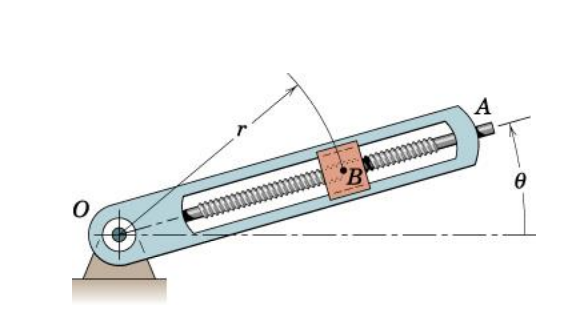
The location of a camera (at B) on a movie set is controlled through the motion of two motors. The first motor rotates the arm OA, varying the angle Θ, according to equation 1 below. Meanwhile, a second motor rotates the screw, which varies the position of B as measured by r according to equation 2 below.
Determine the velocity and acceleration of the camera at B at t = 15 seconds.
t=15

Mark Yourself Question
- Grab a piece of paper and try this problem yourself.
- When you're done, check the "I have answered this question" box below.
- View the solution and report whether you got it right or wrong.
The location of a camera (at B) on a movie set is controlled through the motion of two motors. The first motor rotates the arm OA, varying the angle Θ, according to equation 1 below. Meanwhile, a second motor rotates the screw, which varies the position of B as measured by r according to equation 2 below.
Determine the velocity and acceleration of the camera at B at t = 15 seconds according to the regular x-y coordinate system.