0:00 / 0:00
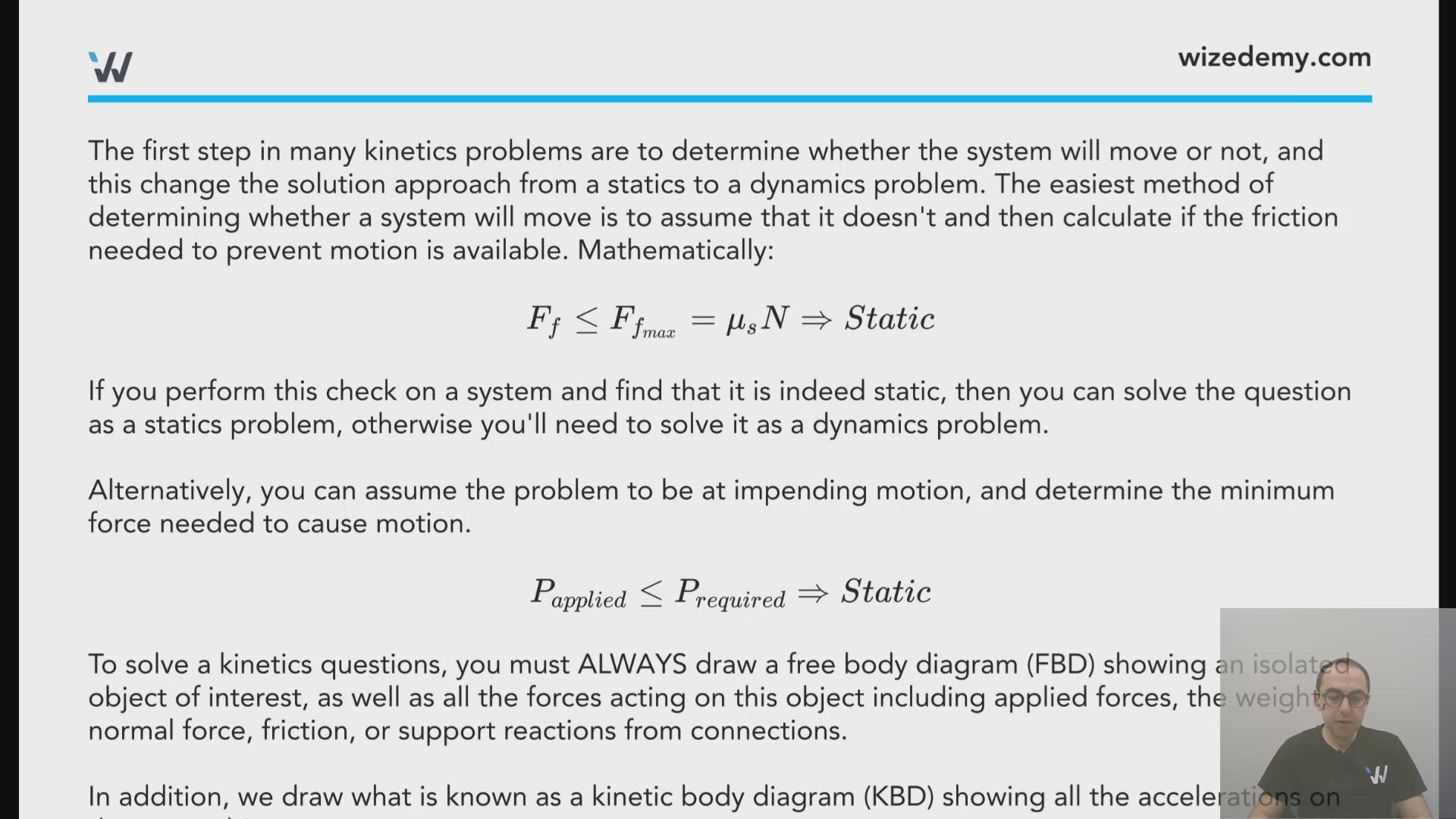
The first step in many kinetics problems are to determine whether the system will move or not, and this change the solution approach from a statics to a dynamics problem. The easiest method of determining whether a system will move is to assume that it doesn't and then calculate if the friction needed to prevent motion is available. Mathematically:
If you perform this check on a system and find that it is indeed static, then you can solve the question as a statics problem, otherwise you'll need to solve it as a dynamics problem.
Alternatively, you can assume the problem to be at impending motion, and determine the minimum force needed to cause motion.
To solve a kinetics questions, you must ALWAYS draw a free body diagram (FBD) showing an isolated object of interest, as well as all the forces acting on this object including applied forces, the weight, normal force, friction, or support reactions from connections.
In addition, we draw what is known as a kinetic body diagram (KBD) showing all the accelerations on the same object.
If the object is undergoing motion, then it obeys Newton's law of motion:
Notice that this is a vector equation.
If the system is static, the acceleration is equal to zero and we're left with a statics problem.
0:00 / 0:00
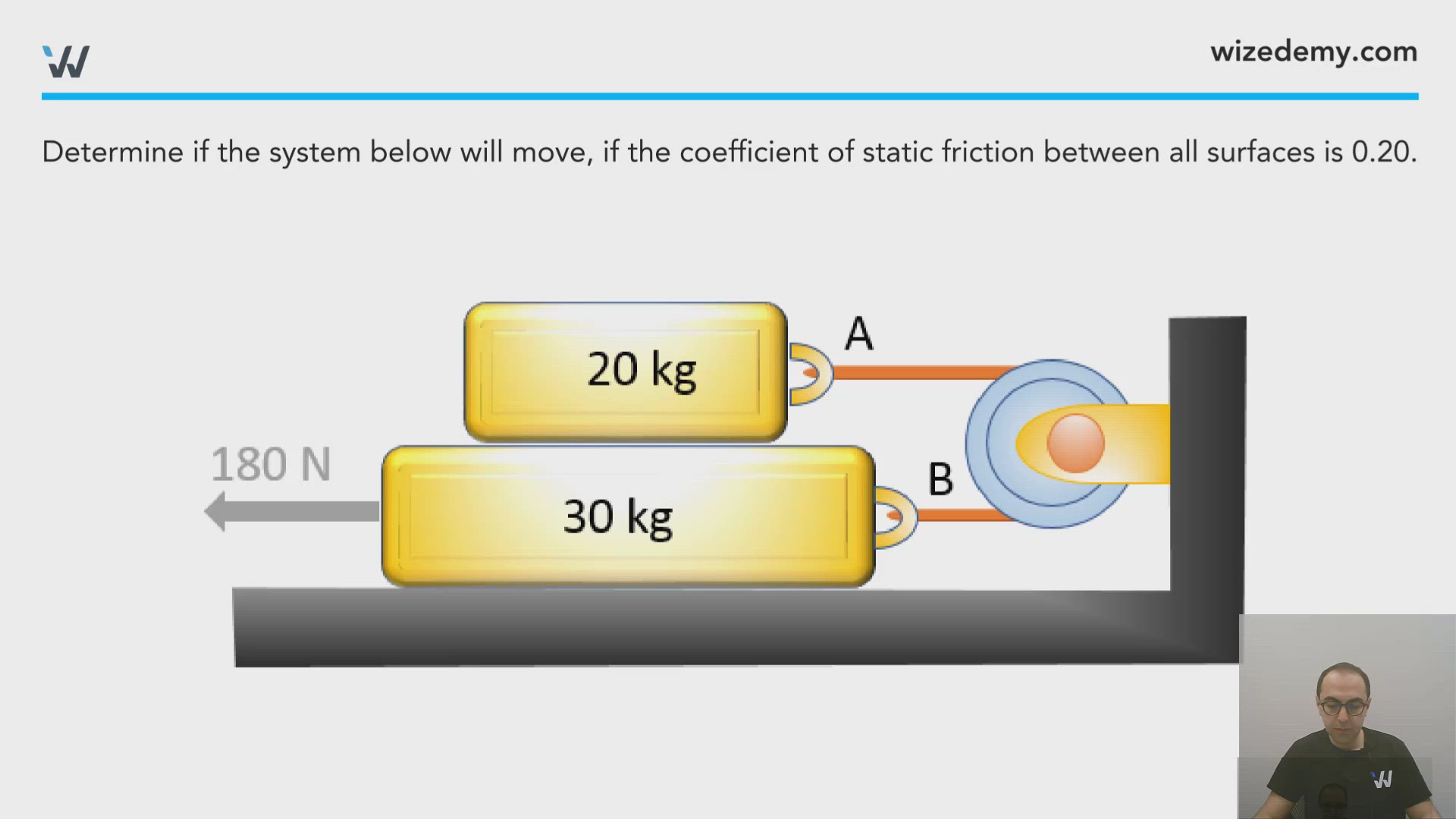
Determine if the system below will move, if the coefficient of static friction between all surfaces is 0.20.
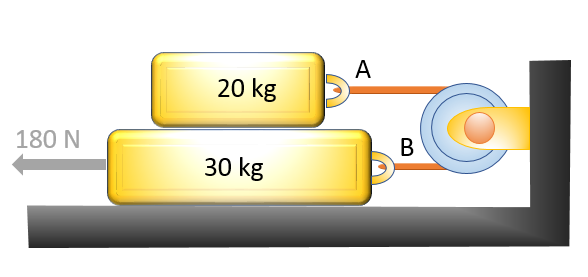
(1) Assume system to be static @ impending motion:

0:00 / 0:00
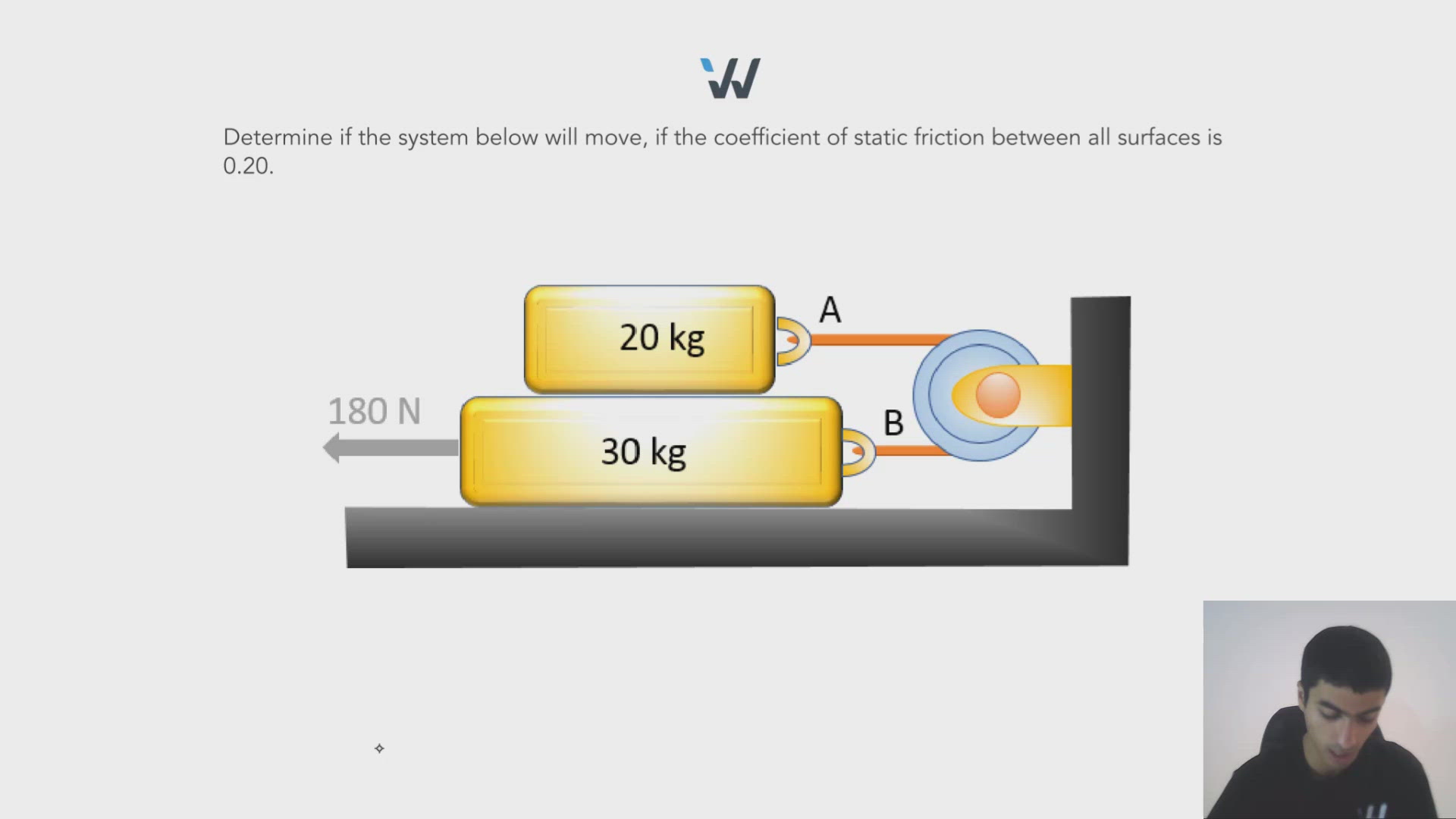
Determine if the system below will move, if the coefficient of static friction between all surfaces is 0.20.
(1) Assume system to be static @ impending motion: