Wize University Dynamics Textbook (Master) > Kinetics of Particle
Rectilinear Motion
0:00 / 0:00
Solving kinetic type of questions for rectilinear motion is typically fairly straight forward. Begin by drawing your free body diagram (FBD), and kinetic body diagram (KBD). Then use the following equation:
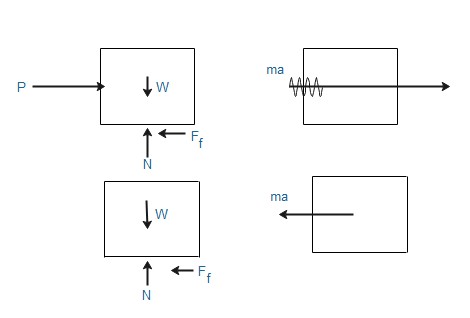
Where your forces are shown on the FBD, while the ma term is shown on the KBD diagram.
In its simplest form, this equation is easy. Things can begin to get complicated when we introduce curvilinear motion, relation motion or constrained relative motion into this equation.
Side note: Newton's law of motion initially stated that the net force is equal to the rate of change of linear momentum (defined as the product of mass and velocity) - we will revisit this when looking at impulse and momentum principles.
0:00 / 0:00
You have a 5 kg box sitting on a table and located 1 m away from the edge. The table is 1 m off the ground. You want the box to land exactly 50 cm away from the edge of the table, so you apply a constant force 'P' over the first 20 cm of travel on the table. The coefficient of static friction is 0.20 and the coefficient of kinetic friction is 0.15. Determine the value of P.
(1) 2 Parts to the motion :
Part 1 and Part 2 :
Begin from the end W Kinematics :
Voy = 0
Vox = v
a = - 9.81
Now Consider second part of motion :-
W=N=5g Ff=ma
from kinematics :
Now consider first part of motion:
Kinematics:
vo=0
a=?
Kinematics :
P=52.1 N