Wize University Dynamics Textbook (Master) > Kinetics of Particle
Curvilinear Motion
0:00 / 0:00
Solving curvilinear problems is slightly more complex, because now you must consider both components of acceleration: normal and tangential, on your KBD. These questions are most often solved in a normal/tangential coordinate system.
There is not much else to these problems besides remembering that the normal component of acceleration always points towards inwards towards the centre of curvature and is equal to the square of the velocity squared divided by the radius of curvature at that point.
0:00 / 0:00
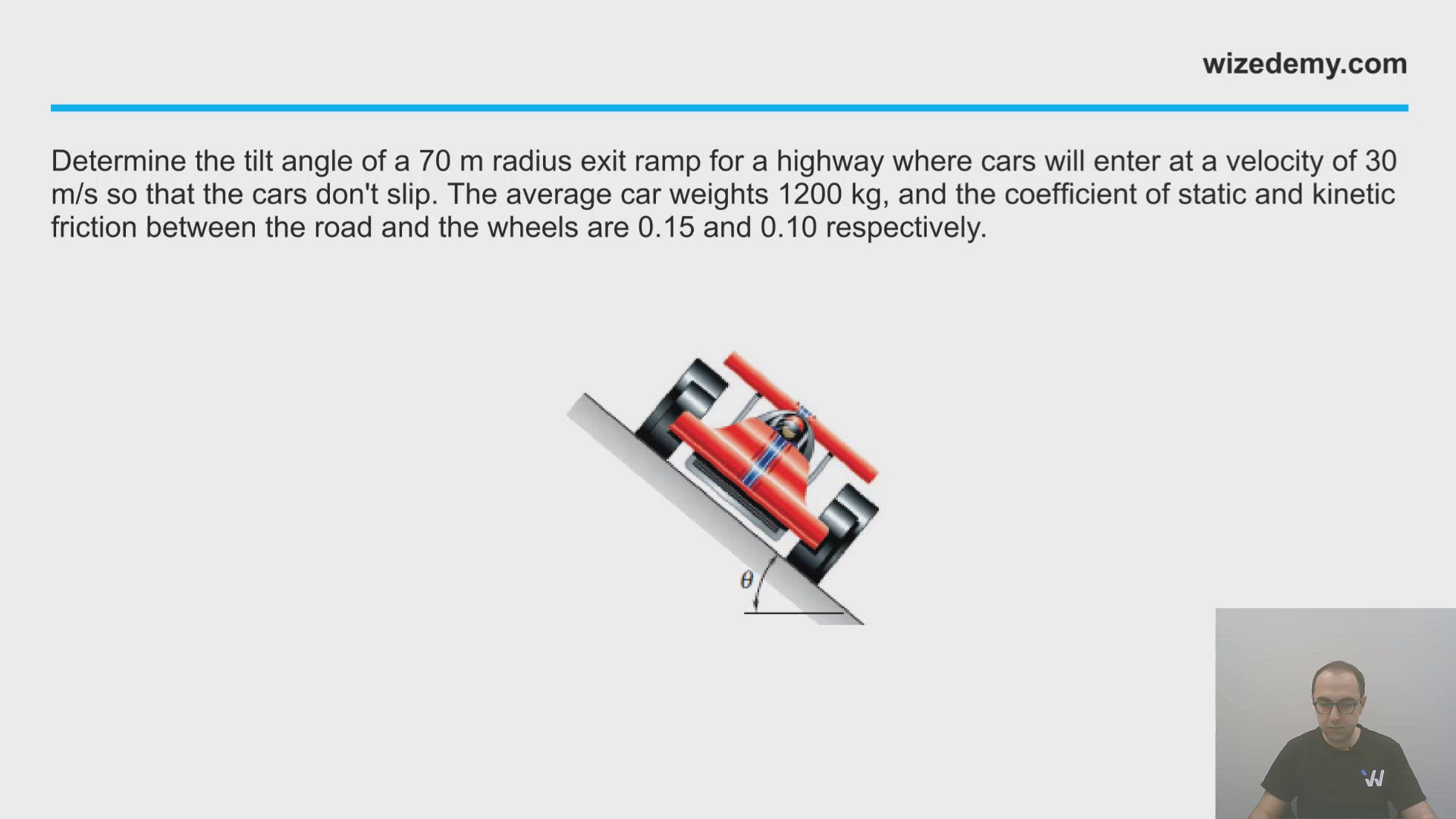
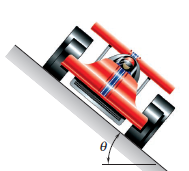
Determine the tilt angle of a 70 m radius exit ramp for a highway where cars will enter at a velocity of 30 m/s so that the cars don't slip. The average car weights 1200 kg, and the coefficient of static and kinetic friction between the road and the wheels are 0.15 and 0.10 respectively.
v = 30 m/s
r=70m
W=1200 kg
Ys=0.15
FBD KBD
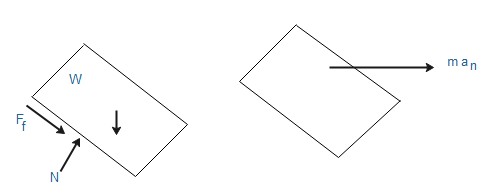
Check : if
N=W=1200g = 11772 N
Check if
N=15430 N
Solve for critical angle values
Check upper bound for :

Mark Yourself Question
- Grab a piece of paper and try this problem yourself.
- When you're done, check the "I have answered this question" box below.
- View the solution and report whether you got it right or wrong.
A small box with a mass of 200 g is placed inside a vertical centrifuge which rotates about the vertical axis at a velocity of 60 RPM (rounds per minute). The centrifuge is 50 cm in diameter, and has a coefficient of static friction of 0.25, and coefficient of kinetic friction of 0.18. Determine whether the box will fall in the centrifuge or stick on the side, and if it falls, what needs to be changed to hold it vertically in place without falling in the centrifuge.
Mark Yourself Question
- Grab a piece of paper and try this problem yourself.
- When you're done, check the "I have answered this question" box below.
- View the solution and report whether you got it right or wrong.
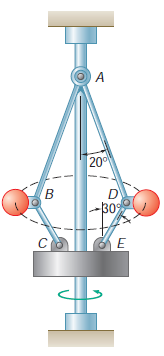
The diagram below shows beam A which rotates quickly about its z-axis as shown below. Two spheres with a weight of 1.2 kg each are connected at B and D using weightless links as shown. There is a spring underneath the plate CE and connected to the ground. The spring constant is 50 N/m, and the spring is unstreched when the velocity is 0 and plate CE rests on the ground. Block CE can be treated like a collar around a smooth bar, with the spring connected on its bottom side. Determine the distance between plate CE and the ground with the beam is rotating with a speed of 30 RPM (rounds per minute).
Note: Arm AD is 7 m in length