0:00 / 0:00
To be able to solve kinetic relative motion problems, you must first be able to solve kinematic relative problem questions. These are arguable some of the most difficult problems for particle equilibrium because they can combine all concepts learned in particle equilibrium.
There are 2 general types of kinetics problems we're interested in: constrained relative motion, and relative motion of one particle on another.
When solving constrained relative motion problems, the most crucial aspect is getting the direction of acceleration of each particle correct (consistent) on both the KBD and in the relative motion (cable) equation. In general:
- Begin by writing the constraint (cable) equation from a reference point (datum) with a positive sense of direction.
- Then, when you go to draw your KBD, label the unknown accelerations in the same positive sense as you choose your datum.
Relative motion of one particle on another can vary based on what the question is asking. Generally:
- Draw the 'base' particle with a KBD showing the acceleration of the 'base' is some direction
- Draw the 'top' particle with a KBD showing both the acceleration of the 'base' particle as well as the relative motion of the two particles. Algebraically, this looks as follows:
0:00 / 0:00
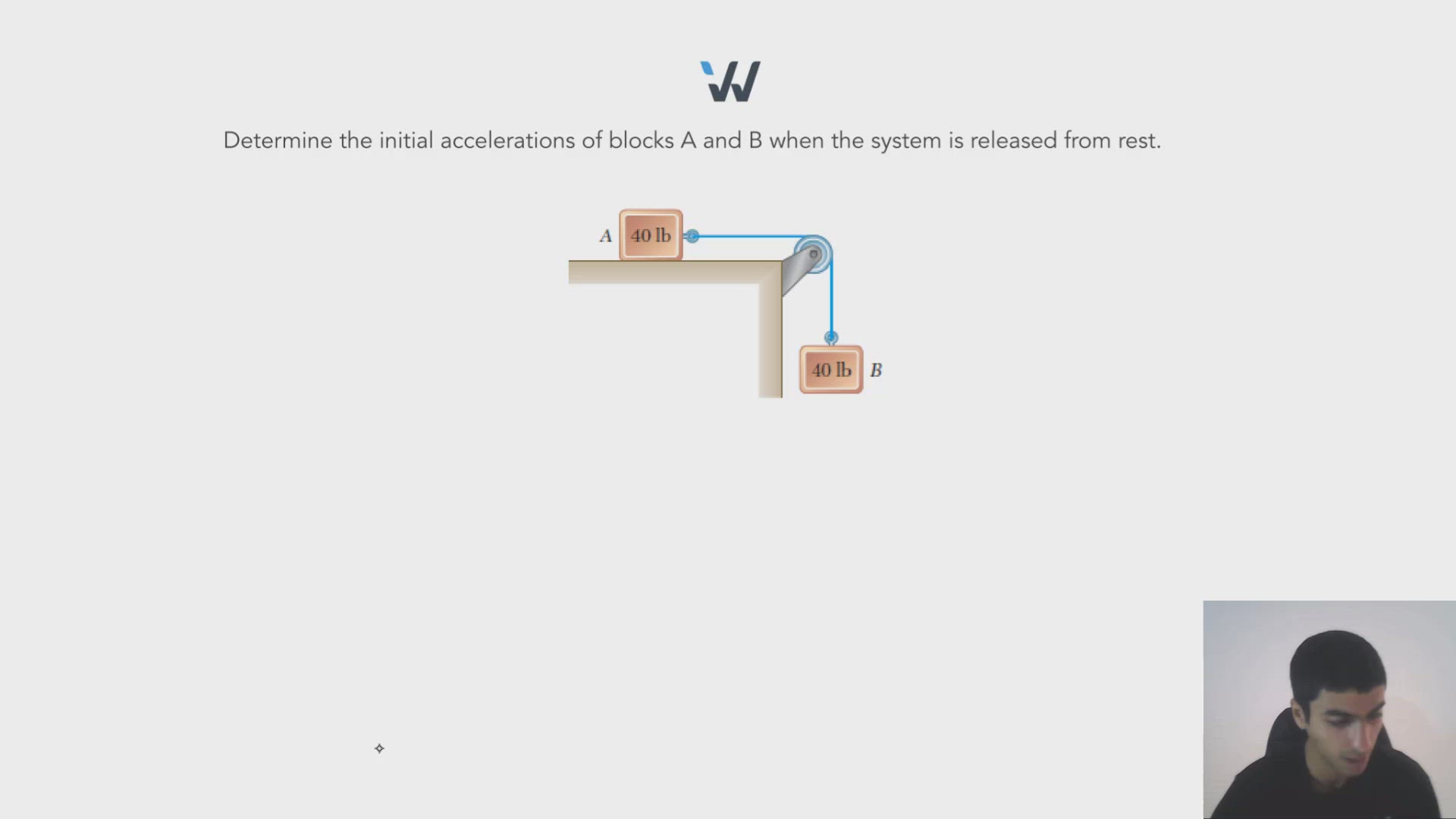
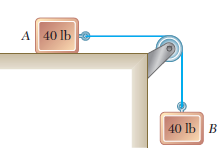
Determine the initial accelerations of blocks A and B when the system is released from rest. The surface at A has a coefficient of kinetic friction equal to 0.22.
(1)
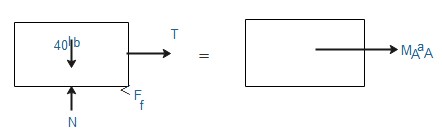
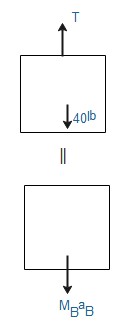
Rope Eqn : XA+XB=0
aB=aA
0:00 / 0:00
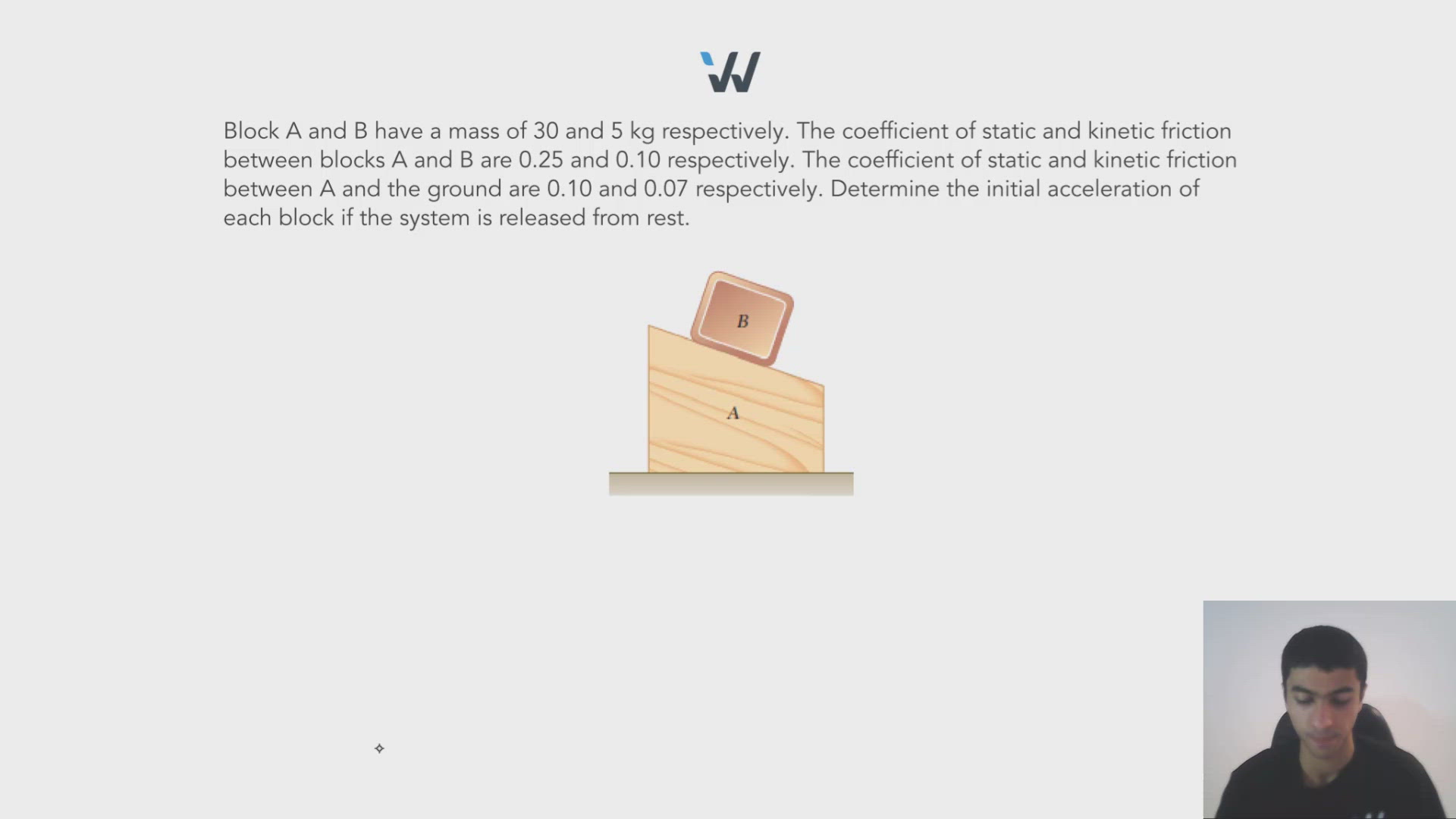
Block A and B have a mass of 30 and 5 kg respectively. The coefficient of static and kinetic friction between blocks A and B are 0.25 and 0.10 respectively. The coefficient of static and kinetic friction between A and the ground are 0.10 and 0.07 respectively. Determine the initial acceleration of each block if the system is released from rest. Wedge A has an angle of 30° to the horizontal.
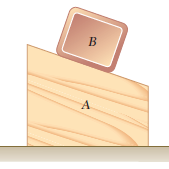
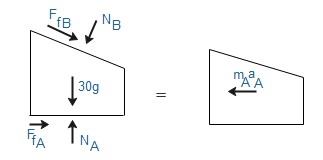
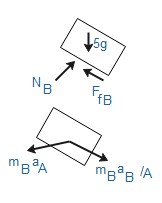
Assume B doesn't slip:
check :
Block B :
Block A: Assume doesn't slip: from eqn 1:NB=42.5N
Check:

Mark Yourself Question
- Grab a piece of paper and try this problem yourself.
- When you're done, check the "I have answered this question" box below.
- View the solution and report whether you got it right or wrong.
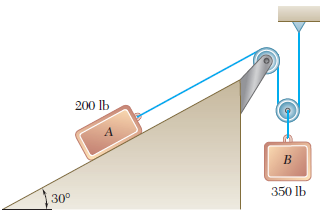
Determine the initial accelerations of blocks A and B if the system is released from rest. Block A has:
a) the coefficient of static and kinetic frictions are 0.80 and 0.70 respectively
b) the coefficient of static and kinetic frictions are 0.20 and 0.10 respectively
Mark Yourself Question
- Grab a piece of paper and try this problem yourself.
- When you're done, check the "I have answered this question" box below.
- View the solution and report whether you got it right or wrong.
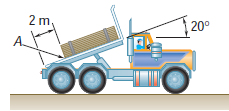
A truck is unloading the 2000 N load its carrying if starting from rest and the coefficient of static and kinetic frictions between the load and the truck bed are 0.50 and 0.15 respectively.
a) Determine the minimum acceleration needed by the truck needed to move the load.
b) If the truck accelerates at 20% more than the minimum needed, how long does it take for the load to reach the edge of the truck bed.