Wize University Introduction to Finance Textbook > Introduction to Finance
The Principle-Agent Problem
Popular Courses
COMM 308
Concordia University
Intro to Finance
University Study Guides
Intro to Finance
University Study Guides
FINA 230
Concordia University
MGCR 341
McGill University
FIN 301
University of Alberta
FIN 300
Toronto Metropolitan University
COMM 121
Queen's University
FIN*2000
University of Guelph
FINC 341
Texas A&M University
COMMERCE 2FA3
McMaster University
COMM 2202
Dalhousie University
BU283
Wilfrid Laurier University
FIN 300
Arizona State University - Tempe
BUSFIN 3220
Ohio State University
SB/FINE 2000 3.00
York University
FIN 301
Pennsylvania State University
BUS-F 255
Indiana University - Bloomington
FIN 3403
University of Central Florida
FIN 3403
University of Florida
0:00 / 0:00
The Agency Relationship
The Agent
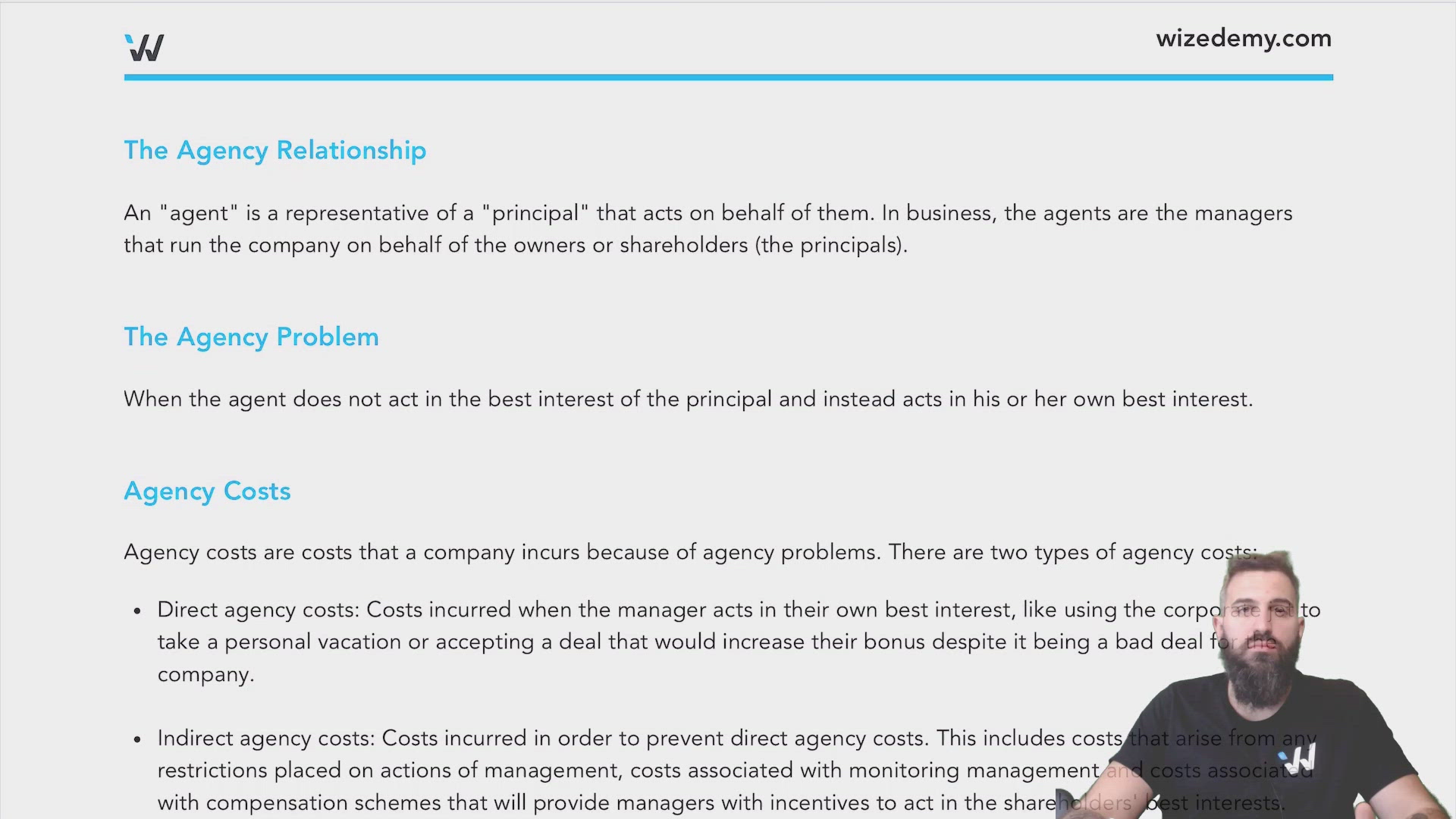
An "agent" is a representative of a "principal" that acts on behalf of them. In business, the agents are the managers that run the company on behalf of the owners or shareholders (the principals).
The Agency Problem
When the agent does not act in the best interest of the principal and instead acts in his or her own best interest.
Agency Costs
Agency costs are costs that a company incurs because of agency problems. There are two types:
- Direct: Costs incurred when the manager acts in their own best interest. E.g. Using the corporate jet to take a personal vacation or accepting a deal that would increase their bonus despite it being a bad deal for the company.
- Indirect: Costs incurred in order to prevent direct agency costs. This includes costs that arise from any restrictions placed on actions of management, costs associated with monitoring management, and costs associated with compensation schemes that will provide managers with incentives to act in the shareholders' best interests.
How to Resolve the Agency Problem
The best way to resolve the agency problem and to align managers' interests with those of the shareholders is to remove financial incentives that encourage conflicts of interest and to instead use a stock-based compensation scheme which would effectively turn the managers into shareholders as well.