Wize University Introduction to Finance Textbook > Market Efficiency
Levels of Market Efficiency
Popular Courses
COMM 308
Concordia University
Intro to Finance
University Study Guides
Intro to Finance
University Study Guides
MGCR 341
McGill University
FIN 301
University of Alberta
FIN 301
University of Alberta
COMM 121
Queen's University
FINC 341
Texas A&M University
COMM 2202
Dalhousie University
BU283
Wilfrid Laurier University
FIN 300
Arizona State University - Tempe
BUSFIN 3220
Ohio State University
SB/FINE 2000 3.00
York University
FIN 301
Pennsylvania State University
BUS-F 255
Indiana University - Bloomington
FIN 3403
University of Central Florida
FIN 3403
University of Florida
FIN 320
California State University - Fullerton
BMGT340
University of Maryland - College Park
FINC-UB 7
New York University
0:00 / 0:00
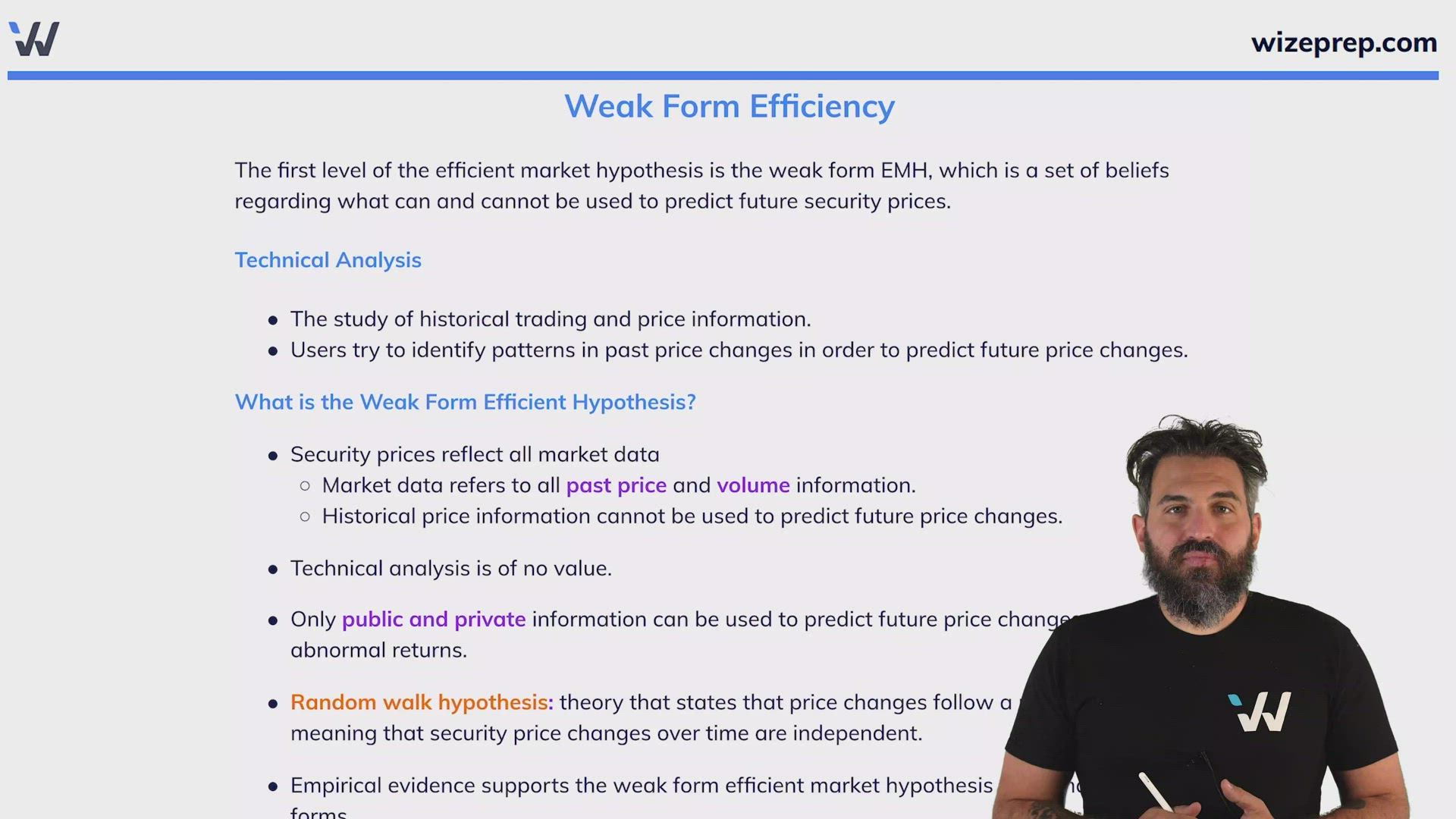
Weak Form Efficiency
The first level of the efficient market hypothesis is the weak form EMH, which is a set of beliefs regarding what can and cannot be used to predict future security prices.
Technical Analysis
- The study of historical trading and price information.
- Users try to identify patterns in past price changes in order to predict future price changes.
What is the Weak Form Efficient Hypothesis?
- Security prices reflect all market data
- Market data refers to all past price and volume information.
- Historical price information cannot be used to predict future price changes.
- Technical analysis is of no value.
- Only public and private information can be used to predict future price changes and earn abnormal returns.
- Random walk hypothesis: theory that states that price changes follow a random walk, meaning that security price changes over time are independent.
- Empirical evidence supports the weak form efficient market hypothesis more than the other forms.
0:00 / 0:00
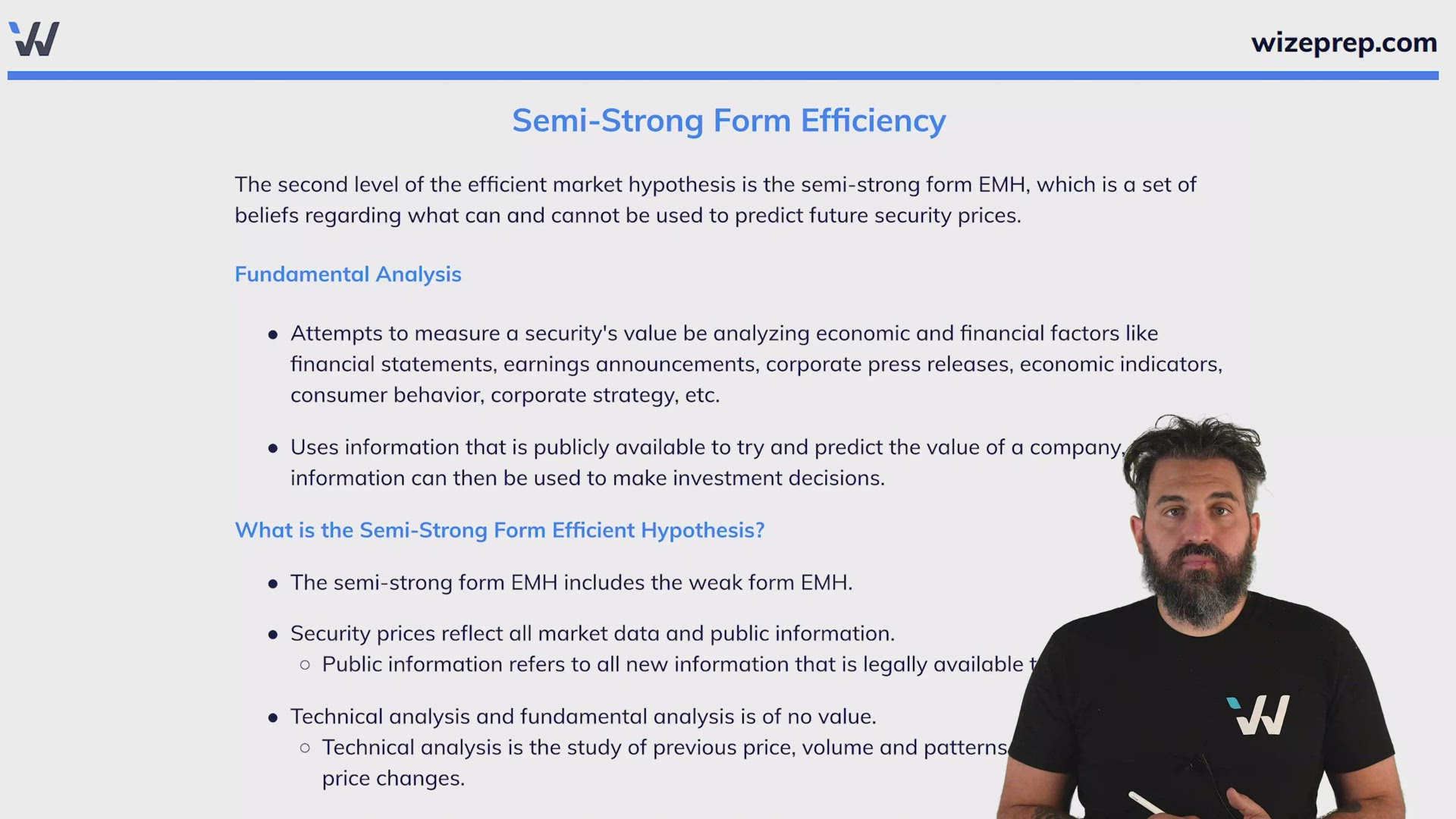
Semi-Strong Form Efficiency
The second level of the efficient market hypothesis is the semi-strong form EMH, which is a set of beliefs regarding what can and cannot be used to predict future security prices.
Fundamental Analysis
- Attempts to measure a security's value be analyzing economic and financial factors like financial statements, earnings announcements, corporate press releases, economic indicators, consumer behavior, corporate strategy, etc.
- Uses information that is publicly available to try and predict the value of a company, this information can then be used to make investment decisions.
What is the Semi-Strong Form Efficient Hypothesis?
- The semi-strong form EMH includes the weak form EMH.
- Security prices reflect all market data and public information.
- Public information refers to all new information that is legally available to the public.
- Technical analysis and fundamental analysis is of no value.
- Technical analysis is the study of previous price, volume and patterns to predict future price changes.
- Only private information can be used to predict future price changes and earn abnormal returns.
- The semi-strong EMH is well supported by empirical evidence, however there is more contradicting evidence for this form than there is for the weak form.

0:00 / 0:00
Strong Form Efficiency
The third level of the efficient market hypothesis is the strong form EMH, which is a set of beliefs regarding what can and cannot be used to predict future security prices.
What is the Strong Form Efficient Hypothesis?
- The strong form EMH includes the weak and semi-strong form EMH.
- Security prices reflect all information (market data, public and private)
- Private information is information that has not been announced and is only known by company insiders.
- Technical analysis, fundamental analysis and insider information are of no value.
- No information can be used to predict future price changes and earn abnormal returns.
- The strong form EMH is not very well supported by empirical evidence.
0:00 / 0:00
Example: Levels of Market Efficiency
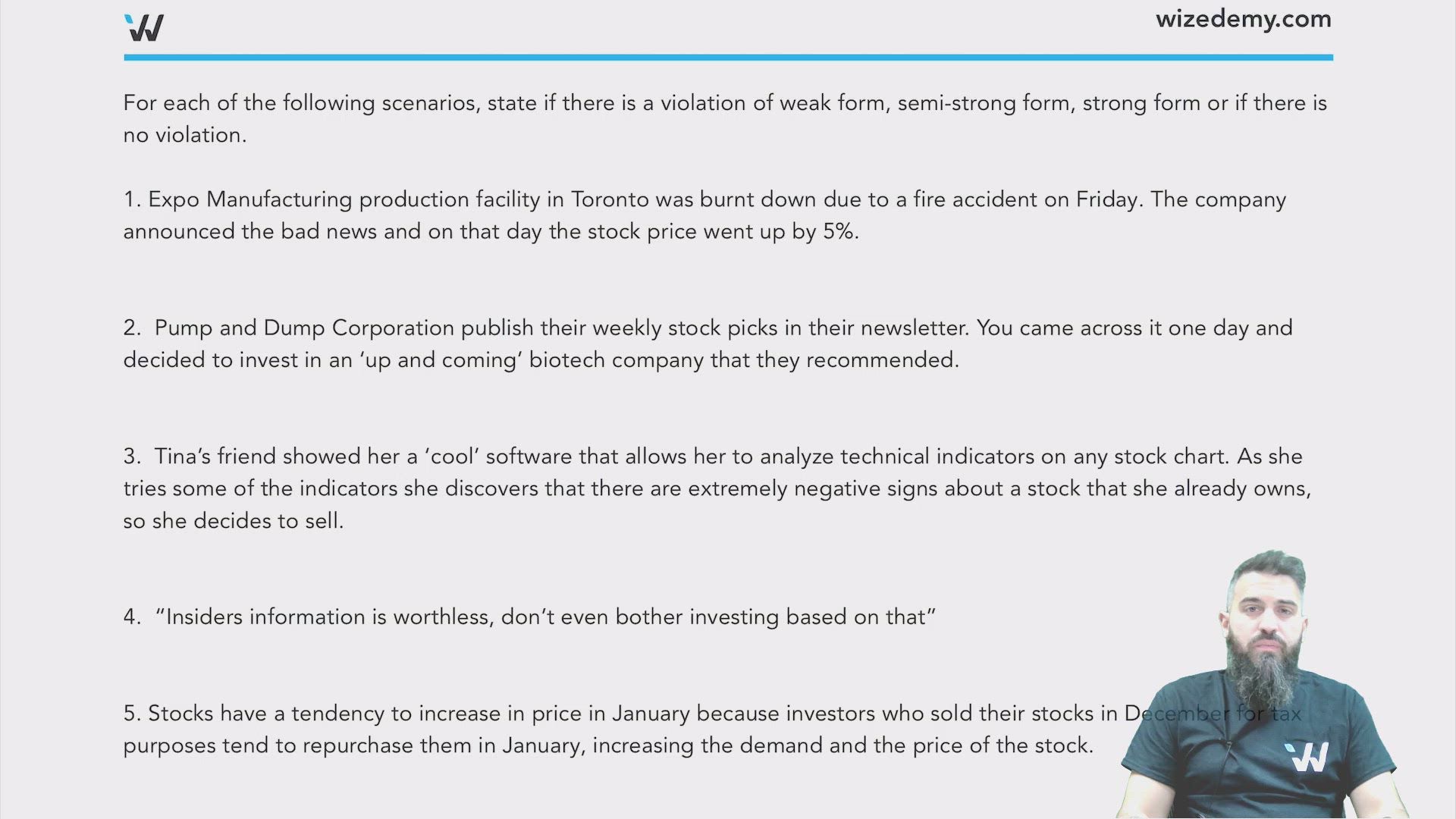
For each of the following scenarios, state if there is a violation of weak form, semi-strong form, strong form, or if there is no violation.
1. Expo Manufacturing production facility in Toronto was burnt down due to a fire accident on Friday. The company announced the bad news and on that day the stock price went up by 5%.
2. Pump and Dump Corporation publish their weekly stock picks in their newsletter. You came across it one day and decided to invest in an ‘up and coming’ biotech company that they recommended.
3. Tina’s friend showed her a ‘cool’ software that allows her to analyze technical indicators on any stock chart. As she tries some of the indicators she discovers that there are extremely negative signs about a stock that she already owns, so she decides to sell.
4. “Insiders information is worthless, don’t even bother investing based on that”
5. Stocks have a tendency to increase in price in January because investors who sold their stocks in December for tax purposes tend to repurchase them in January, increasing the demand and the price of the stock.
Practice: Levels of Market Efficiency
Answer the following multiple choice questions
Which of the following statements is most correct