Popular Courses
COMM 308
Concordia University
Intro to Finance
University Study Guides
Intro to Finance
University Study Guides
FIN 301
University of Alberta
FINC 341
Texas A&M University
COMM 2202
Dalhousie University
BU283
Wilfrid Laurier University
FIN 300
Arizona State University - Tempe
BUSFIN 3220
Ohio State University
FIN 301
Pennsylvania State University
BUS-F 255
Indiana University - Bloomington
FIN 3403
University of Central Florida
FIN 3403
University of Florida
FIN 320
California State University - Fullerton
FINC-UB 7
New York University
BMGT340
University of Maryland - College Park
FINC-UB 2
New York University
BUS1 170
San José State University
BUSM 2021
University of Colorado Boulder
33:390:203
Rutgers University - New Brunswick (Busch)
0:00 / 0:00
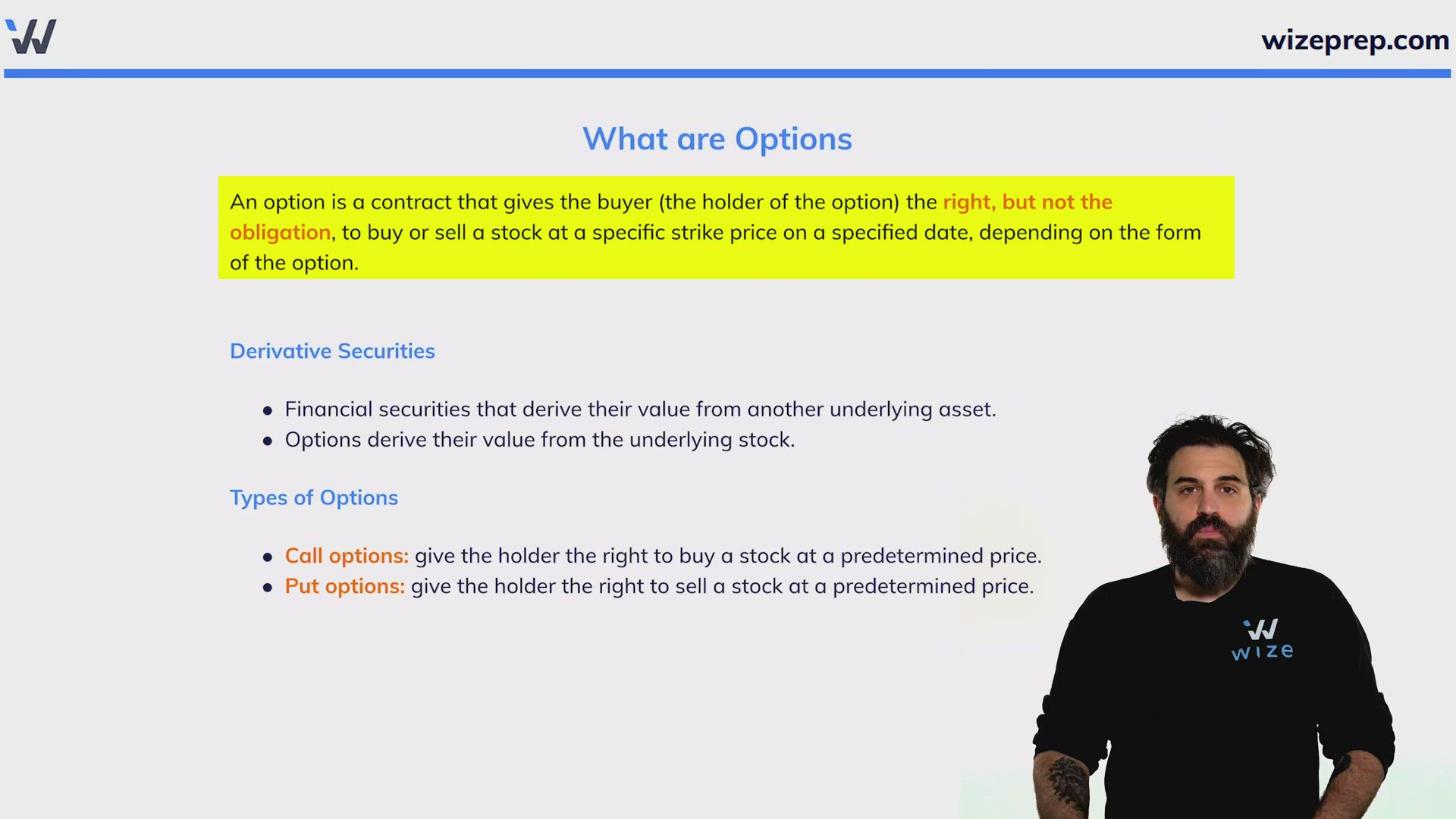
What are Options
An option is a contract that gives the buyer (the holder of the option) the right, but not the obligation, to buy or sell a stock at a specific strike price on a specified date, depending on the form of the option.
Derivative Securities
- Financial securities that derive their value from another underlying asset.
- Options derive their value from the underlying stock.
Types of Options
- Call options: give the holder the right to buy a stock at a predetermined price.
- Put options: give the holder the right to sell a stock at a predetermined price.
Options Terminology
- Strike Price/Exercise Price (X): The predetermined price that the holder of the option can buy or sell the stock for.
- Market Price (S): The current market value of a stock.
- Premium (P): The current market value of the option
- Payoff: The proceeds that would be generated if the stock option is exercised today.
- “In the Money”: The option would generate a payoff if exercised.
- "Out of the money": The option would not generate a payoff if exercised.
- Long Position: Holder (buyer) of the option, can exercise the option on a specified date if profitable.
- Short Position: Issuer (seller, writer) of the option, must sell or purchase the stock on a specified date if the holder exercises it.
- European Options: Can only be exercised at maturity.
- American Options: This can be exercised any time up to and including the expiration date