Wize University Introduction to Finance Textbook > Capital Budgeting
Introduction to Capital Budgeting
Popular Courses
COMM 308
Concordia University
Intro to Finance
University Study Guides
Intro to Finance
University Study Guides
FINA 230
Concordia University
MGCR 341
McGill University
FIN 301
University of Alberta
FIN 300
Toronto Metropolitan University
COMM 121
Queen's University
FIN*2000
University of Guelph
FINC 341
Texas A&M University
COMMERCE 2FA3
McMaster University
COMM 2202
Dalhousie University
FIN 300
Arizona State University - Tempe
BUSFIN 3220
Ohio State University
SB/FINE 2000 3.00
York University
FIN 301
Pennsylvania State University
BUS-F 255
Indiana University - Bloomington
FIN 3403
University of Central Florida
FIN 3403
University of Florida
FIN 320
California State University - Fullerton

0:00 / 0:00
What is Capital Budgeting
Capital budgeting is the process of evaluating potential investments or projects to determine whether or not they should be approved.
Examples of Capital Budgeting Decisions
- Constructing a new factory
- Acquiring or renovating a building
- Expanding business into a new geographic market
0:00 / 0:00
Cost of Capital
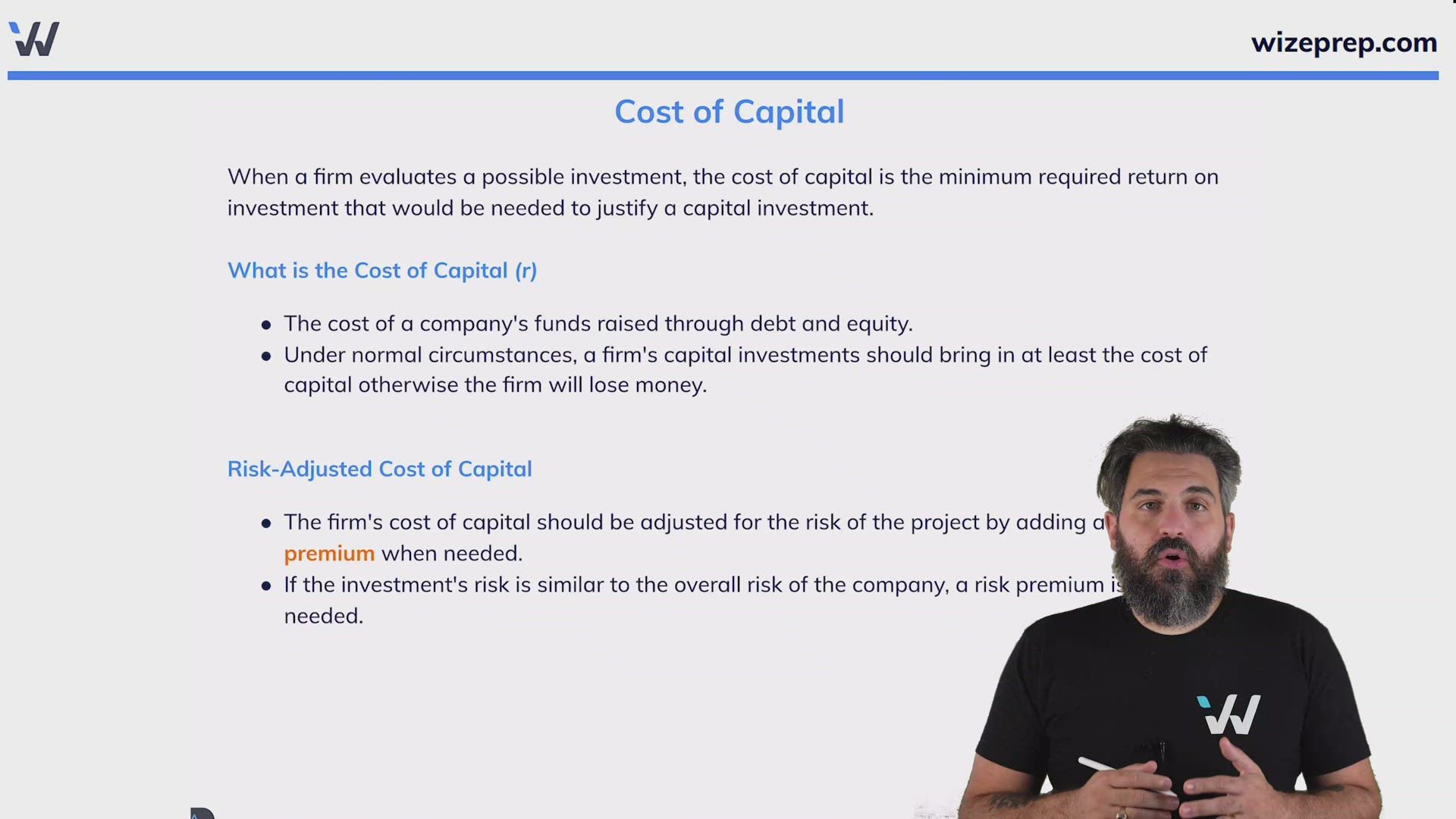
When a firm evaluates a possible investment, the cost of capital is the minimum required return on investment that would be needed to justify a capital investment.
What is the Cost of Capital (r)
- The cost of a company's funds raised through debt and equity.
- Under normal circumstances, a firm's capital investments should bring in at least the cost of capital otherwise the firm will lose money.
Risk-Adjusted Cost of Capital
- The firm's cost of capital should be adjusted for the risk of the project by adding a risk premium when needed.
- If the investment's risk is similar to the overall risk of the company, a risk premium is not needed.