Wize University Introduction to Finance Textbook > Time Value of Money
Effective Rates with Continuous Compounding
Popular Courses
COMM 308
Concordia University
Intro to Finance
University Study Guides
FINA 200
Concordia University
Intro to Finance
University Study Guides
MGCR 341
McGill University
FIN 301
University of Alberta
FIN 300
Toronto Metropolitan University
COMM 121
Queen's University
FIN*2000
University of Guelph
FINC 341
Texas A&M University
COMMERCE 2FA3
McMaster University
COMM 2202
Dalhousie University
BU283
Wilfrid Laurier University
FIN 300
Arizona State University - Tempe
BUSFIN 3220
Ohio State University
SB/FINE 2000 3.00
York University
FIN 301
Pennsylvania State University
BUS-F 255
Indiana University - Bloomington
FIN 3403
University of Central Florida
FIN 3403
University of Florida
0:00 / 0:00
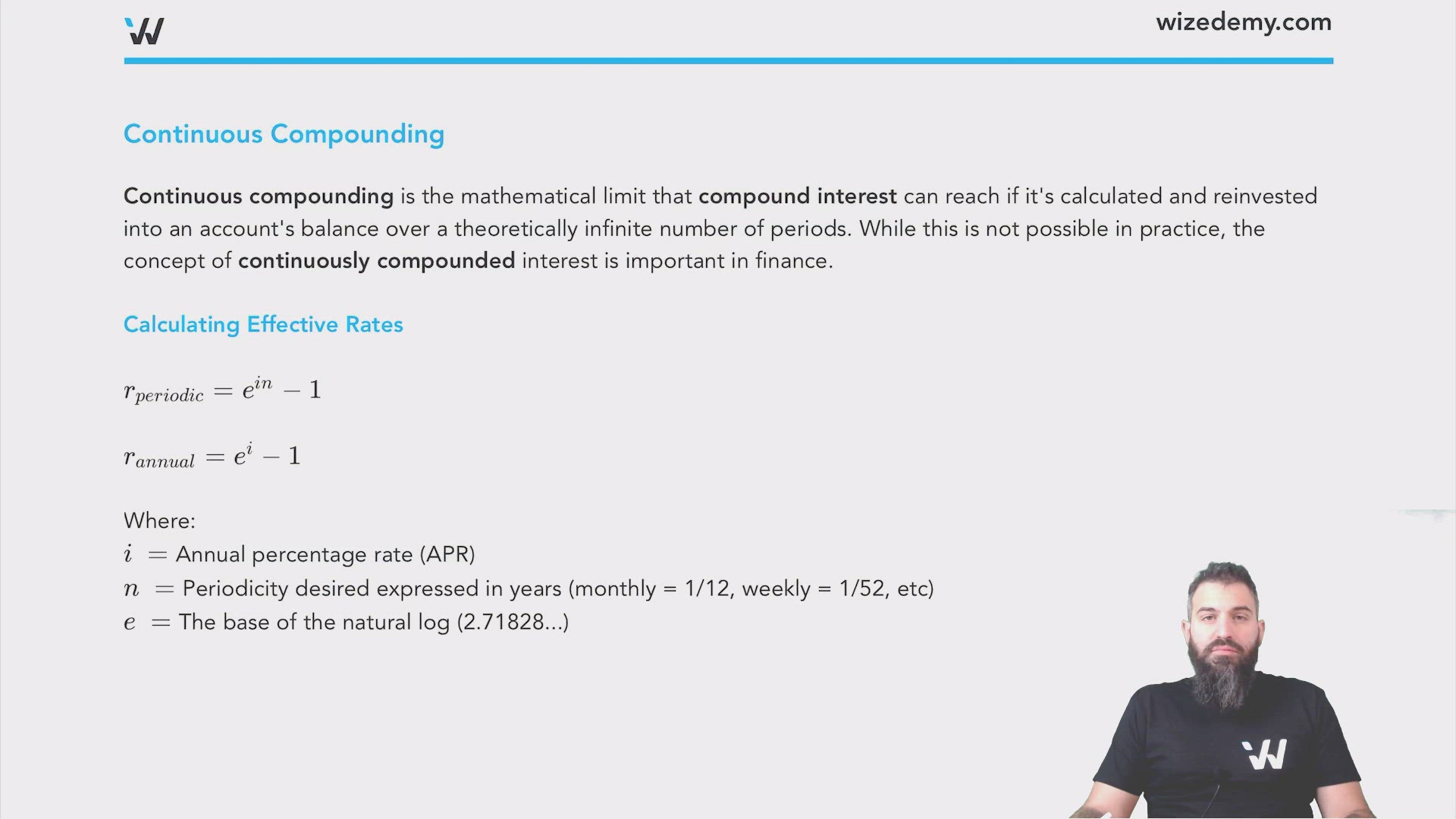
Continuous Compounding
Continuous compounding is the mathematical limit that compound interest can reach if it's calculated and reinvested into an account's balance over a theoretically infinite number of periods. While this is not possible in practice, the concept of continuously compounded interest is important in finance.

Where:
Periodicity desired expressed in years (monthly = 1/12, weekly = 1/52, etc)
The base of the natural log (2.71828...)

0:00 / 0:00
Example: Continuous Compounding
A savings account advertised on Facebook caught your eye because it claims to offer a savings rate of APR 5.2% compounded continuously. Your current account is paying you an effective annual rate of 5.3%, should you switch your savings to the new account?

Mark Yourself Question
- Grab a piece of paper and try this problem yourself.
- When you're done, check the "I have answered this question" box below.
- View the solution and report whether you got it right or wrong.
Practice: Continuous Compounding
You borrowed money from your friend's uncle Rocco. The money was lent under the terms 6% APR compounded continuously, and you intend on making monthly payments over the next few years to pay it off.
What is the interest rate required to compute the payment on your loan?