Wize University Introduction to Finance Textbook > Time Value of Money
Lump Sum Calculations
Popular Courses
COMM 308
Concordia University
Intro to Finance
University Study Guides
FINA 200
Concordia University
Intro to Finance
University Study Guides
FINA 230
Concordia University
MGCR 341
McGill University
FIN 301
University of Alberta
FIN 300
Toronto Metropolitan University
COMM 121
Queen's University
FIN*2000
University of Guelph
FINC 341
Texas A&M University
COMMERCE 2FA3
McMaster University
COMM 2202
Dalhousie University
BU283
Wilfrid Laurier University
FIN 300
Arizona State University - Tempe
BUSFIN 3220
Ohio State University
SB/FINE 2000 3.00
York University
FIN 301
Pennsylvania State University
BUS-F 255
Indiana University - Bloomington
FIN 3403
University of Central Florida

0:00 / 0:00
Lump-Sum Calculations
- A lump sum is a single amount at a specific point in time.
- Lump-sum calculations involve finding the present or future value of single amounts.
- Example: You have $5,000 today, what will this be worth in 7 years?
- Finding the present value of some future value is called discounting.
- Finding the future value of some present value is called compounding.

Wize Concept
The present value (PV) is inversely related to the discount rate (r).
The future value (FV) is positively related to the discount rate (r).
0:00 / 0:00
Example: Future Value of a Lump Sum
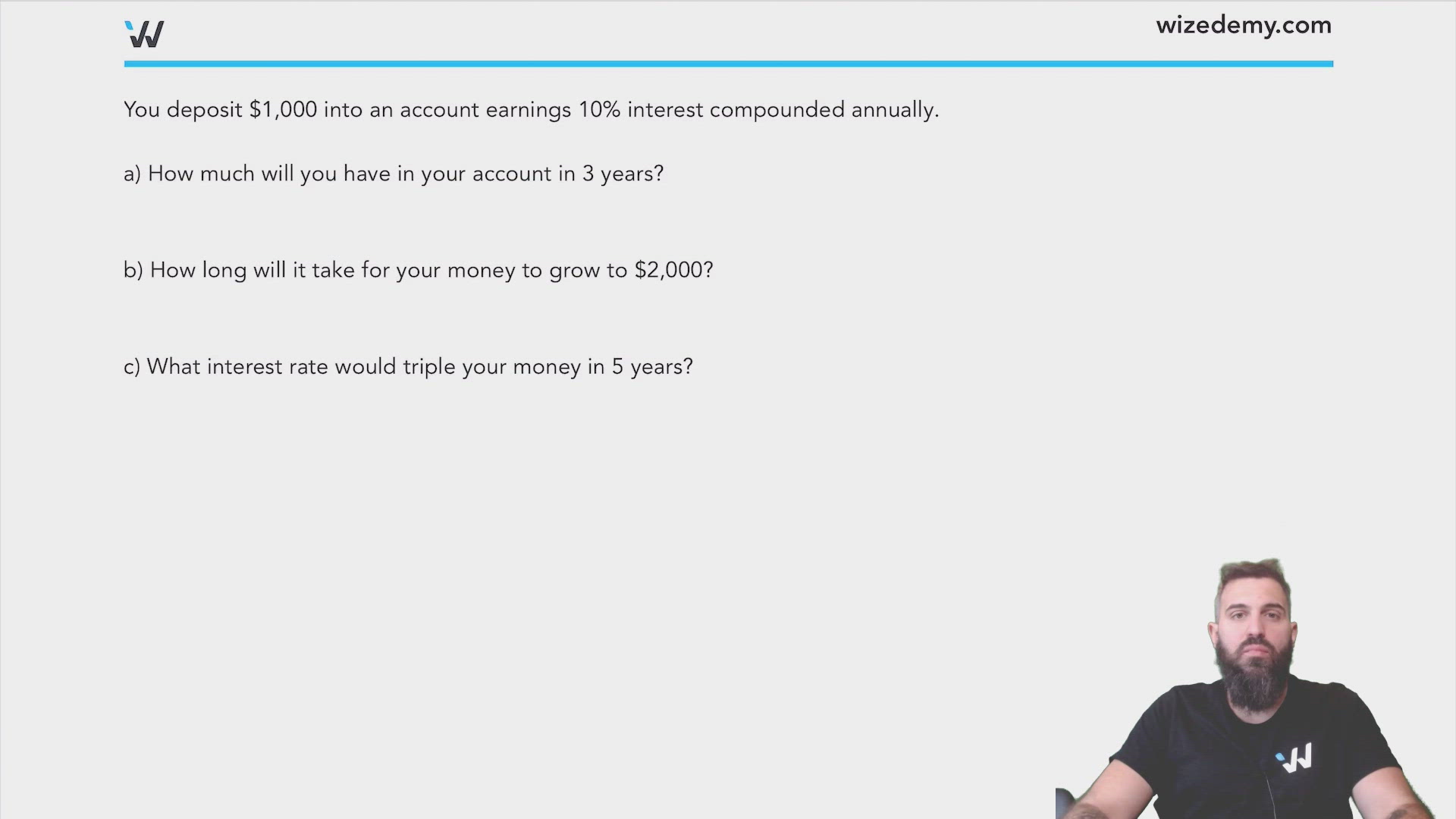
You deposit $1,000 into an account, earning 10% interest compounded annually.
a) How much will you have in your account in 3 years?
b) How long will it take for your money to grow to $2,000?
c) What interest rate would triple your money in 5 years?
Practice: Future Value of a Lump Sum
You deposit $4,000 today at the bank into your earning which earns 6% interest compounded monthly.
Round your answers to 2 decimal places.
0:00 / 0:00
Example: Present Value of a Lump Sum
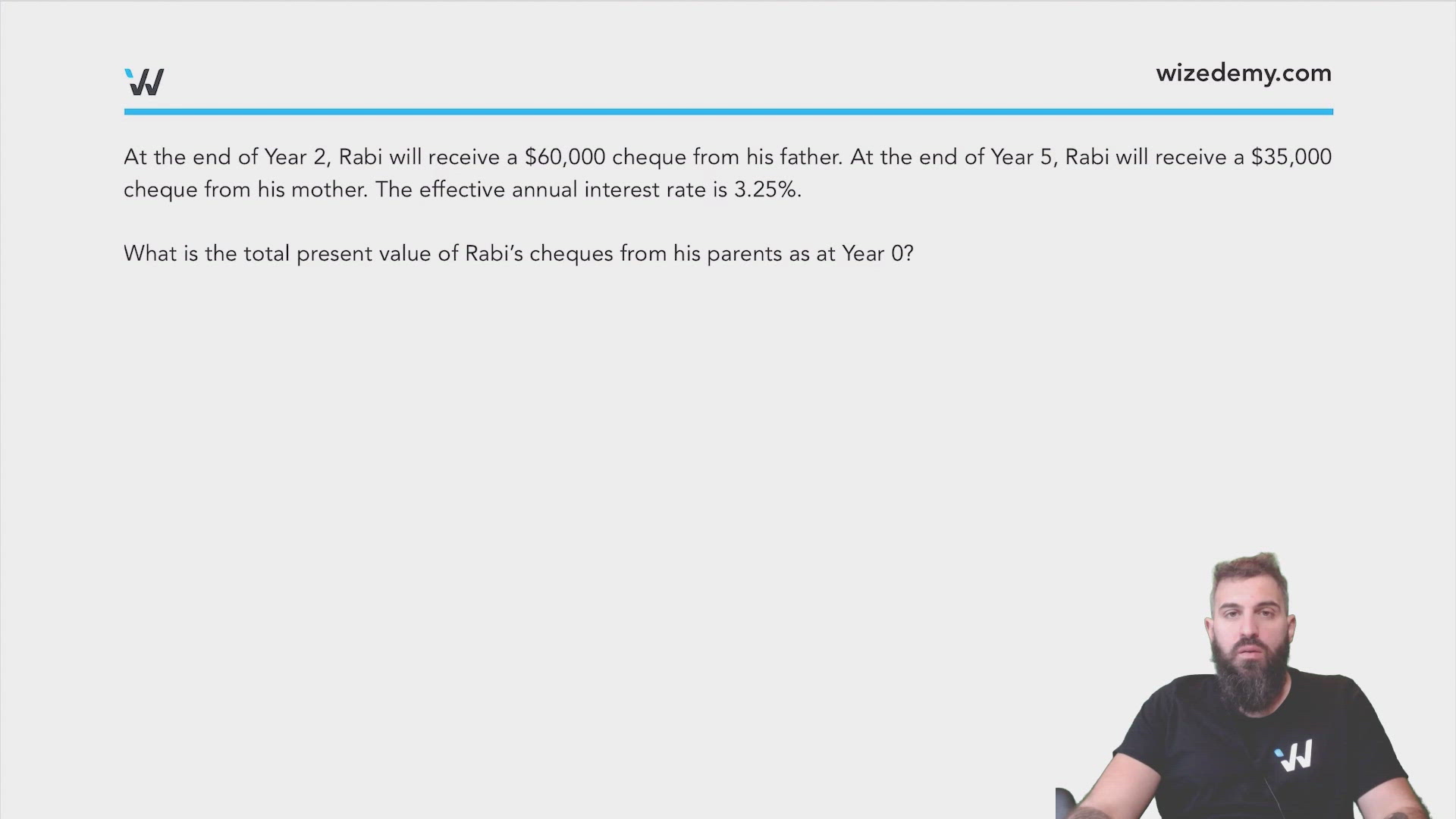
At the end of Year 2, Rabi will receive a $60,000 cheque from his father. At the end of Year 5, Rabi will receive a $35,000 cheque from his mother. The effective annual interest rate is 3.25%.
What is the total present value of Rabi’s cheques from his parents as of Year 0?

Mark Yourself Question
- Grab a piece of paper and try this problem yourself.
- When you're done, check the "I have answered this question" box below.
- View the solution and report whether you got it right or wrong.
Practice: Present Value of a Lump Sum
One night, Sean dreamed that a magic wizard offered him two gift options. The first gift option provides $1,000 in Year 2 and Year 4. The second gift option provides $950 in Year 1 and Year 3.
If Sean’s dream were to be true, which option should he select if the effective annual interest rate is 7.50%?