Wize University Calculus 3 Textbook > Applications of Partial Derivatives
Tangent Planes, Gradient Vectors, and the Normal Line
Popular Courses
MATH 200
University of British Columbia
MATH 253
University of British Columbia
MATH 222
McGill University
MATH 209
University of Alberta
SC/MATH 2015 3.00
York University
MAT 2322
University of Ottawa
MATH 237
University of Waterloo
MAT235Y1
University of Toronto
MAT 2384
University of Ottawa
MATH 200
University of Victoria
MATH 251
Simon Fraser University
MAT237Y1
University of Toronto
MATH 20C
University of California - San Diego
MAT 2122
University of Ottawa
MATH 2214
Virginia Tech
MATH 10C
University of California - San Diego
SC/MATH 2310 3.00
York University
MATH 20E
University of California - San Diego

0:00 / 0:00
Gradient Vectors, Tangent Planes, Normal Lines
Let us look at tangent planes in terms of the gradient vector and the normal line.
Wize Concept
~ The gradient vector is orthogonal to the level curve at the point .
~ The gradient vector is orthogonal to the level curve at the point .
~ The gradient vector is given by
So, the tangent plane to is:
Sometimes, we want a line orthogonal to a surface at a point called the normal line and it is parallel to the gradient vector at the point
Thus, the equation of the normal line is:
Example
Find the tangent plane and the normal line to .
Let
The tangent plane is:
The normal line is:
0:00 / 0:00
Example
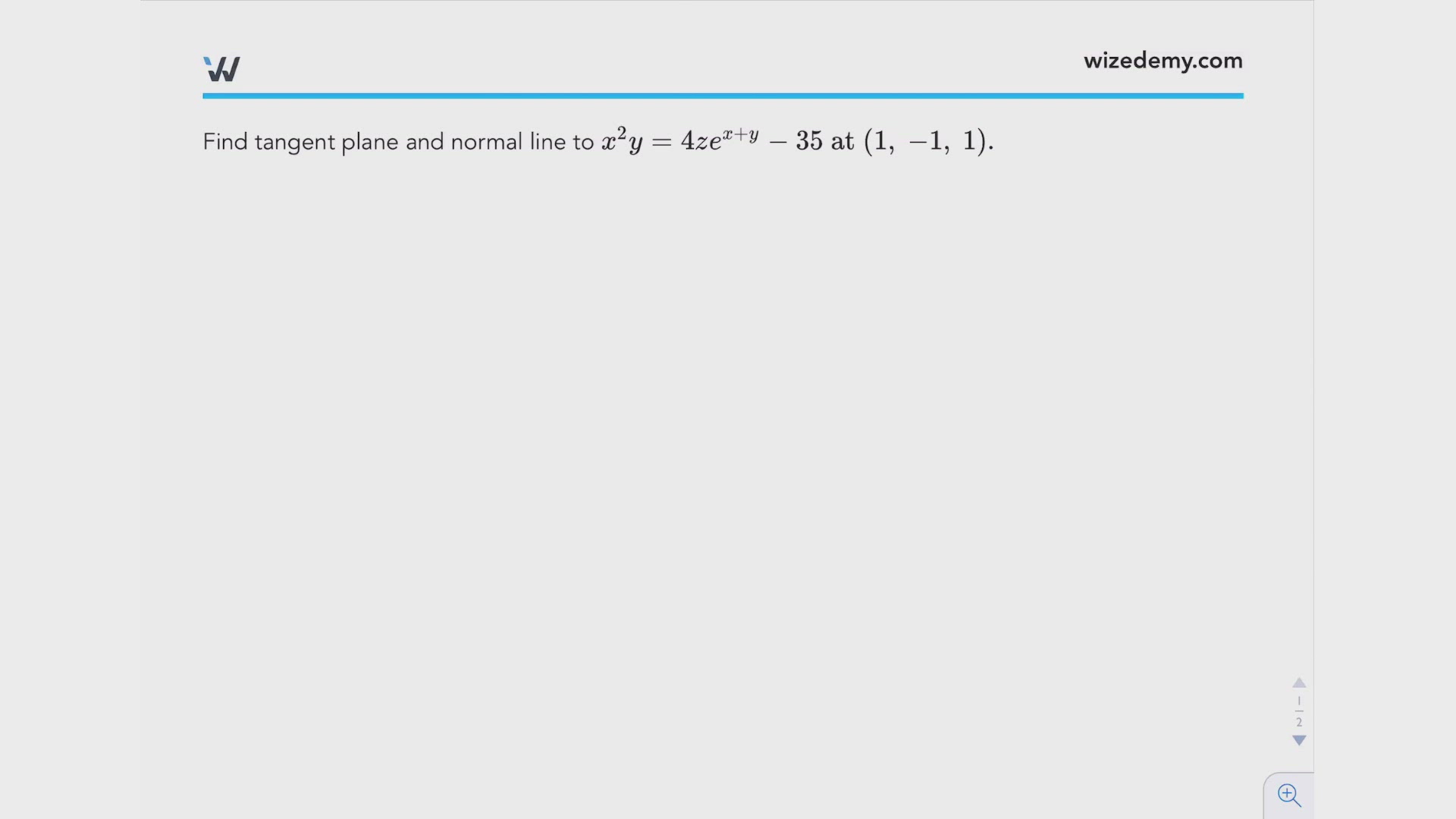
Find tangent plane and normal line to
Let . We need to find
Tangent Plane:
Normal Line:
Practice
An ant is crawling along a flat concrete surface with the temperature of the surface at a point (x, y) given by .
a) At (3, -1), what is the direction of the greatest decrease of the temperature?
b) Find the rate of change of the temperature if the ant crawled from (3, -1) at speed 1 in the direction of the vector