Wize University Calculus 3 Textbook > Applications of Partial Derivatives
Maximum and Minimum Points - Finding Critical Points in Level Curves
Popular Courses
MATH 200
University of British Columbia
MATH 253
University of British Columbia
MAT133Y1
University of Toronto
MATH 222
McGill University
MA129
Wilfrid Laurier University
MATH 209
University of Alberta
SC/MATH 2015 3.00
York University
MAST 218
Concordia University
MAT 2322
University of Ottawa
MATH 237
University of Waterloo
MAT235Y1
University of Toronto
MAT 2384
University of Ottawa
MATH 200
University of Victoria
MATH 136
University of Alberta
MATH 251
Simon Fraser University
MATH 20C
University of California - San Diego
MAT237Y1
University of Toronto
MAT 2122
University of Ottawa
MATH-1524
Virginia Tech
MATH 2214
Virginia Tech
0:00 / 0:00
Maximums, Minimums, and Critical Points
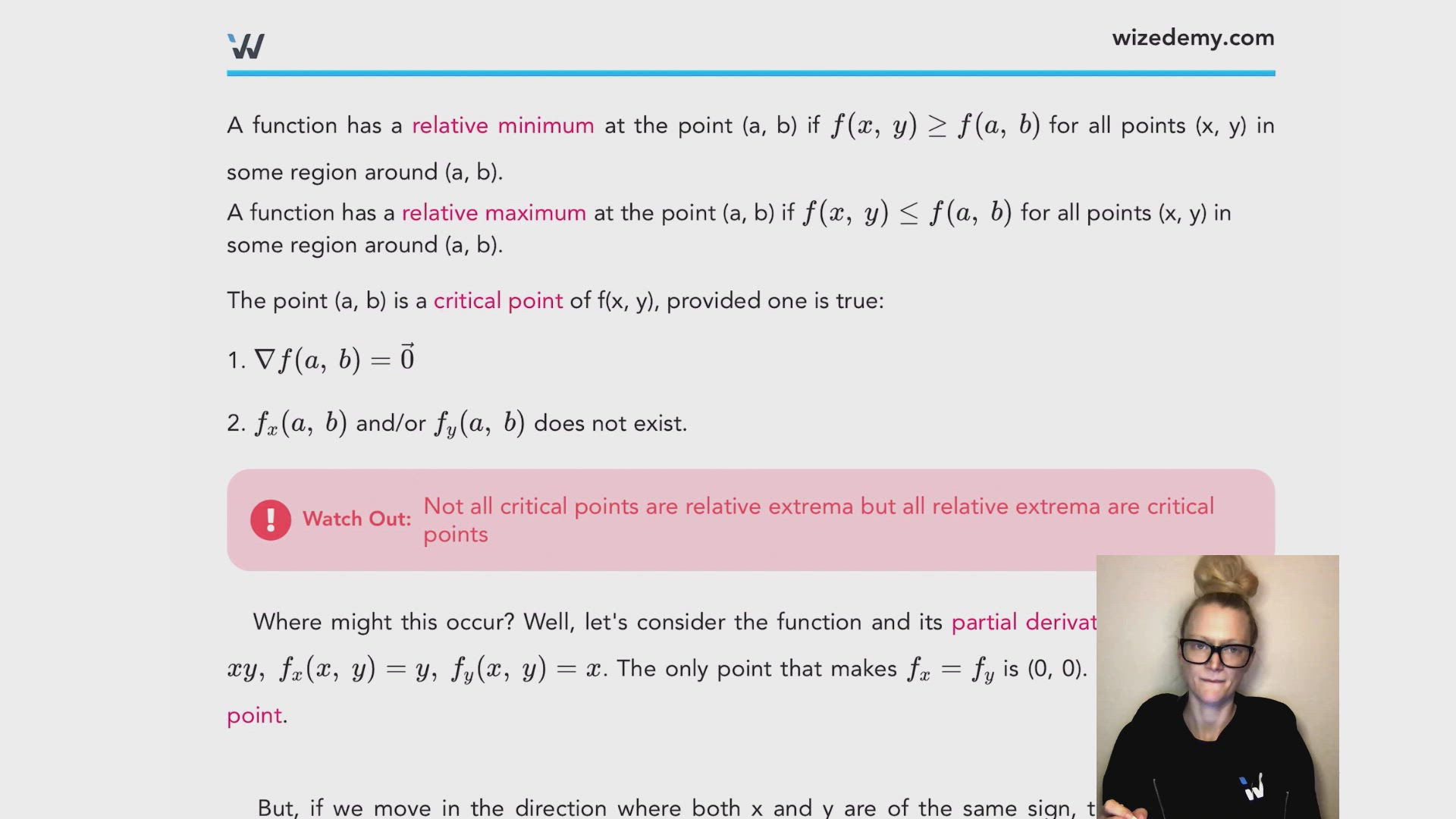
- A function has a relative minimum at the point (a, b) if for all points (x, y) in some region around (a, b).
- A function has a relative maximum at the point (a, b) if for all points (x, y) in some region around (a, b).
- The point (a, b) is a critical point of f(x, y), provided one is true:
- and/or does not exist.
Watch Out!
Not all critical points are relative extrema but all relative extrema are critical points
Classifying Critical Points
Suppose that is a critical point of and that the 2 order partial derivatives are continuous in some region that contains .
Then, the following is used to classify critical points:
- If there is a relative minimum at (a, b).
- If there is a relative maximum at (a, b).
- If then (a, b) is a saddle point.
- If then (a, b) could be a relative maximum, relative minimum, or a saddle point but other techniques will need to be used to classify (a, b).
Level Curves & Gradient Vectors
Critical points can also be classified in the level curves using the gradient vectors.
- Gradient vectors are always orthogonal to level curves.
- Gradients vectors are pointing toward the relative maximum in all directions.
- Gradient vectors are pointing away from relative minimum in all directions.
- For saddle points, gradient vectors are pointing toward the point in some directions and away from the point in other directions.
0:00 / 0:00
Example
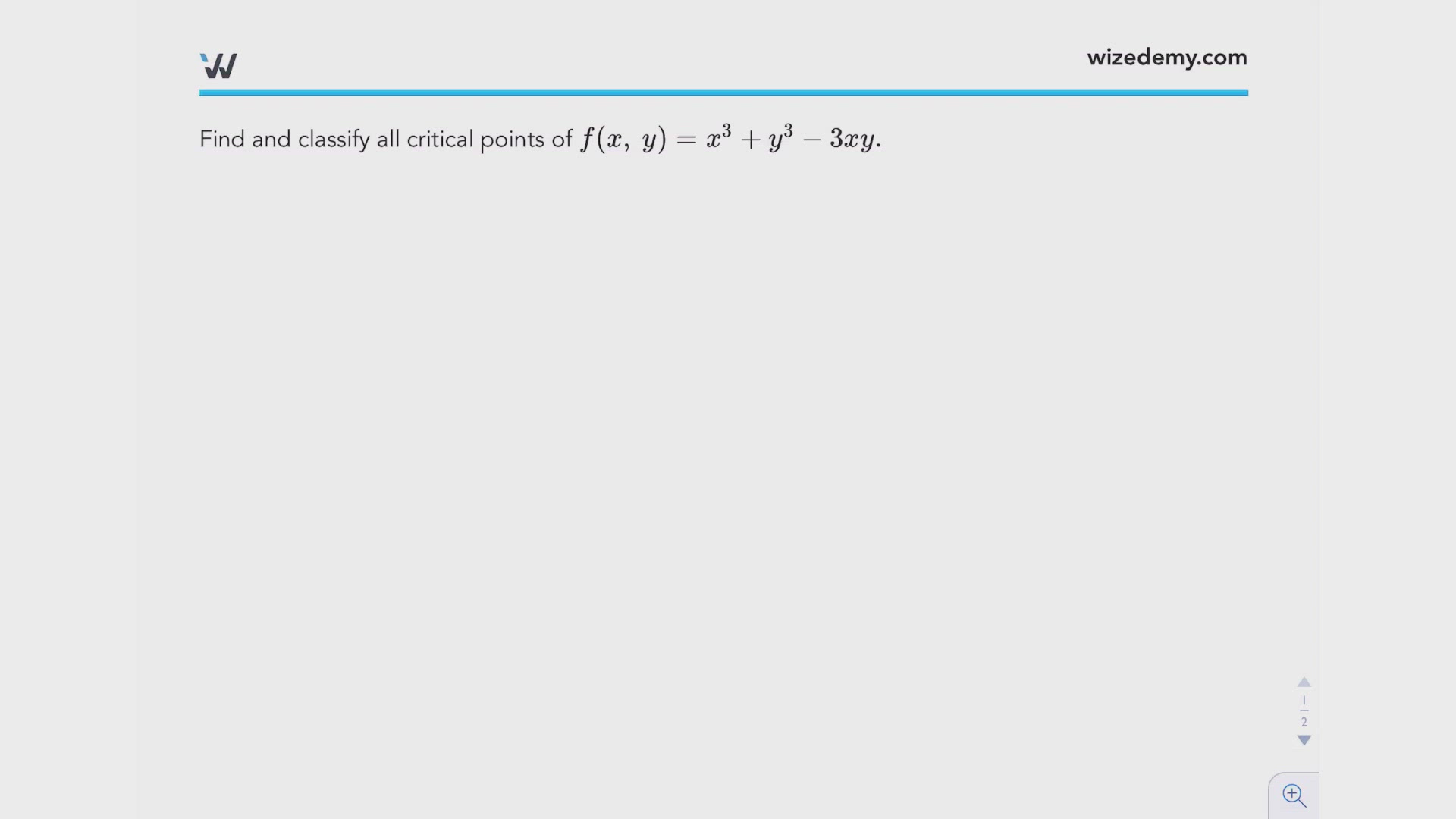
Find and classify all critical points of
Step 1: Find all the first and second order partial derivatives
Step 2: Find the critical points
Step 3: Classify the critical points
0:00 / 0:00
Example
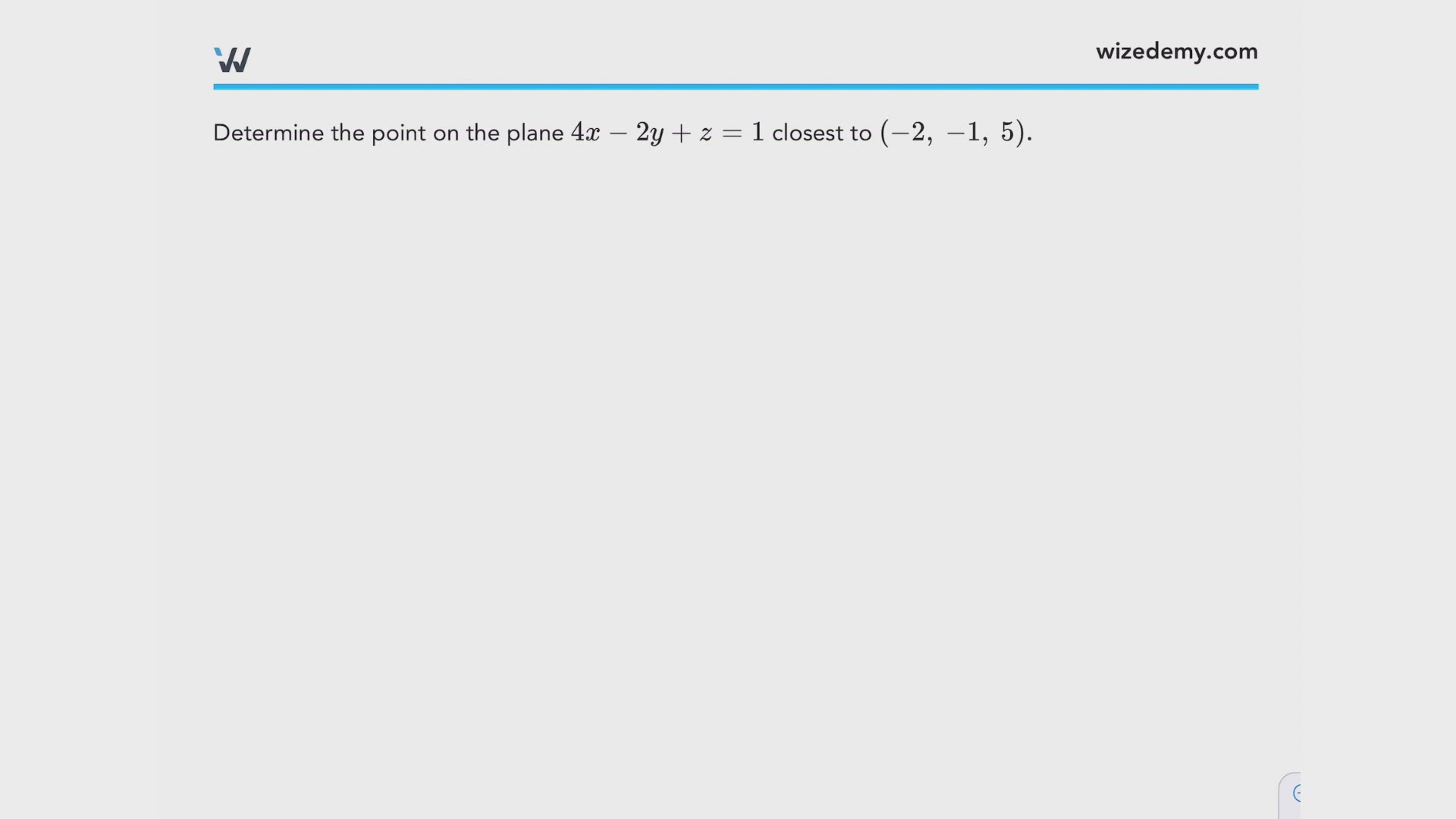
Determine the point on the plane closest to
Let be the point on the plane closest to The distance between them is:
The equation of the plane can be written as:
Substitute the equation of the plane into the formula we have for distance:
Watch Out!
We want the point on the plane closest to (-2, -1, 5), which is not the same thing as a critical point. We will use the critical point to find the point on the plane that we are looking for.
Find the partial derivatives:
Notice that always, which means that any critical point we get will be a relative minimum
Find the critical points:
Ok, so where is our critical point We can substitute the critical point into the equation of the plane find out:
So the point closest is

Mark Yourself Question
- Grab a piece of paper and try this problem yourself.
- When you're done, check the "I have answered this question" box below.
- View the solution and report whether you got it right or wrong.
Practice
Find and classify all the critical points for .
Practice
Determine the point on the plane closest to .