Wize University Calculus 3 Textbook > Applications of Partial Derivatives
Absolute Maximum and Minimum Values
Popular Courses
MATH 200
University of British Columbia
MATH 253
University of British Columbia
MATH 222
McGill University
MA129
Wilfrid Laurier University
MATH 209
University of Alberta
SC/MATH 2015 3.00
York University
MAT 2322
University of Ottawa
MATH 237
University of Waterloo
MAT235Y1
University of Toronto
MAT 2384
University of Ottawa
MATH 200
University of Victoria
MATH 136
University of Alberta
MATH 251
Simon Fraser University
MAT237Y1
University of Toronto
MATH 20C
University of California - San Diego
MAT 2122
University of Ottawa
MATH 2214
Virginia Tech
MATH 10C
University of California - San Diego
SC/MATH 2310 3.00
York University
MATH 20E
University of California - San Diego
0:00 / 0:00
Absolute Max and Min
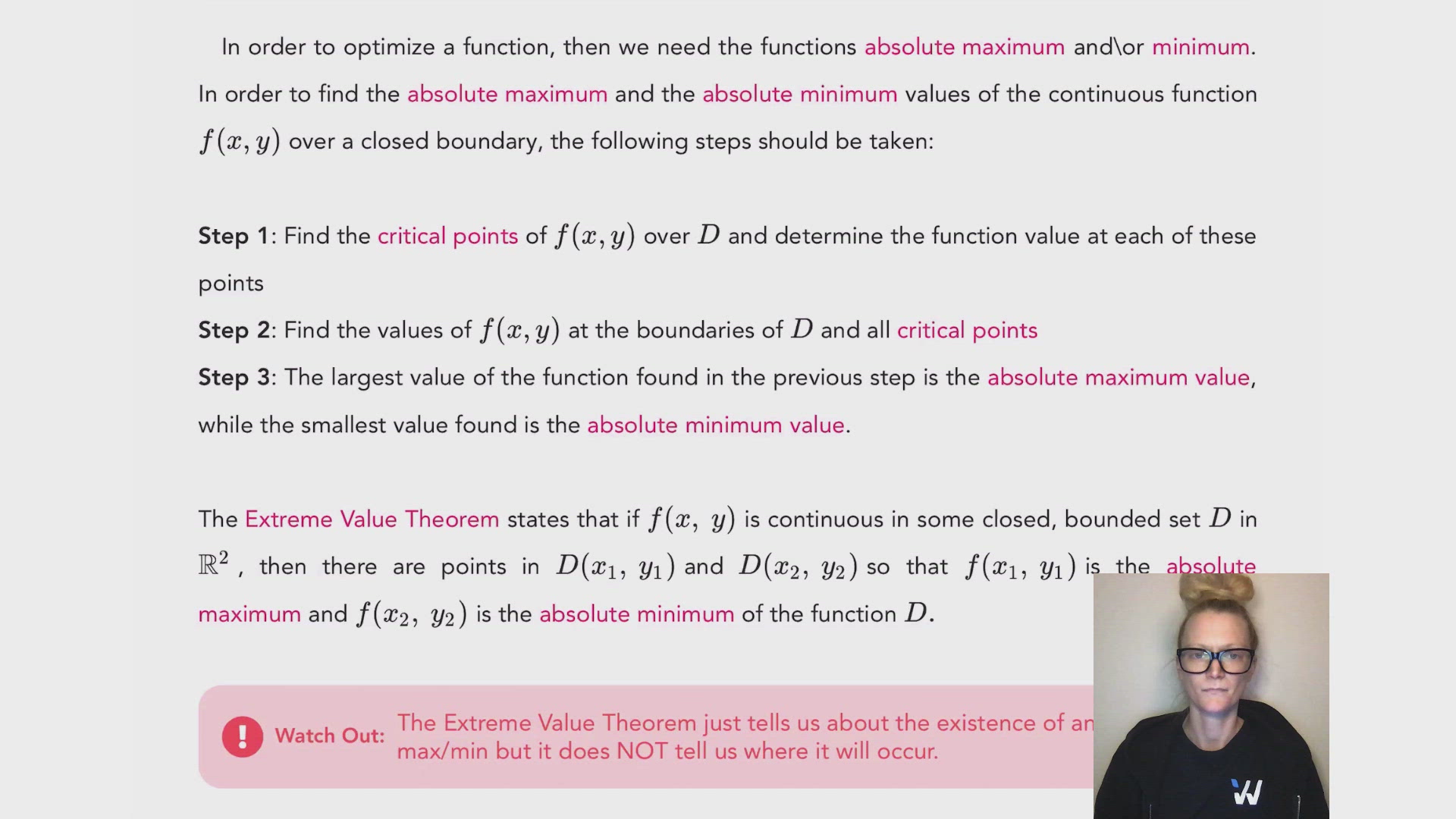
In order to optimize a function, we need the functions absolute maximum and\or minimum.
In order to find the absolute maximum/minimum values of the continuous function over a closed boundary, the following steps should be taken:
Step 1
Find the critical points of over and determine the function value at each of these points
Step 2
Find the values of at the boundaries of and all critical points
Step 3
The largest value of the function found in the previous step is the absolute maximum value, while the smallest value found is the absolute minimum value.
The Extreme Value Theorem
The Extreme Value Theorem states that if is continuous in some closed, bounded set in , then there are points in and so that is the absolute maximum and is the absolute minimum of the function
Wize Tip
The Extreme Value Theorem just tells us about the existence of an absolute max/min but it does NOT tell us where it will occur.
0:00 / 0:00
Example
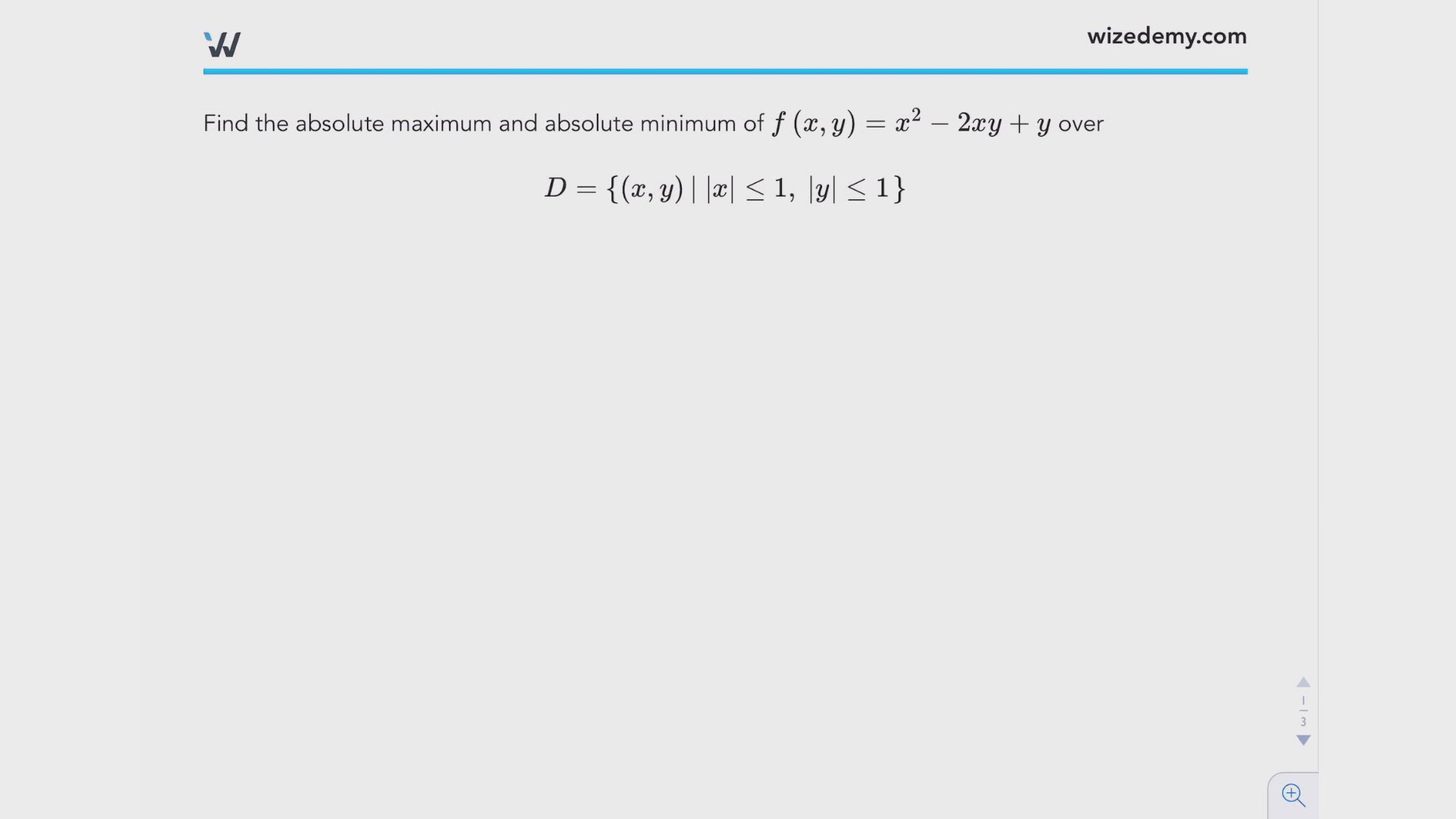
Find the absolute maximum and absolute minimum of over
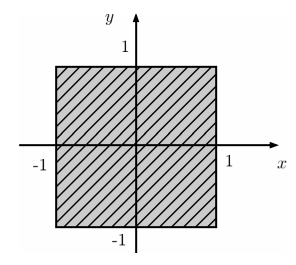
Let's find critical points
critical point it's inside domain
(eq. 1)
Now we have to look at max & min points on each boundary line!
Right:
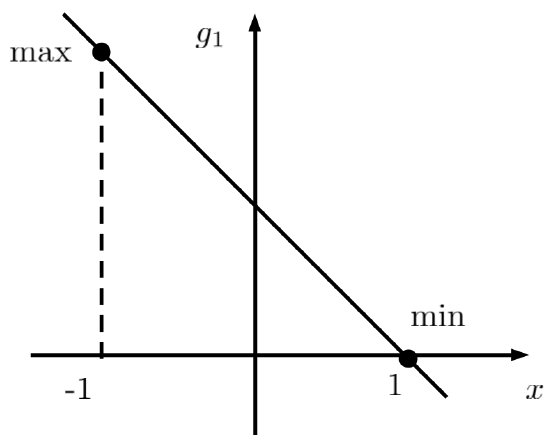
(eq. 2)
(eq. 3)
Left:
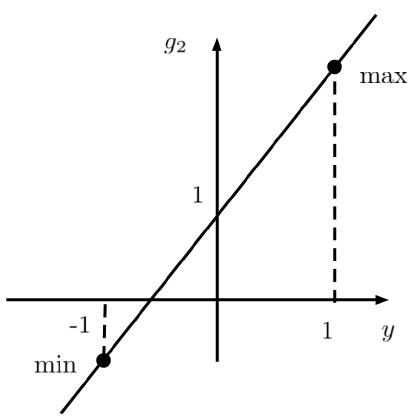
(eq. 4)
(eq. 5)
Up:
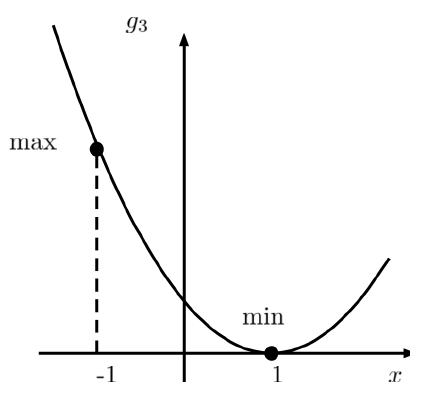
Down:
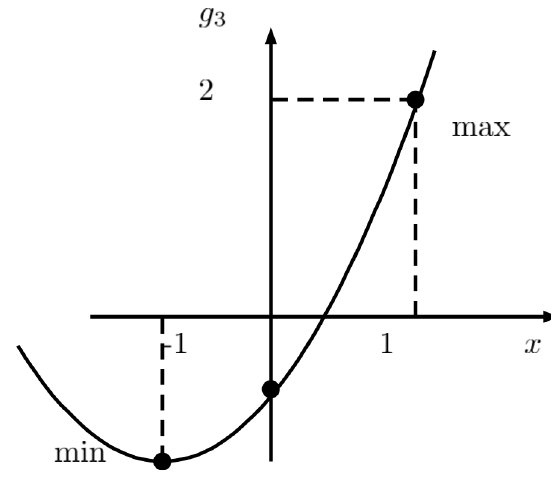
from equation (1) to (5):
0:00 / 0:00
Example
Find the absolute maximum and minimum of on the domain
The domain is given by the following:
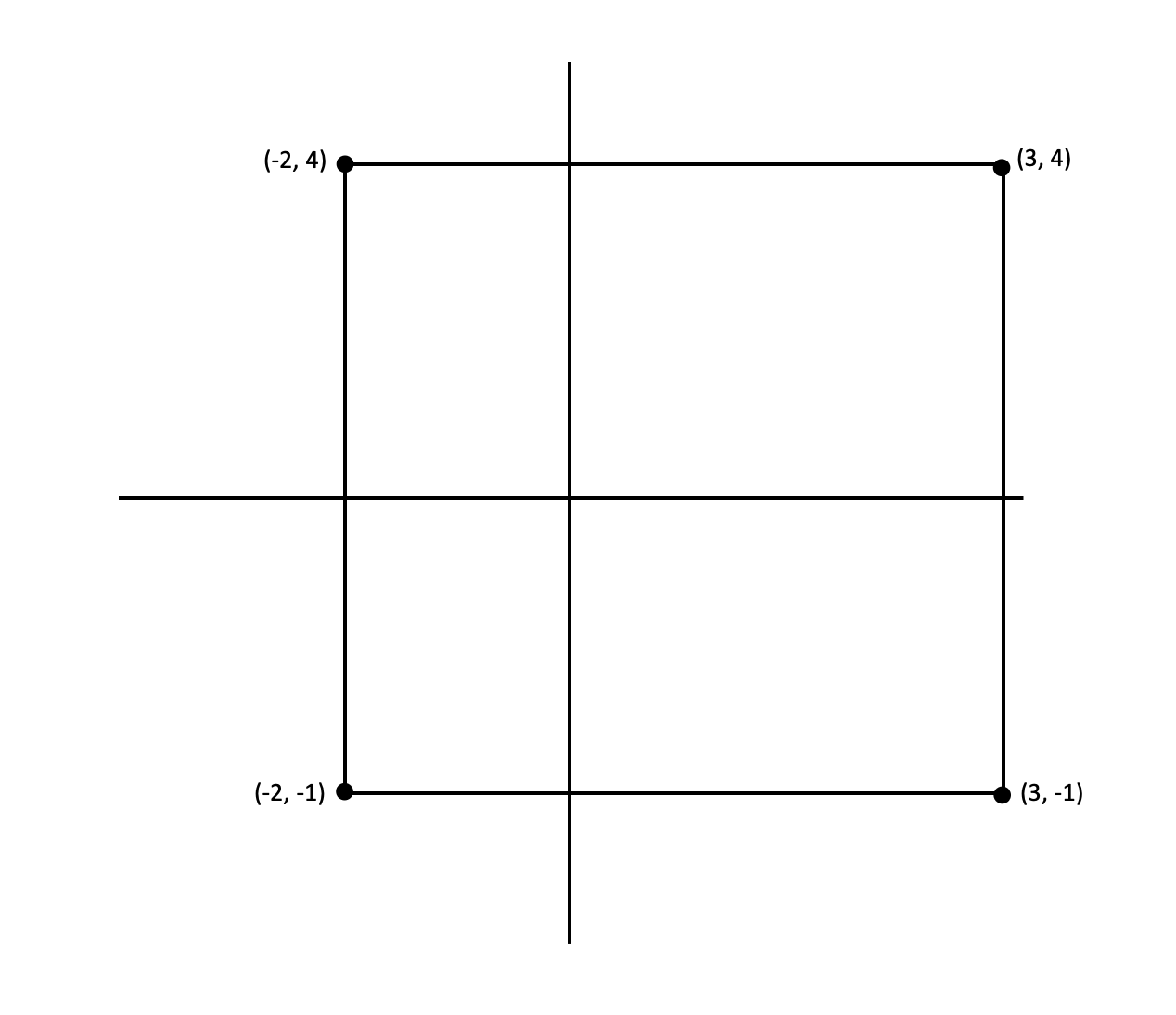
So, let's first find the critical points:
Let us test to see if these critical points lie in the domain:
The critical points, are in the domain.
Now, we need to check the boundaries:
1.
The point (0, 4) is in the domain. Thus,
We also test the vertex points:
2.
The point (0, -1) is in the domain. Thus,
We also text the vertex points:
3.
4.
Thus, the absolute maximum is and the absolute minimum is
Practice
a) Find the complete list of points where the absolute maximum/minimum of on the triangle with vertices could occur.
b) Find the absolute maximum and minimum of on the triangle with vertices

Mark Yourself Question
- Grab a piece of paper and try this problem yourself.
- When you're done, check the "I have answered this question" box below.
- View the solution and report whether you got it right or wrong.
a) Find the complete list of points where the absolute maximum/minimum of on the triangle with vertices could occur.