Wize University Calculus 3 Textbook > Multiple Integrals
Double Integrals over Rectangular Regions
Popular Courses
MATH 200
University of British Columbia
MATH 253
University of British Columbia
MATH 222
McGill University
MATH 262
McGill University
MATH 156
University of Alberta
MATH 209
University of Alberta
SC/MATH 2015 3.00
York University
MAT 2322
University of Ottawa
MATH 237
University of Waterloo
MAT235Y1
University of Toronto
MAT 2384
University of Ottawa
MATH 200
University of Victoria
MATH 251
Simon Fraser University
MATH 20C
University of California - San Diego
MAT237Y1
University of Toronto
MAT 2122
University of Ottawa
MATH 2214
Virginia Tech
MATH 10C
University of California - San Diego
SC/MATH 2310 3.00
York University
MATH 20E
University of California - San Diego

0:00 / 0:00
Double Integrals over Rectangular Regions
The Definite Integral
- The definite integral for a function represents the area under a curve bounded by the region , the y-axis, and , where .
- The definite integral for a function z = f(x, y) represents the volume of a solid that lies below f(x, y) and above a region D in the XY-plane, where D is defined as
Therefore, we can say that the volume under a function f(x, y) over a rectangular area is and can be expressed as:
where f(x, y) is integrable over D if the limit exists.
Fubini's Theorem: If is continuous over the rectangular region , then:
Wize Concept
To perform double integrals, we follow a similar procedure we had for partial derivatives:
i) To solve double integral with respect to , all terms containing is treated to be constant.
ii) To solve double integral with respect to , all terms containing is treated to be constant.
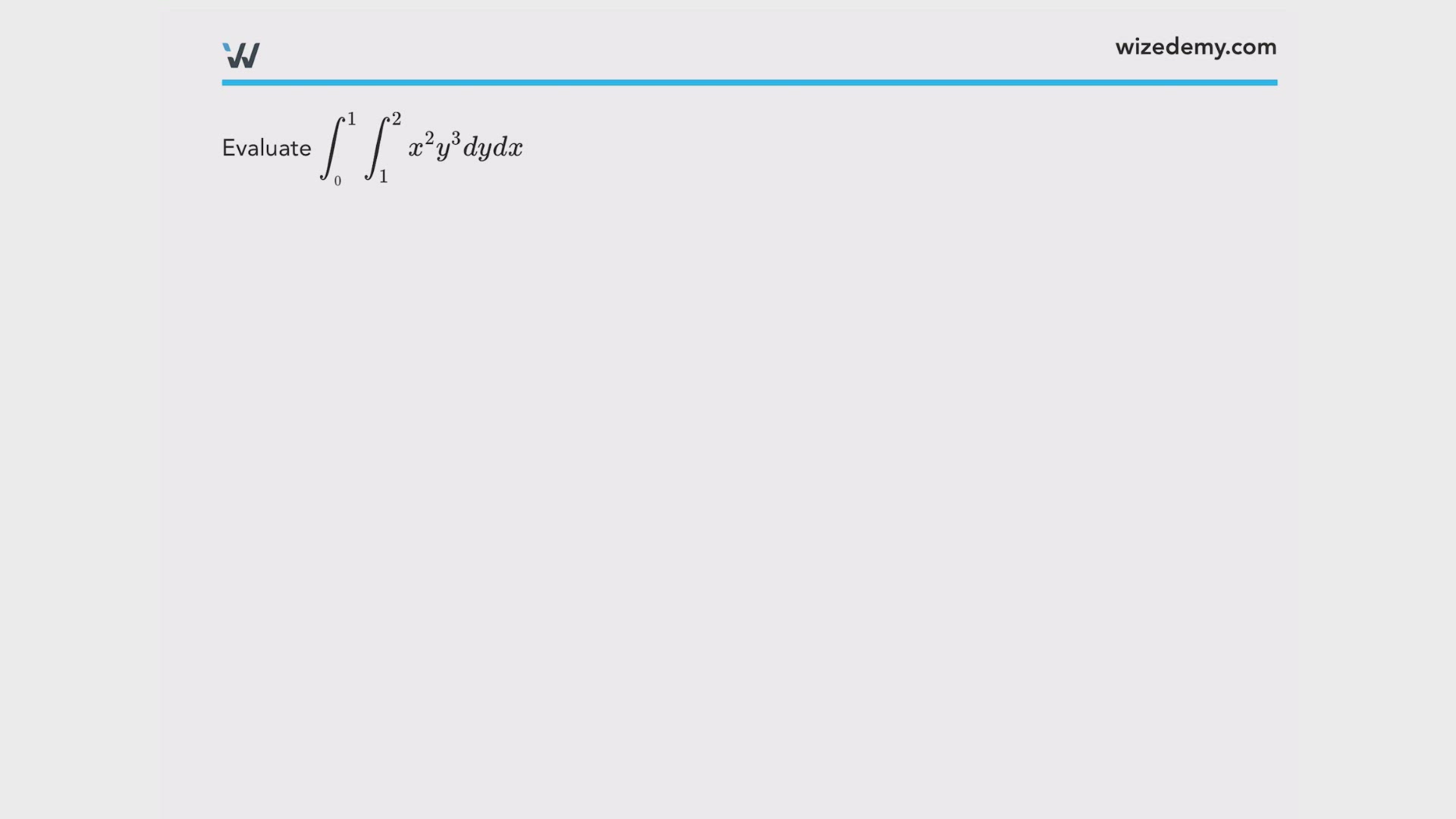
0:00 / 0:00
Evaluate

0:00 / 0:00
Compute
First, integrate with respect to y using substituion.
Let . Then:
Let . Then:

Mark Yourself Question
- Grab a piece of paper and try this problem yourself.
- When you're done, check the "I have answered this question" box below.
- View the solution and report whether you got it right or wrong.
Determine the volume that lies under and above the rectangle R: [-2, 3] x [-1, 1].