0:00 / 0:00
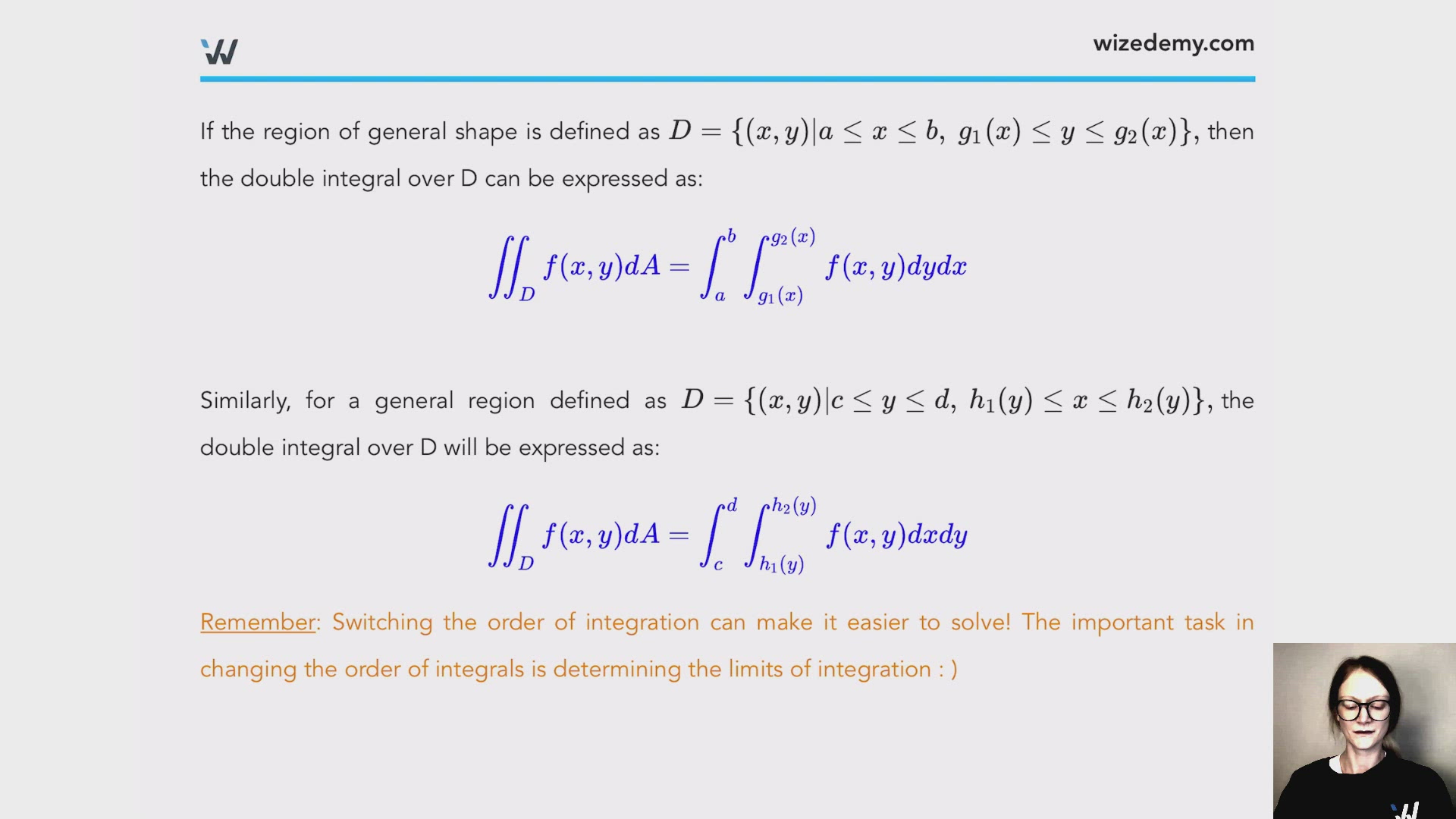
If the region of general shape is defined as D={(x,y)∣a≤x≤b, g1(x)≤y≤g2(x)}, D=\{(x,y)|a\le x\le b,\ g_1(x)\le y\le g_2(x)\},~then the double integral over D can be expressed as:
∬Df(x,y)dA=∫ab∫g1(x)g2(x)f(x,y)dydx\color{blue}\iint_Df(x,y)dA=\int_a^b\int_{g_1(x)}^{g_2(x)}f(x,y)dydx

Similarly, for a general region defined as D={(x,y)∣c≤y≤d, h1(y)≤x≤h2(y)}, D = \{(x,y)| c \le y \le d,\ h_1(y) \le x \le h_2(y)\},~the double integral over D will be expressed as:
∬Df(x,y)dA=∫cd∫h1(y)h2(y)f(x,y)dxdy\color{blue}\iint_Df(x,y)dA=\int_c^d\int_{h_1(y)}^{h_2(y)}f(x,y)dxdy
Remember: Switching the order of integration can make it easier to solve! The important task in changing the order of integrals is determining the limits of integration : )
0:00 / 0:00
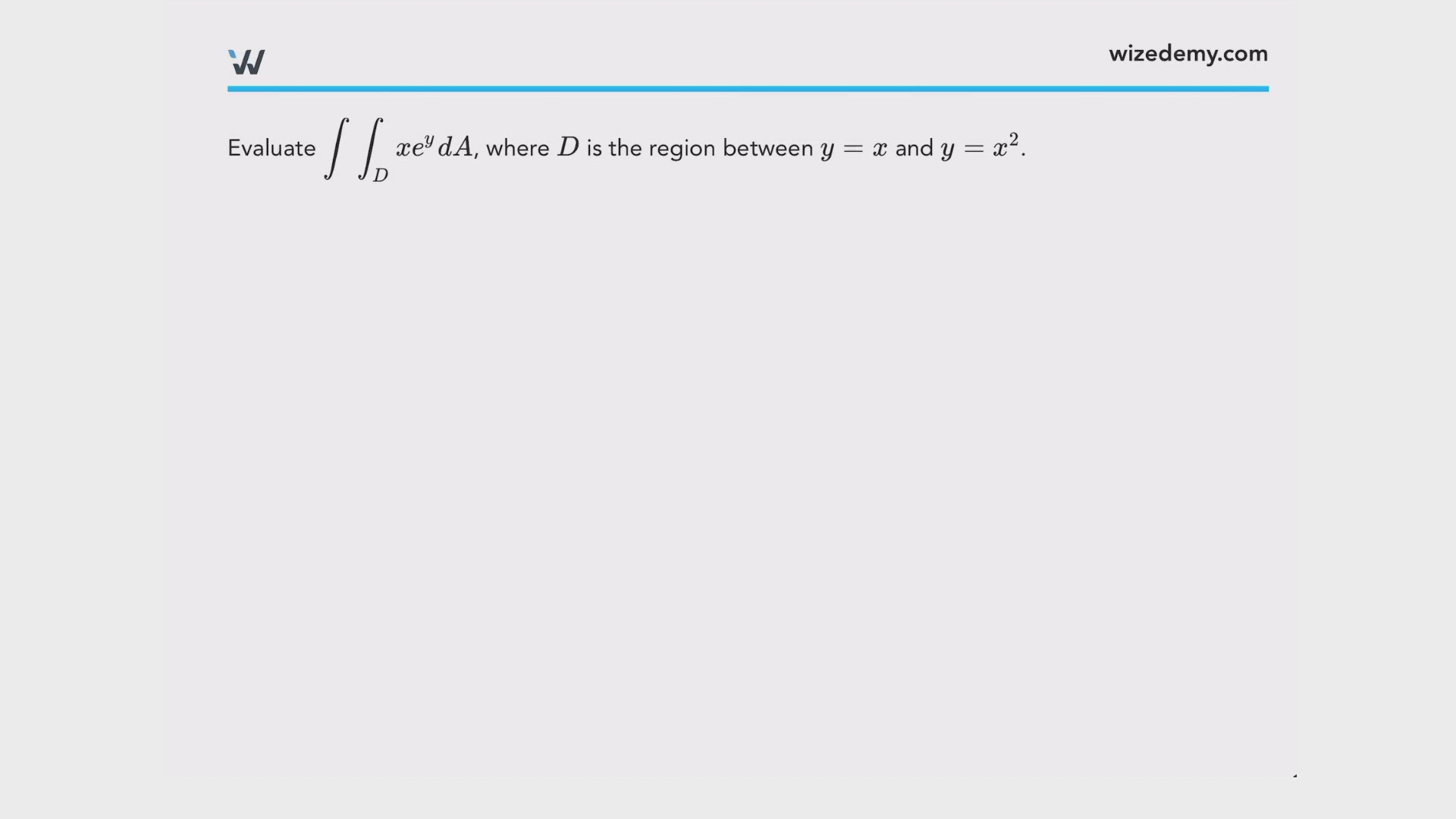
Evaluate ∫∫DxeydA\displaystyle\int_{ }^{ }\int_D^{ }xe^ydA, where D is the region between y=xy=x and y=x2y=x^2.
I=∫01∫x2xxey dydx    =∫01x dx∫x2xey dy   =∫01x dx(ey∣x2x)            =∫01x dx ⋅ [ex − ex2]                 =∫01xex dx − ∫01xex2 dx                      A                     BI=\displaystyle\int_0^1\int_{x^2}^{x}xe^y~dydx\newline{}\newline{} ~~~~ =\int_0^1x~dx\int_{x^2}^{x}e^y~dy\newline{}\newline{} ~~~ =\int_0^1x~dx\Bigg(e^y\Bigg|_{x^2}^x\Bigg)\newline{}\newline{} ~~~~~~~~~~~~ =\int_0^1x~dx~\cdot~\Big[e^{x}~-~e^{x^2}\Big]\newline{}\newline{} ~~~~~~~~~~~~~~~~~ =\int_0^1xe^x~dx~-~\int_0^1xe^{x^2}~dx\newline{} ~~~~~~~~~~~~~~~~~~~~~~{\scriptsize\color{magenta}A}~~~~~~~~~~~~~~~~~~~~~ {\scriptsize\color{magenta}B}
Let A \color{magenta}A~be integrated by parts and let B \color{magenta}B~be integrated with substitution:
A‾:B‾:∫01xex dx = xex∣01 − ∫01ex dx        ∫01xex2 dx =                      Let u=x2. Then, du2=xdx=e − (ex)∣01= 12∫01eu du                    =e − (e − 1)=12(ex2)∣01                     =1                 =12(e−1)                      \begin{array}{c|c} {\color{magenta}\underline{A}:} & {\color{magenta}\underline{B}:} \\\\ \displaystyle\int_0^1xe^x~dx~=~xe^x\Big|_0^1~-~\int_0^1e^x~dx~~~~~~&~~\displaystyle\int_0^1xe^{x^2}~dx~=~~~~~~~~~~~~~~~~~~~~~~{\scriptsize\color{magenta}Let~u=x^2.~Then,~\frac{du}{2}=xdx}\\\\ =e~-~(e^x)\bigg|_0^1 &=~\frac{1}{2}\displaystyle\int_0^1e^u~du~~~~~~~~~~~~~~~~~\\\\~~~=e~-~(e~-~1)&=\frac{1}{2}\Big(e^{x^2} \Big)\Big|_{0}^{1}~~~~~~~~~~~~~~~~~~~~~\\\\=1~~~~~~~~~~~~~~~~~&=\frac{1}{2}(e-1)~~~~~~~~~~~~~~~~~~~~~~ \end{array}
Then,
I=A−B             =1−12(e−1)=32−12eI=A-B \newline{}~~~~~~~~~~~~~=1-\frac{1}{2}(e-1)\newline{}\newline{} =\frac{3}{2}-\frac{1}{2}e

0:00 / 0:00
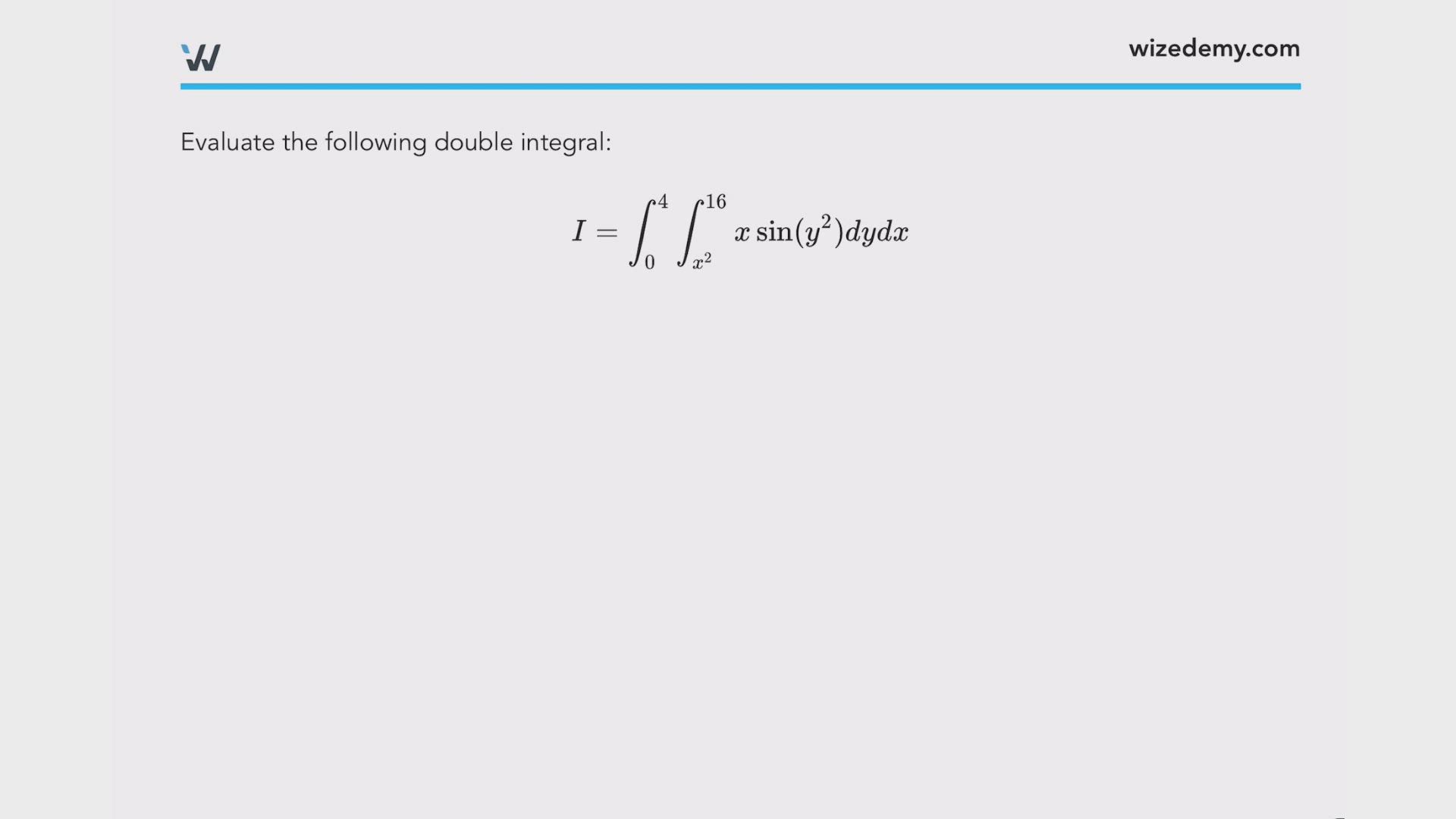
Evaluate the following double integral:
I=∫04∫x216xsin⁡(y2)dydxI=\int_0^4\int_{x^2}^{16}x\sin(y^2)dydx

I=∫04∫x216xsin⁡(y2)dydx\displaystyle I=\int_0^4\int_{x^2}^{16}x\sin(y^2)dydx

Change the order of integration to become:
original ordernew order0≤x≤4⇒0≤y≤16x2≤y≤160≤x≤y\begin{array}{ccc} \textrm{original order}&&\textrm{new order}\\ 0\leq x\leq4&\Rightarrow&0\leq y\leq16\\ x^2\leq y\leq 16&&0\leq x\leq \sqrt{y} \end{array}
Then:
I=∫016∫0yxsin⁡(y2)dxdy     =∫016sin⁡(y2)dy ⋅(x22)∣0y           =∫016sin⁡(y2)dy ⋅(y22 − 0)                                    =12∫016ysin⁡(y2) dy          Let u=y2. Then, du2=ydy=12∫016du2 ⋅ sin⁡u         =14(−cos⁡u)∣y=0y=16            =14(−cos⁡(y2))∣016                     =14(−cos⁡(162) − (−cos⁡02))=14(1−cos⁡(162))          I=\displaystyle\int_0^{16}\int_{0}^{\sqrt{y}}x\sin(y^2)dxdy\newline{}\newline{} ~~~~~ =\int_0^{16}\sin(y^2)dy~\cdot\Bigg(\frac{x^2}{2}\Bigg)\Bigg|_0^{\sqrt{y}}\newline{}\newline{} ~~~~~~~~~~~ =\int_0^{16}\sin(y^2)dy~\cdot\Bigg(\frac{{\sqrt{y}}^2}{2}~-~0\Bigg)\newline{}\newline{} ~~~~~~~~~~~~~~~~~~~~~~~~~~~~~~~~~~~~ =\frac{1}{2}\int_0^{16}y\sin(y^2)~dy {\scriptsize\color{magenta}~~~~~~~~~~Let~u=y^2.~Then,~\frac{du}{2}=ydy}\newline{}\newline{} =\frac{1}{2}\int_0^{16}\frac{du}{2}~\cdot~\sin{u}~~~~~~~~~\newline{}\newline{} =\frac{1}{4}(-\cos{u})\Big|_{y=0}^{y=16}~~~~~~~~~~~~\newline{}\newline{} =\frac{1}{4}\Big(-\cos(y^2)\Big)\Big|_0^{16}~~~~~~~~~\newline{}\newline{} ~~~~~~~~~~~~ =\frac{1}{4}\Big(-\cos(16^2)~-~(-\cos0^2)\Big)\newline{}\newline{} =\frac{1}{4}(1-\cos(16^2))~~~~~~~~~~

Evaluate ∫D∫(4xy−y3)dA, \displaystyle\int_D\int(4xy-y^3)dA,~where D is the region bounded by y=x  and  y=x3.y=\sqrt{x}~~\text{and}~~y=x^3.
Evaluate ∫D∫(6x2−40y)dA \displaystyle\int_D\int\Bigg(6x^2-40y\Bigg)dA~where D is the triangle with vertices (0, 3), (1, 1), and (5, 3).