Wize University Calculus 3 Textbook > Multiple Integrals
Triple Integrals in Cylindrical and Spherical Coordinates
Triple Integrals in Cylindrical Coordinates
Triple Integrals in Spherical Coordinates
Example: Triple Integrals in Cylindrical Coordinates (1)
Example: Triple Integrals in Spherical Coordinates (2)
Practice: Triple Integrals in Cylindrical Coordinates (1)
Practice: Triple Integrals in Spherical Coordinates (2)
Practice: Triple Integrals in Cylindrical Coordinates & Spherical Coordinates (3)
Popular Courses
MATH 200
University of British Columbia
MATH 253
University of British Columbia
MATH 222
McGill University
MATH 262
McGill University
MATH 209
University of Alberta
SC/MATH 2015 3.00
York University
MAT 2322
University of Ottawa
MATH 237
University of Waterloo
MAT235Y1
University of Toronto
MAT 2384
University of Ottawa
MATH 200
University of Victoria
MATH 251
Simon Fraser University
MATH 20C
University of California - San Diego
MAT237Y1
University of Toronto
MAT 2122
University of Ottawa
MATH 2214
Virginia Tech
MATH 10C
University of California - San Diego
SC/MATH 2310 3.00
York University
MATH 20E
University of California - San Diego
0:00 / 0:00
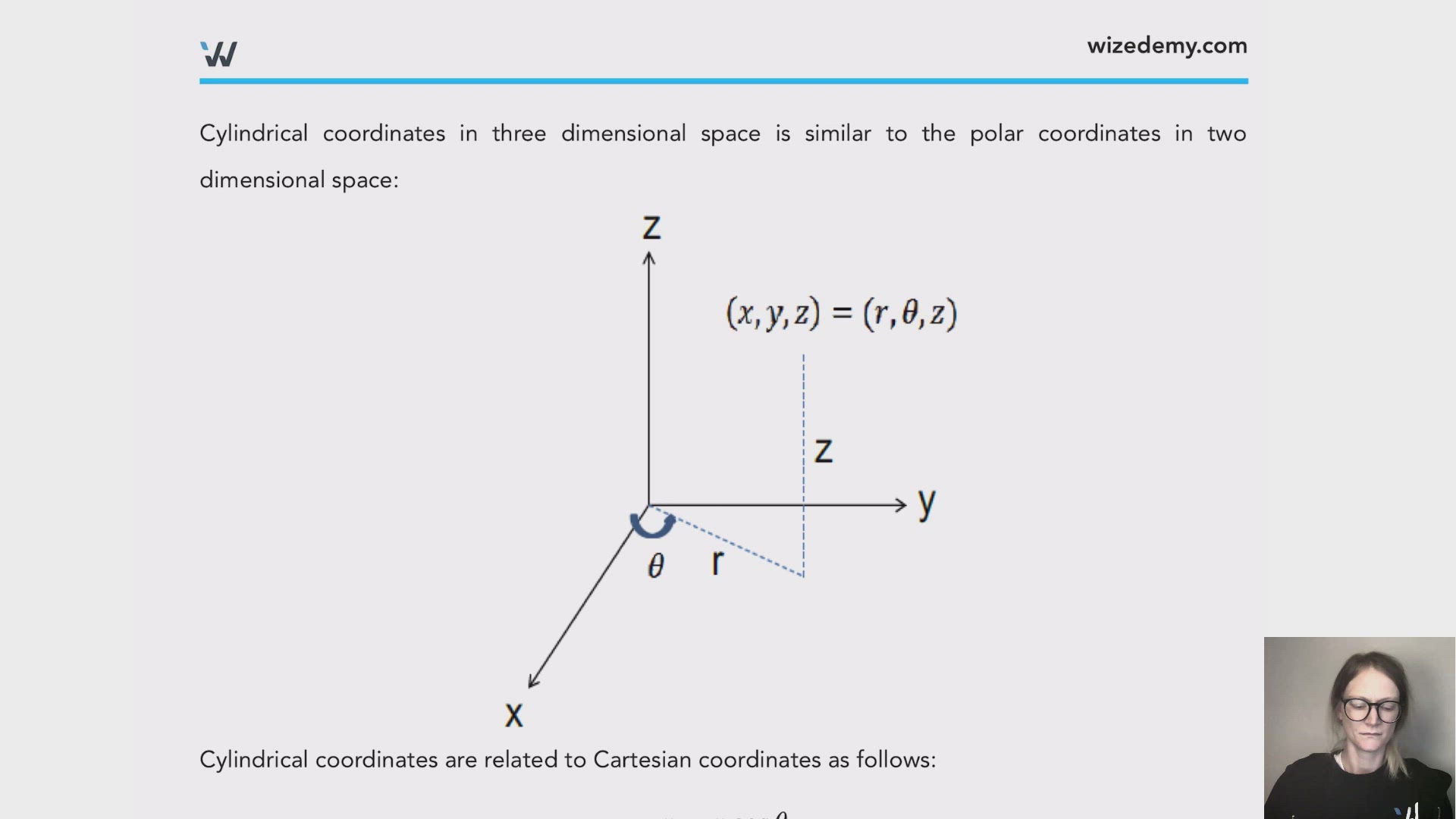
Cylindrical coordinates in three dimensional space is similar to the polar coordinates in two dimensional space:

Cylindrical coordinates are related to Cartesian coordinates as follows:
Similar to polar coordinates:
The following integration could be rewritten in terms of cylindrical coordinates:
if region is defined as:
Then, the general form of a triple integral using cylindrical coordinates will be:
0:00 / 0:00
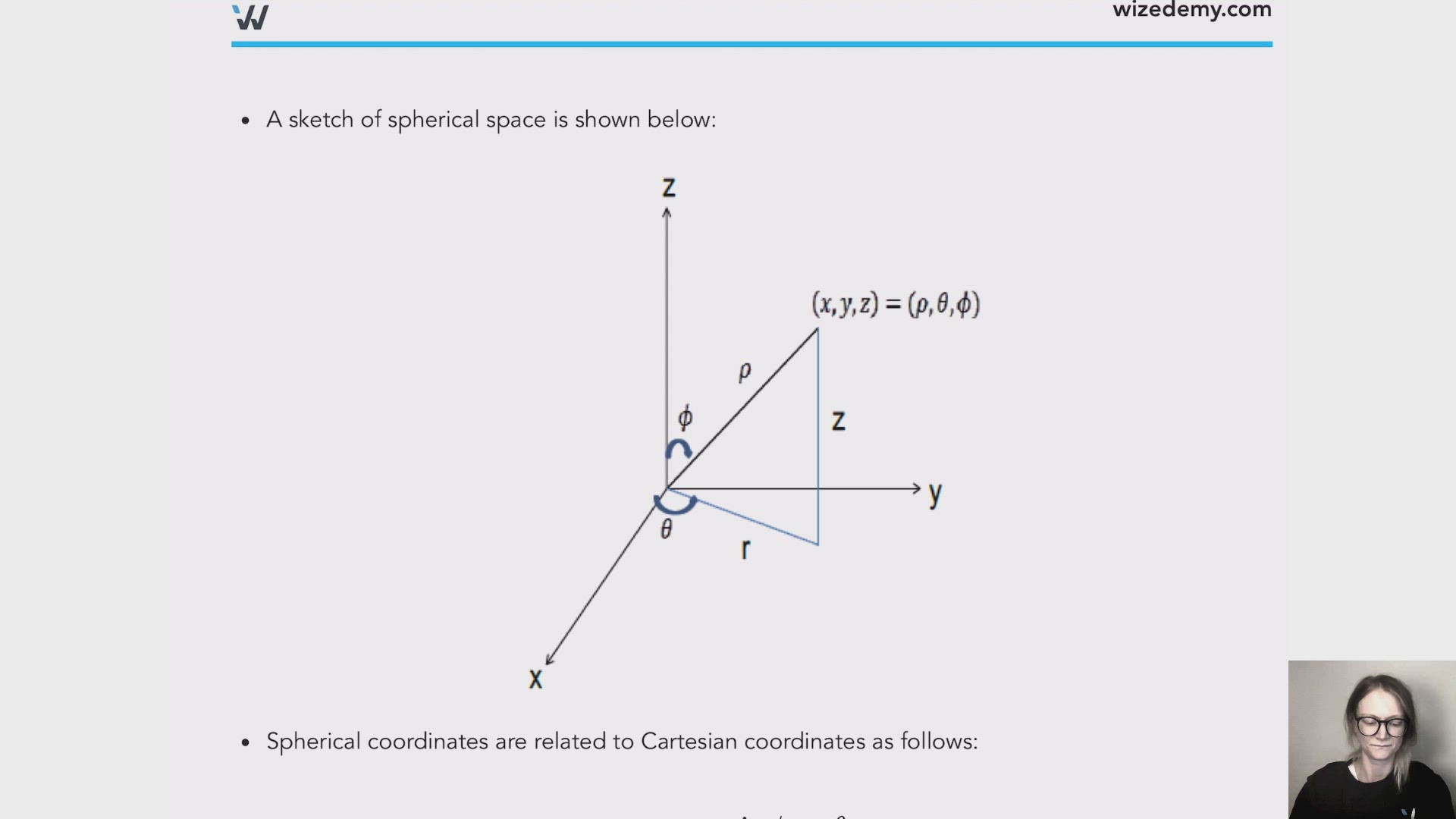
- A sketch of spherical space is shown below:
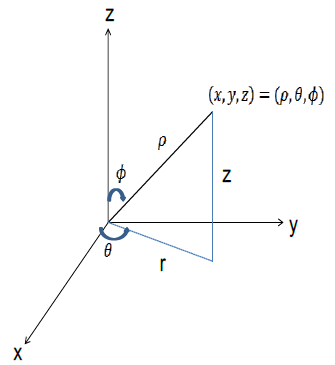
- Spherical coordinates are related to Cartesian coordinates as follows:
where that is the angle in the space.
is the angle measured from the positive -axis.
is the distance from the origin.
- We also have:
- If region in spherical space is defined as follows:
Then, the triple integral of over is equal to:
0:00 / 0:00
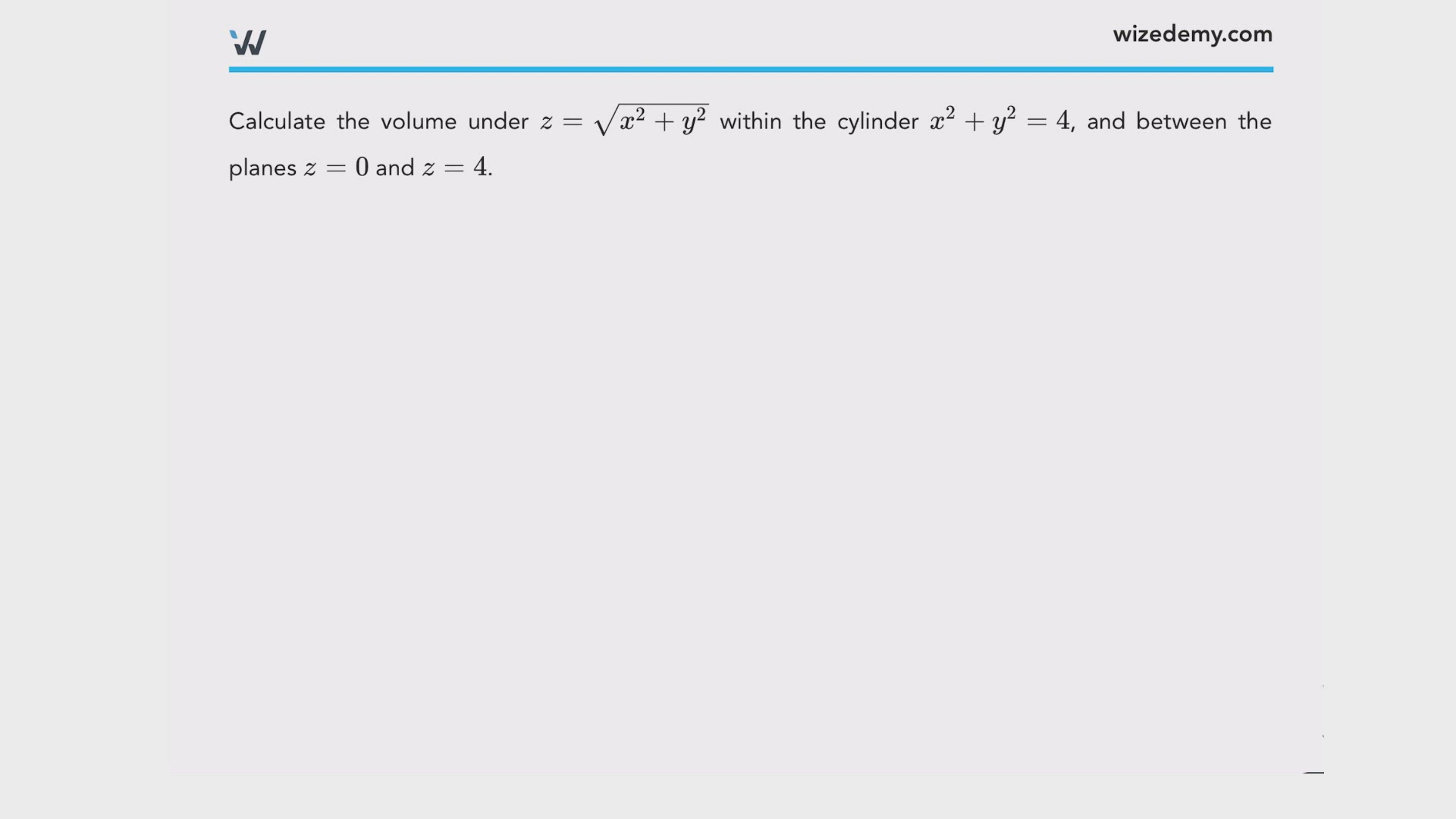
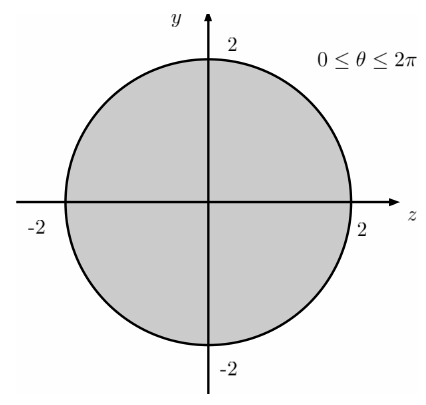
Calculate the volume under within the cylinder , and between the planes and .
0:00 / 0:00
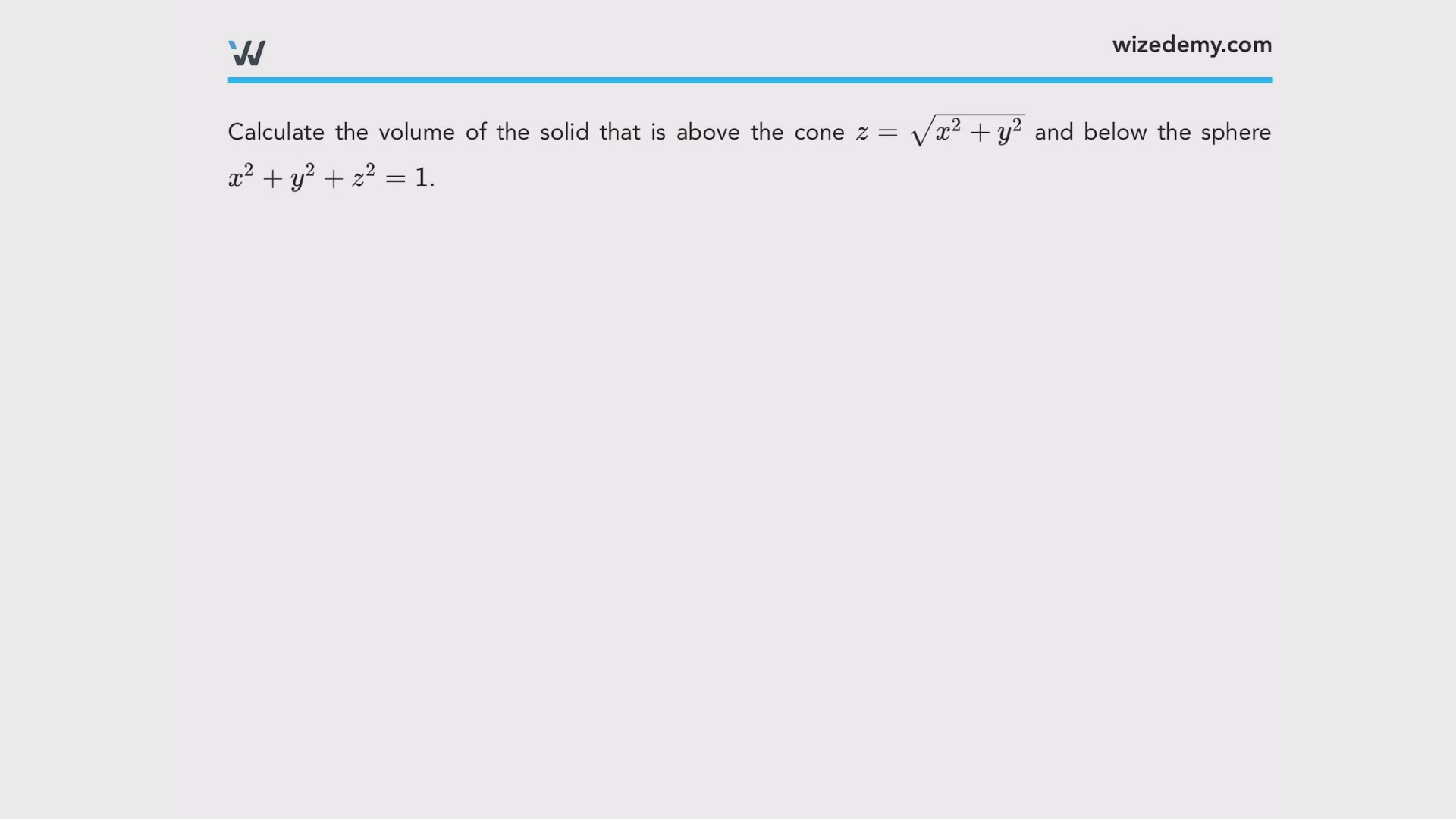
Calculate the volume of the solid that is above the cone and below the sphere .
Evaluate using cylindrical coordinates.
Evaluate , where E is the region portion at with

Mark Yourself Question
- Grab a piece of paper and try this problem yourself.
- When you're done, check the "I have answered this question" box below.
- View the solution and report whether you got it right or wrong.
Let S be the region on the first octant which lies above and below Express in:
a) Cylindrical Coordinates
b) Spherical Coordinates
c) Evaluate using either