Wize University Calculus 3 Textbook > Multiple Integrals
Triple Integrals
Triple Integrals over Rectangular Regions
Triple Integrals over Regions of General Shape
Example: Triple Integrals over Regions of General Shape (1)
Example: Triple Integrals over Regions of General Shape (2)
Practice: Triple Integrals over Regions of General Shape (1)
Practice: Triple Integrals over Regions of General Shape (2)
Practice: Changing the Order of Integration - Triple Integrals (3)
Practice Question: Changing the Order of Integration - Triple Integrals (4)
Popular Courses
MATH 200
University of British Columbia
MATH 253
University of British Columbia
MATH 222
McGill University
MATH 262
McGill University
MATH 209
University of Alberta
SC/MATH 2015 3.00
York University
MAT 2322
University of Ottawa
MATH 237
University of Waterloo
MAT235Y1
University of Toronto
MAT 2384
University of Ottawa
MATH 200
University of Victoria
MATH 251
Simon Fraser University
MAT237Y1
University of Toronto
MATH 20C
University of California - San Diego
MAT 2122
University of Ottawa
MATH 2214
Virginia Tech
MATH 10C
University of California - San Diego
SC/MATH 2310 3.00
York University
MATH 20E
University of California - San Diego

0:00 / 0:00
Similar to double integrals, we can define triple integrals for functions of three variables. Therefore, if is defined over a rectangular box, E, where , then the triple integral of over is equal to:
Similar to double integrals, Fubini's Theorem expresses a triple integral in terms of three single partial integrals:
Similar to double integrals, the integration over a variable is done by treating the rest of the variables as constants.

0:00 / 0:00
The Fubini's theorem for regions of general shapes is similar to the one for the region with a rectangular shape. If , where is the projection of region in the xy-plane, then the triple integral of over is equal to:
In general, if , then, the triple integral of over is equal to:
Effectively, after taking integration over one of the variables, the problem is converted to a double integral and we can use the methods we learned for double integrals to do the rest of calculations.
0:00 / 0:00
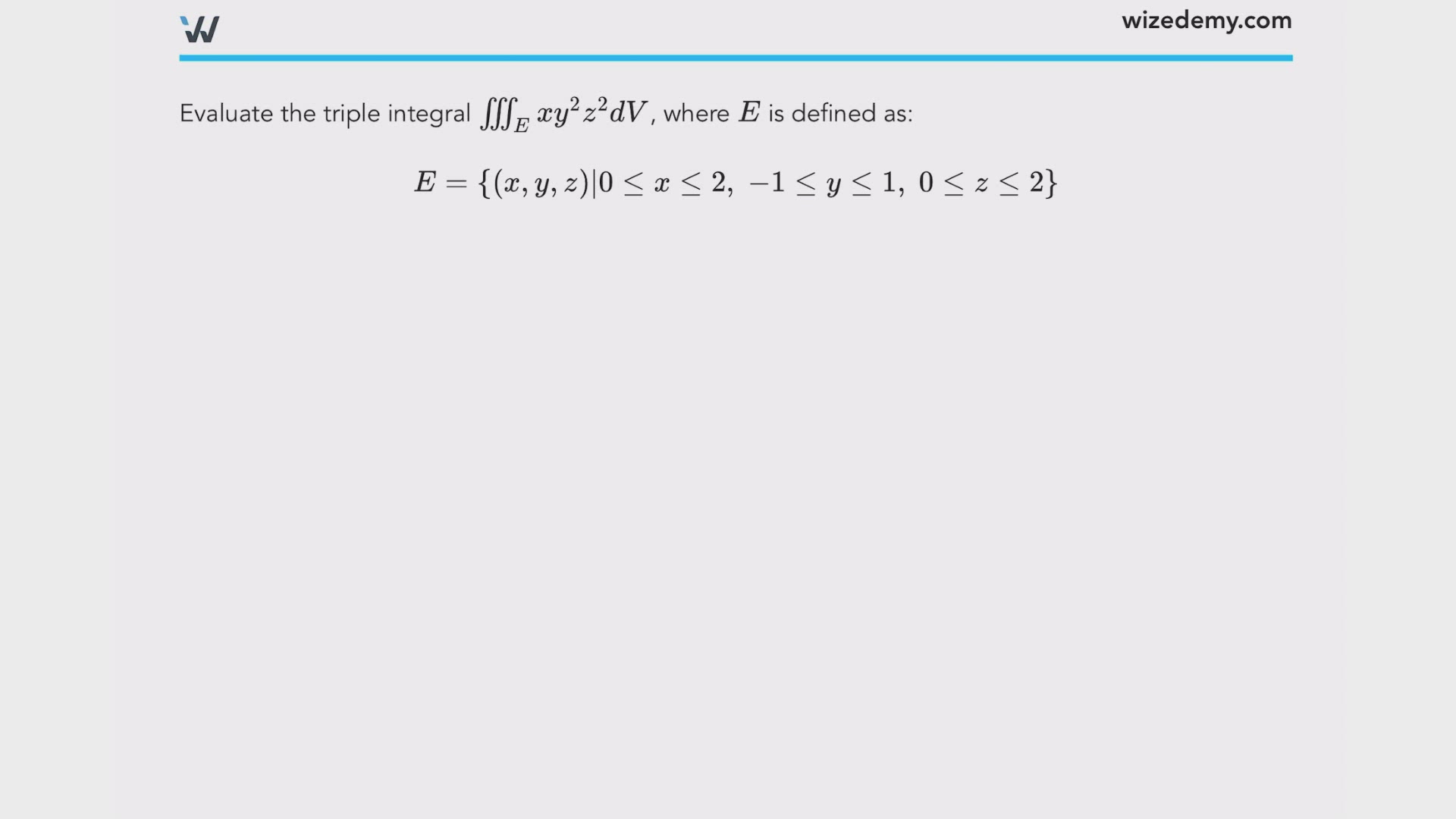
Evaluate the triple integral , where is defined as:
0:00 / 0:00
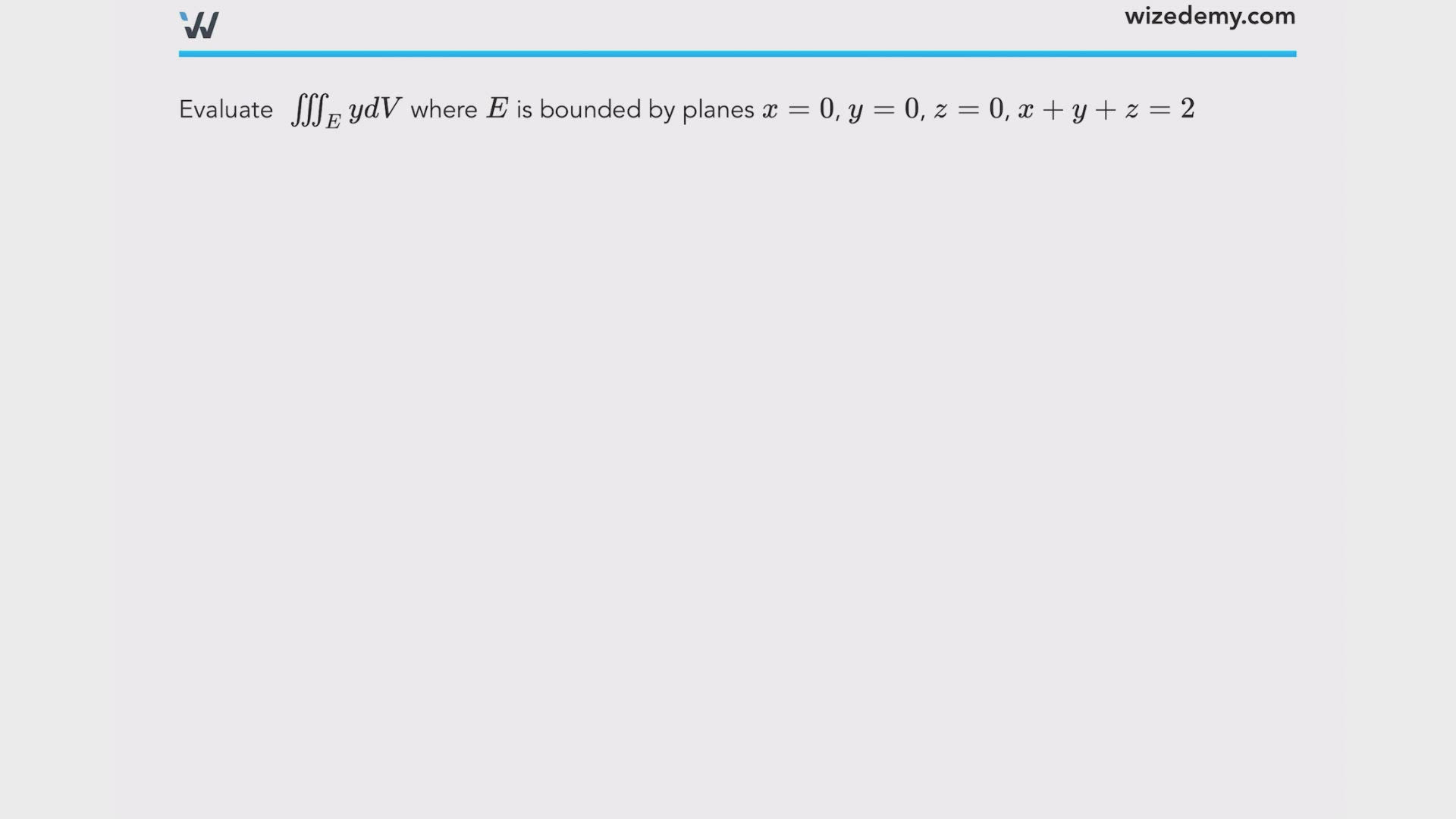
Evaluate where is bounded by planes , , ,
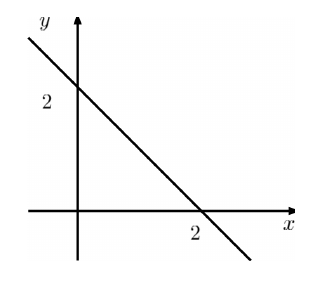
Determine the volume of the region between and the yz-plane that is bounded by and .
Evaluate , where E is between z = 4 - xy and they xy-plane such that .

Mark Yourself Question
- Grab a piece of paper and try this problem yourself.
- When you're done, check the "I have answered this question" box below.
- View the solution and report whether you got it right or wrong.
Express 6 ways if .
Mark Yourself Question
- Grab a piece of paper and try this problem yourself.
- When you're done, check the "I have answered this question" box below.
- View the solution and report whether you got it right or wrong.
Let E be the region bounded by the planes y = 0, y = 2, y + z = 3, and the surface . Consider
Express the integral as