Wize University Calculus 3 Textbook > Multiple Integrals
Application of the Double Integral: Mass, Center of Mass, Surface Area
Popular Courses
MATH 200
University of British Columbia
MATH 253
University of British Columbia
MATH 222
McGill University
MATH 262
McGill University
MATH 209
University of Alberta
SC/MATH 2015 3.00
York University
MAT 2322
University of Ottawa
MATH 237
University of Waterloo
MAT235Y1
University of Toronto
MAT 2384
University of Ottawa
MATH 200
University of Victoria
MATH 251
Simon Fraser University
MAT237Y1
University of Toronto
MAT 2122
University of Ottawa
MATH 2214
Virginia Tech
MATH 10C
University of California - San Diego
SC/MATH 2310 3.00
York University
MATH 20E
University of California - San Diego
0:00 / 0:00
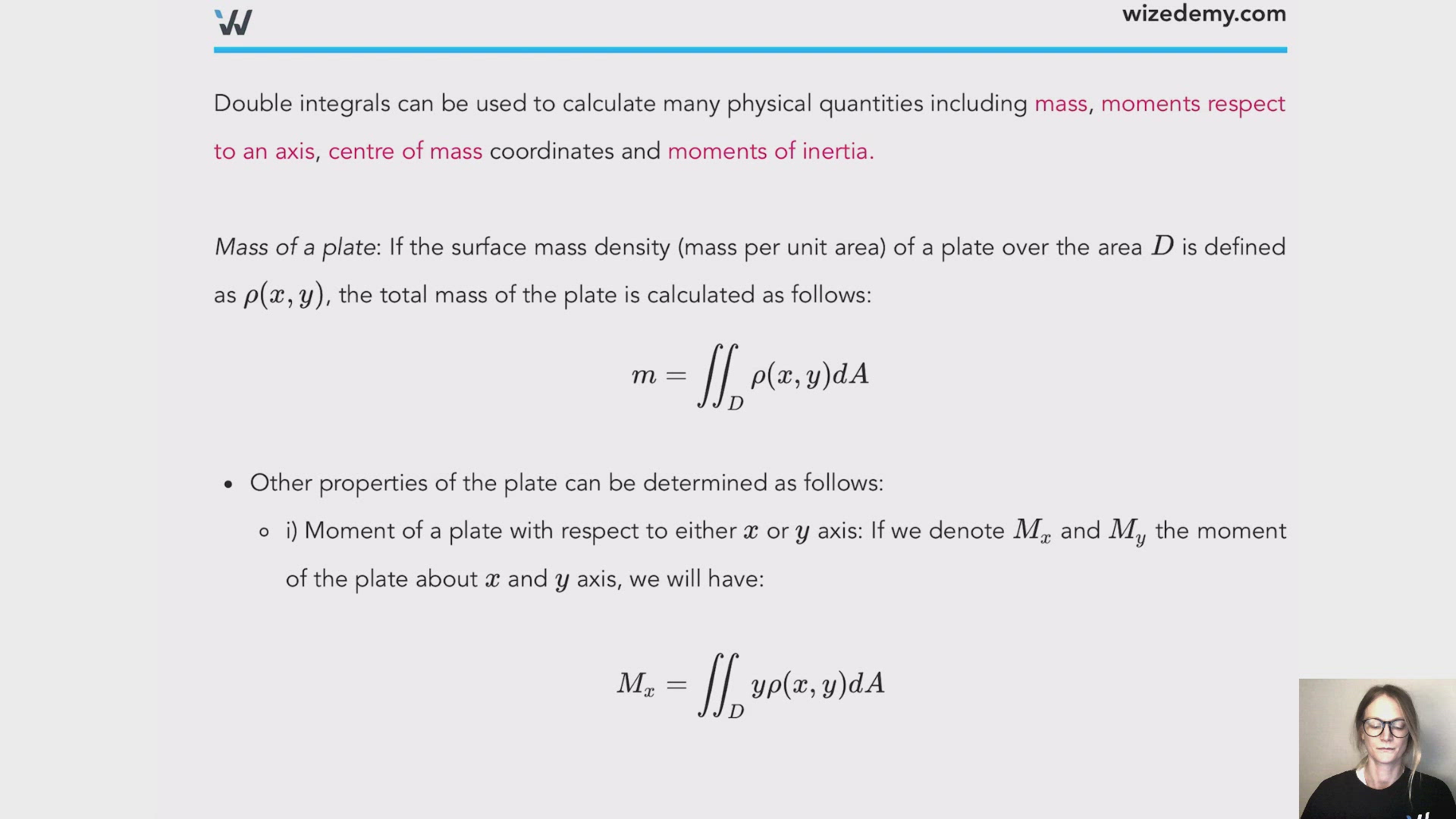
Double integrals can be used to calculate many physical quantities including mass, moments respect to an axis, centre of mass coordinates, moments of inertia, and surface area.
Mass of a plate: If the surface mass density (mass per unit area) of a plate over the area is defined as , the total mass of the plate is calculated as follows:
- Other properties of the plate can be determined as follows:
- i) Moment of a plate with respect to either or axis: If we denote and the moment of the plate about and axis, we will have:
- here is the distance of the point of interest to the -axis
- here is the distance of the point of interest to the -axis
- ii) The coordinates of the center of mass: The center of mass is the point at which all of the mass of the object is concentrated.
- If the force is applied to the center of mass, there is no torque generated in the object.
- The coordinates of this point could be calculated as follows:
where the mass is given by:
- iii) The moment of inertia of plate about axis () and about axis (): Moment of inertia is the rotational analog to the mass!
- here is the distance of the point of interest to the -axis
- here is the distance of the point of interest to the -axis
- iv) The polar moment of inertia (): The polar moment of inertia is calculated as follows:
The surface area of a surface z = f(x, y) where (x, y) is a point from the region D in the xy - plane, can be defined as:
0:00 / 0:00
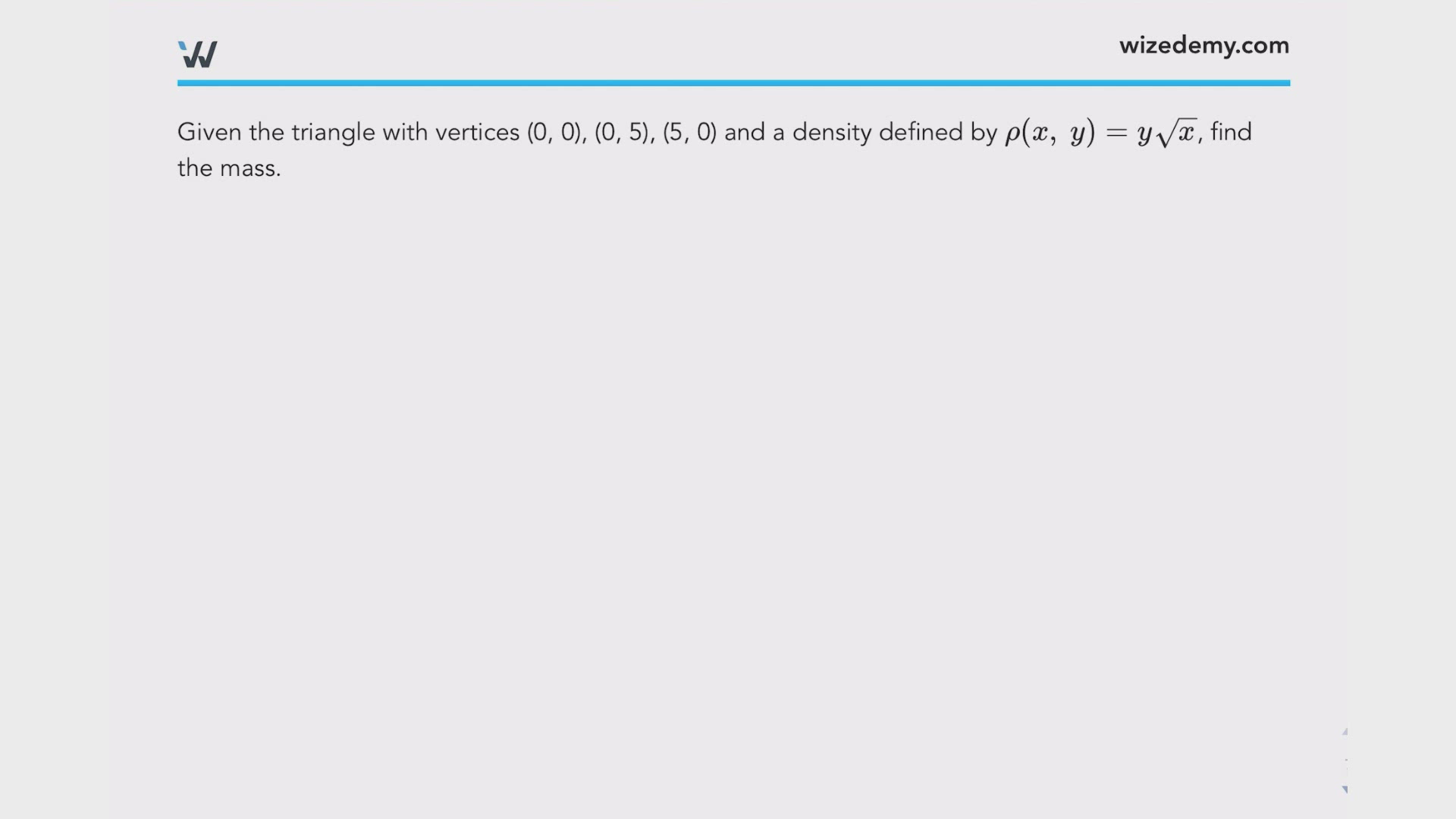
Given the triangle with vertices (0, 0), (0, 5), (5, 0) and a density defined by , find the mass.
Find m:
0:00 / 0:00
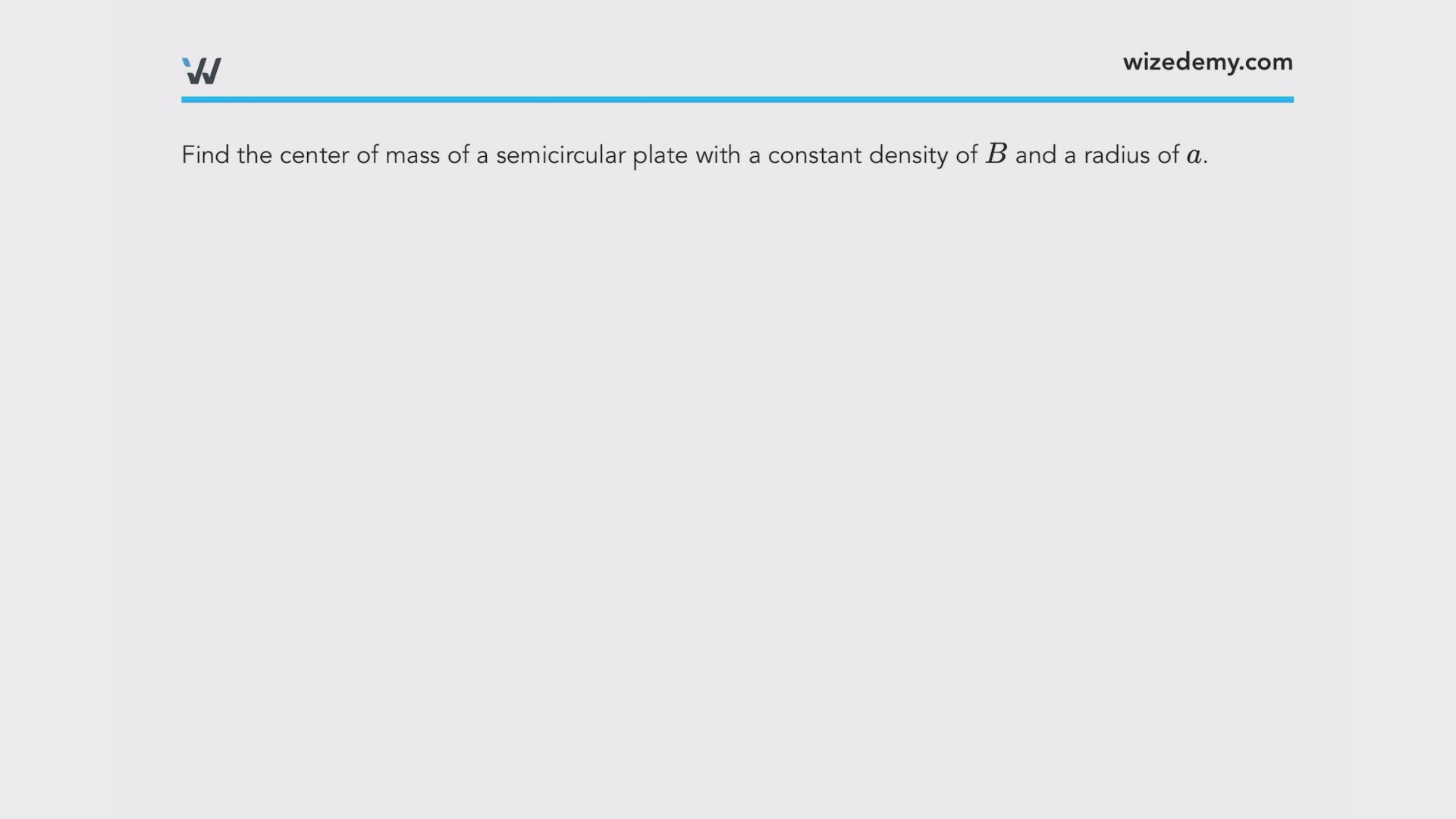
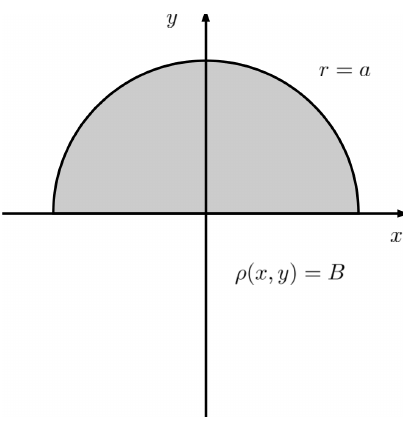
Find the center of mass of a semicircular plate with a constant density of and a radius of .
We use polar coordinates system!
Find the surface area of the part of the plane that is in the first octant.
Letting shows us that the bounds for x and y in the first octant can be determined by looking at . Let the domain, D, be defined as: . Then, since we have the below partial derivatives and surface area integral:
Find the center of mass between y = cosx and the x-axis and between x = and x = , where
Find the center of mass of a 2D plate in the first quadrant for the circle and

Mark Yourself Question
- Grab a piece of paper and try this problem yourself.
- When you're done, check the "I have answered this question" box below.
- View the solution and report whether you got it right or wrong.
Determine the surface area of the portion inside