Wize University Calculus 2 Textbook > Parametric & Polar Curves
Calculus w/ Parametric Curves
Popular Courses
Calculus 2
University Study Guides
AP Calculus (BC) Exam Prep Course
AP Exam Prep
Calculus 2
General Course
CALCULUS 1301A/B
Western University
Calculus 2
University Study Guides
MATH 101
University of Alberta
SC/MATH 1014 3.00
York University
MATH 117
University of Waterloo
NMM 1414A/B
Western University
MATH 101
University of Victoria
MAT187H1
University of Toronto
MTH 240
Toronto Metropolitan University
MATH 118
University of Waterloo
MATH*1210
University of Guelph
MATH 1700
University of Manitoba
MATH 119
University of Waterloo
MATH 1226
Virginia Tech
MATH 1010
Dalhousie University
MATH 10B
University of California - San Diego
MATH 1005
Carleton University
0:00 / 0:00
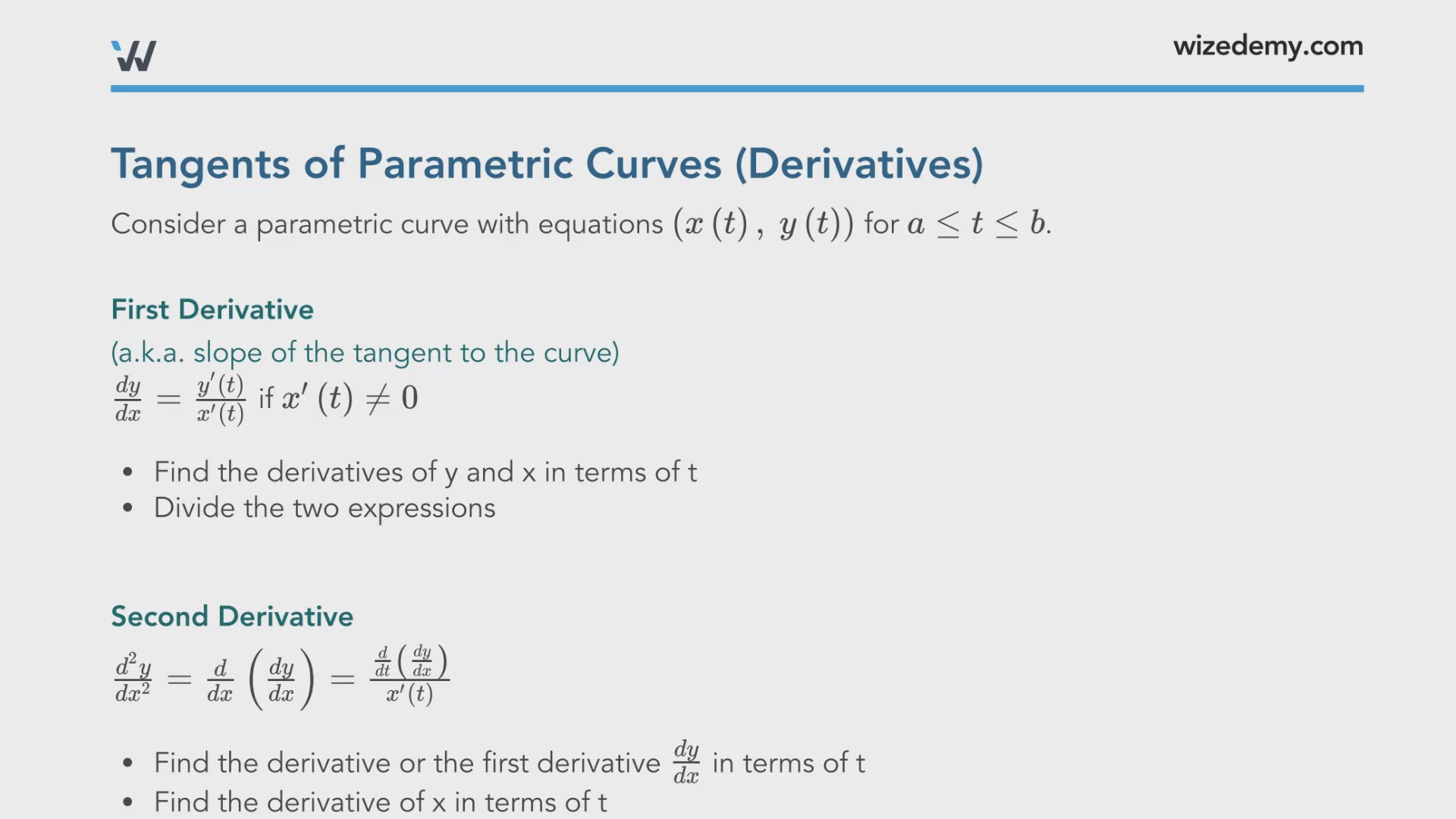
Tangents of Parametric Curves (Derivatives)
Consider a parametric curve with equations for .
First Derivative
(a.k.a. slope of the tangent to the curve)
if
- Find the derivatives of y and x in terms of t
- Divide the two expressions
Second Derivative
- Find the derivative of the first derivative in terms of t
- Find the derivative of x in terms of t
- Divide the two expressions
The parametric curve has
- A Horizontal Tangent when and
- A Vertical Tangent when and
*If both and , use L'Hospital's rule
Practice Question
If x and y are described with parametric equations and , find at .
Practice: Tangents
Given the parametric curves ,
a.) Find the equation of the tangent line to the curve at the point
b.) Identify all points where the tangent is horizontal
c.) Identify all points where the tangent is vertical
Practice Question
Given the cycloid and , find all points where the slope of the tangent is horizontal or vertical
0:00 / 0:00
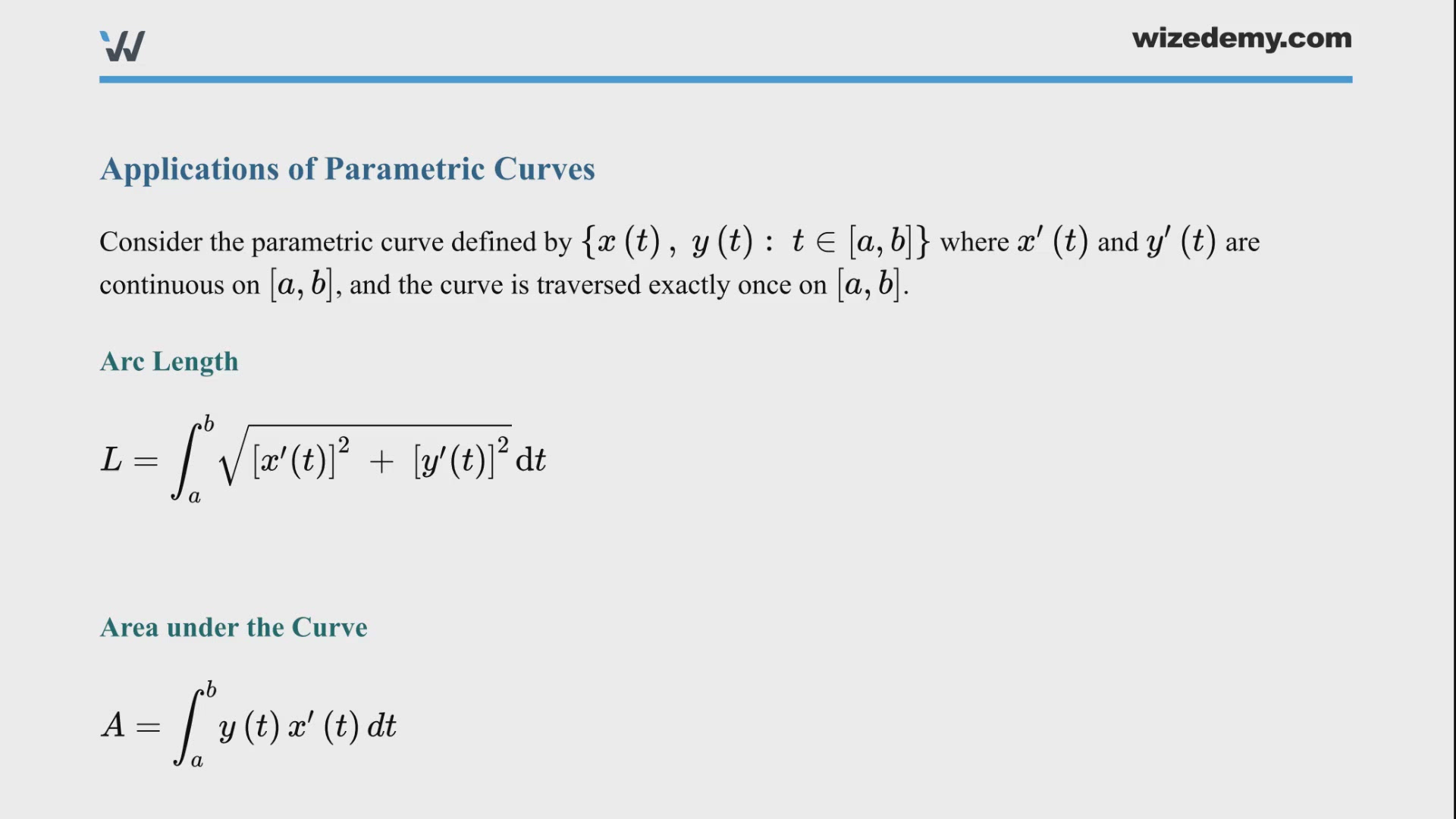
Applications of Parametric Curves
Consider the parametric curve defined by where and are continuous on , and the curve is traversed exactly once on .
Arc Length
Area under the Curve
Surface Area
Obtained by revolving the curve about the x-axis (or al ine parallel to the x-axis):
Practice Question
Write down the integral representing the length of the curve parameterized by , from the point (1, -1) to the point (3, 0).
Practice Question
Find the area under the cruve .
Practice: Surface Area
Find the area of the surface obtained by revolving the curve on about the x-axis.
Practice Question
Find the integral that represents the area of the surface of revolution obtained by rotating the curve defined by about the x-axis.