Calculus w/ Polar Coordinates

Tangents of Polar Curves (Derivatives)
First Derivative
(a.k.a slope of the tangent to the curve)
dxdy=dθdrcosθ−rsinθdθdrsinθ+rcosθ or x′(θ)y′(θ)
*Recall that y=rsinθ, x=rcosθ
The polar curve has
- A Horizontal Tangent when
- dθdrsinθ+rcosθ or y′(θ)=0 and
- dθdrcosθ−rsinθ or x′(θ)=0
- A Vertical Tangent when
- dθdrcosθ−rsinθ or x′(θ)=0 and
- dθdrsinθ+rcosθ or y′(θ)=0
*If both y′(θ)=0 and x′(θ)=0, use L'Hosputal's rule
Practice: Tangents
Consider the polar curve r=eθ where θ∈[0,2π].
a) Find the slope of the tangent line to the curve at θ=π.
b) Find all points at which the tangent line to the curve is horizontal.
c) Find all points at which the tangent line to the curve is vertical.

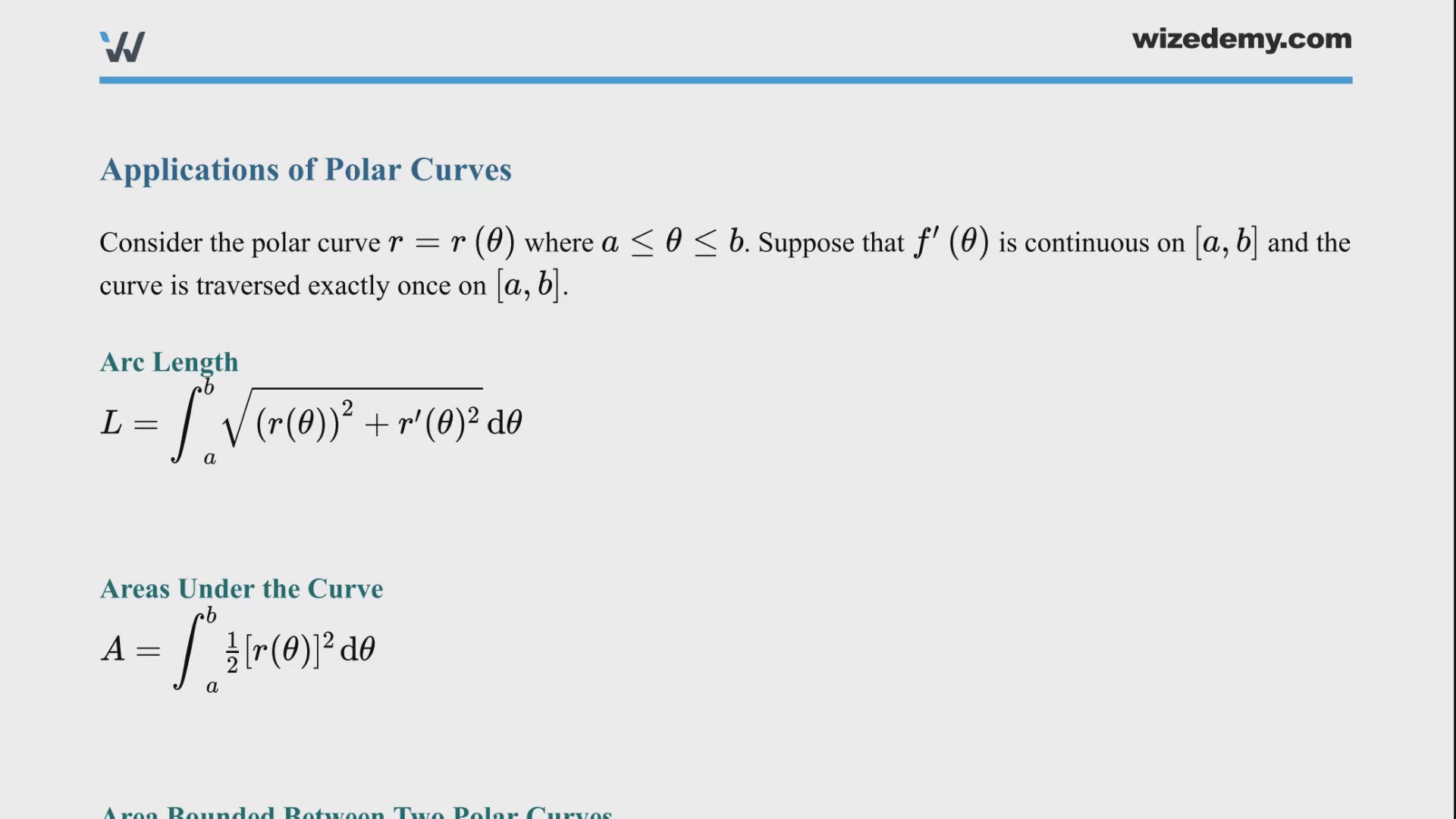
Applications of Polar Curves
Consider the polar curve r=r(θ) where a≤θ≤b. Suppose that f′(θ) is continuous on [a,b] and the curve is traversed exactly once on [a,b].
Arc Length L=∫ab(r(θ))2+r′(θ)2 dθ
Areas Under the Curve A=∫ab21[r(θ)]2 dθ
Area Bounded Between Two Polar Curves
A=21∫ab[(router)2−(rinner)2] dθ
Practice: Arc Length
Compute the total length of the curve r=2acosθ for a>0 and θ∈[0,π]
Practice: Area Under Polar Curve
Find the area inside r=1+sinθ.
Practice Question
Write the integral representing the area of the inner loop of r=2+4sinθ.
Practice: Area Between Polar Curves
Find the area of the region lying inside the limacon curve of equation r=1+2cosθ, but outside the circle r = 2.