Wize University Calculus 2 Textbook > Review: Derivatives
Basics of Derivatives
Popular Courses
Calculus 2
University Study Guides
Calculus 2
General Course
Calculus 2
University Study Guides
MATH 205
Concordia University
SC/MATH 1014 3.00
York University
NMM 1414A/B
Western University
MTH 240
Toronto Metropolitan University
MATH-1730
University of Windsor
MATH 118
University of Waterloo
MAST 218
Concordia University
MATH 1700
University of Manitoba
MTH 231
Toronto Metropolitan University
MATH 119
University of Waterloo
MATH 1010
Dalhousie University
MATH 1LT3
McMaster University
MATH 10B
University of California - San Diego
MATH 1005
Carleton University
MATH 1B
University of California - Berkeley
M 408D
The University of Texas at Austin
MATH 124
Queen's University
0:00 / 0:00
Interpretation of Derivatives
The derivative of a function is represented by .
- Graphically: The derivative of a function at a point is the slope of the tangent to that curve at
- Real-world application: It represents the rate of change of that function at that point
Note:
The curve has a
horizontal tangent
at a point the derivative at that point is 0
Limit/Formal Definitions
The derivative of a function :
The derivative of a function at a point :
Differentiability
If this limit exists at a point , we say that is differentiable at .
If this limit exists for all points , we say that is a differentiable function.
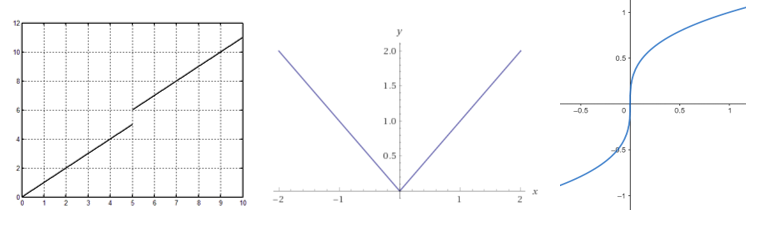
Not Differentiable
- If it is not continuous
- If it has a corner
- If it has a vertical tangent
Watch Out!
If a function is differentiable at a point, then it is continuous at that point.
But this is NOT necessarily true the other way around.
Using the formal definition of a derivative, the derivative of simplifies to
Practice: Differentiability
Which of the following is/are NOT differentiable at ?
(Select all that apply)