0:00 / 0:00

Derivative Rules

Power Rule

ddx(a)=0\frac{d}{dx}\left(a\right)=0 ddx(xn)=nxn1\frac{d}{dx}\left(x^n\right)=nx^{n-1}

Exponential

ddx(ax)=axlna\frac{d}{dx}\left(a^x\right)=a^x\ln a ddx(ex)=ex\frac{d}{dx}\left(e^x\right)=e^x

Logarithmic

ddx(logax)=1xlna\frac{d}{dx}\left(\log_ax\right)=\frac{1}{x\ln a} ddx(lnx)=1x\frac{d}{dx}\left(\ln x\right)=\frac{1}{x}

Trig

ddx(sinx)=cosx\frac{d}{dx}\left(\sin x\right)=\cos x ddx(cosx)=sinx\frac{d}{dx}\left(\cos x\right)=-\sin x ddx(tanx)=sec2x\frac{d}{dx}\left(\tan x\right)=\sec^2x

ddx(cscx)=cscxcotx\frac{d}{dx}\left(\csc x\right)=-\csc x\cot x ddx(secx)=secxtanx\frac{d}{dx}(\sec x)=\sec x\tan x ddx(cotx)=csc2x\frac{d}{dx}(\cot x)=-\csc^2x

Inverse Trig

ddx(arcsinx)=11x2\frac{d}{dx}\left(\arcsin x\right)=\frac{1}{\sqrt{1-x^2}} ddx(arccosx)=11x2\frac{d}{dx}\left(\arccos x\right)=-\frac{1}{\sqrt{1-x^2}} ddx(arctanx)=11+x2\frac{d}{dx}\left(\arctan x\right)=\frac{1}{1+x^2}

Two More Important Rules

ddx(f±g)=ddx(f)±ddx(g)\frac{d}{dx}\left(f\pm g\right)=\frac{d}{dx}\left(f\right)\pm\frac{d}{dx}\left(g\right)
ddx(cf)=cddx(f)\frac{d}{dx}\left(c\cdot f\right)=c\cdot\frac{d}{dx}\left(f\right)


You can keep taking derivatives to find second derivatives, third derivatives, etc.

Wize Tip
Always try to simplify before finding derivatives.
0:00 / 0:00

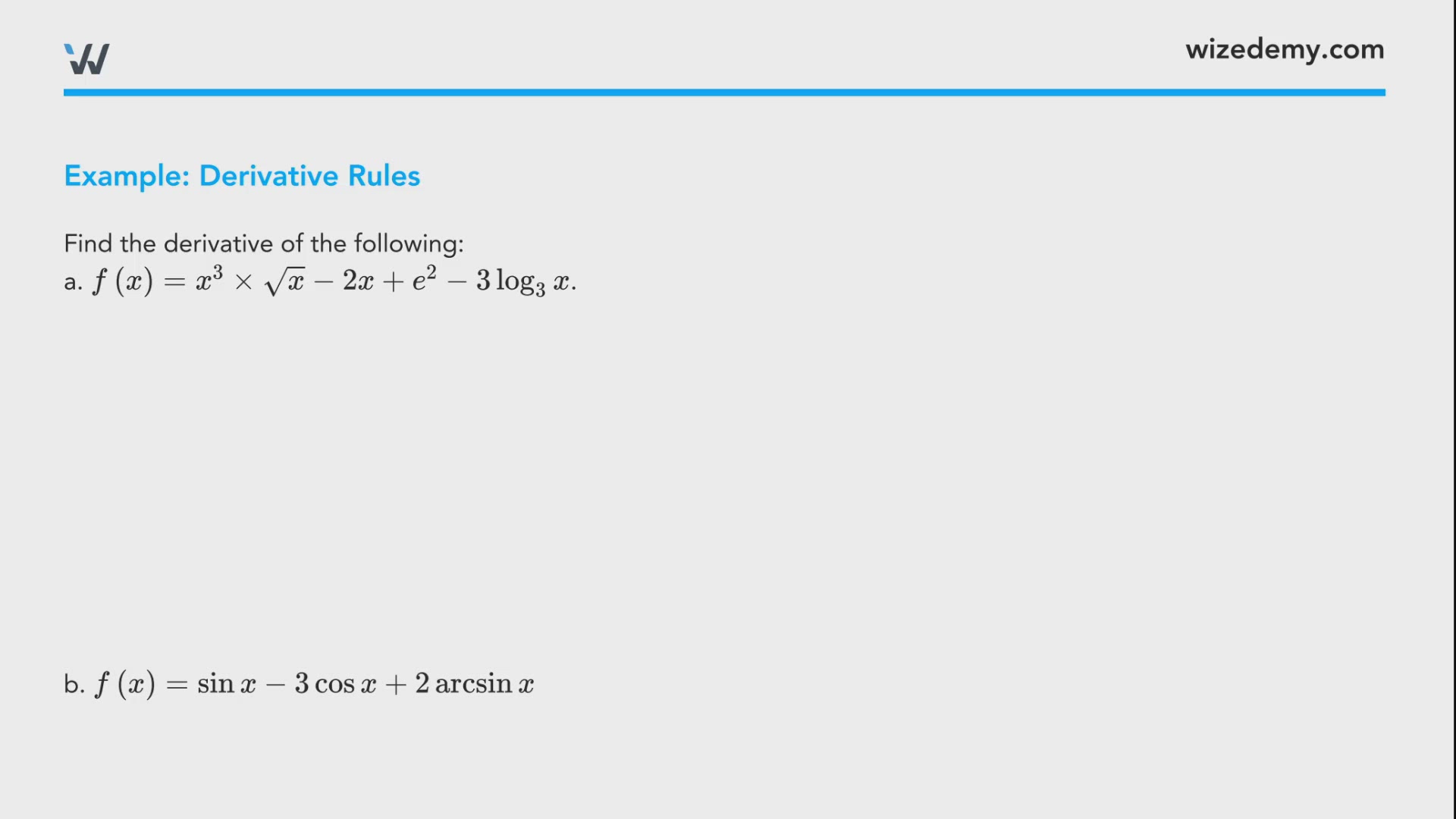
Example: Derivative Rules

Find the derivative of the following:
a. f(x)=x3×x2x+e23log3xf\left(x\right)=x^3\times\sqrt{x}-2x+e^2-3\log_3x.
We first simplify:
f(x)=x3×x122x+e23log3xf\left(x\right)=x^3\times x^{\frac{1}{2}}-2x+e^2-3\log_3x
f(x)=x722x+e23log3xf\left(x\right)=x^{\frac{7}{2}}-2x+e^2-3\log_3x

Now we find the derivative one term at a time:
f(x)=72x522+03(1xln3)f'\left(x\right)=\frac{7}{2}x^{\frac{5}{2}}-2+0-3\left(\frac{1}{x\cdot\ln3}\right)
f(x)=72x5223xln3f'\left(x\right)=\frac{7}{2}x^{\frac{5}{2}}-2-\frac{3}{x\ln3}


b. f(x)=sinx3cosx+2arcsinxf\left(x\right)=\sin x-3\cos x+2\arcsin x
This is already simplified as much as possible, we find the derivative one term at a time.
f(x)=cosx3(sinx)+2(11x2)f'\left(x\right)=\cos x-3\left(-\sin x\right)+2\left(\frac{1}{\sqrt{1-x^2}}\right)
f(x)=cosx+3sinx+21x2f'\left(x\right)=\cos x+3\sin x+\frac{2}{\sqrt{1-x^2}}
0:00 / 0:00

Product, Quotient, and Chain Rule

Product Rule

ddx(f(x)g(x))=f(x)g(x)+g(x)f(x)\frac{d}{dx}\left(f\left(x\right)g\left(x\right)\right)=f'\left(x\right)g\left(x\right)+g'\left(x\right)f\left(x\right)

Quotient Rule

ddx(f(x)g(x))=f(x)g(x)g(x)f(x)(g(x))2\frac{d}{dx}\left(\frac{f\left(x\right)}{g\left(x\right)}\right)=\frac{f'\left(x\right)g\left(x\right)-g'\left(x\right)f\left(x\right)}{\left(g\left(x\right)\right)^2}

Chain Rule

ddx(f(g(x)))=f(g(x))×g(x)\frac{d}{dx}\left(f\left(g\left(x\right)\right)\right)=f'\left(g\left(x\right)\right)\times g'\left(x\right)

Strategies for finding derivatives:

  1. Simplify as much as you can
  2. Combine like terms
  3. Rewrite trignxtrig^nx as (trig x)n\left(trig\ x\right)^n
  4. Check if product, quotient, or chain rule is/are needed
  5. Determine which function type (derivative rule) is/are needed
  6. Simplify your answer after finding the derivative
0:00 / 0:00

Example: Product, Quotient, and Chain Rule

Find the derivative of the following functions:
a) f(x)=x2sinxf\left(x\right)=x^2\sin x
Since we have a product of 2 terms, we need product rule.
f(x)=(2x)(sinx)+(cosx)(x2)f'\left(x\right)=\left(2x\right)\left(\sin x\right)+\left(\cos x\right)\left(x^2\right)
f(x)=2xsinx+x2cosxf'\left(x\right)=2x\sin x+x^2\cos x

b) f(x)=sin(x3)f\left(x\right)=\sin\left(x^3\right)
Since we have a function wrapped inside another, we need chain rule.
Starting from the outside function, then working our way in:
f(x)=cos(x3)×(3x2)f'\left(x\right)=\cos\left(x^3\right)\times\left(3x^2\right)
f(x)=3x2cosx3f'\left(x\right)=3x^2\cos x^3

c) f(x)=sin3xf\left(x\right)=\sin^3x
Rewriting this, we get f(x)=(sinx)3f\left(x\right)=\left(\sin x\right)^3
Sine we have a function wrapped inside another, we need chain rule.
Starting from the outside function, then working our way in:
f(x)=3(sinx)2×(cosx)f'\left(x\right)=3\left(\sin x\right)^2\times\left(\cos x\right)
f(x)=3sin2x cosxf'\left(x\right)=3\sin^2x\ \cos x

d) f(x)=etanxf\left(x\right)=e^{\sqrt{\tan x}}
Rewriting this, we get f(x)=e(tanx)12f\left(x\right)=e^{\left(\tan x\right)^{\frac{1}{2}}}
Since we have a function wrapped inside another, wrapped inside another, we need chain rule.
Starting from the outermost function, then working our way in:
f(x)=[e(tanx)12]×[12(tanx)12]×[sec2x]f'\left(x\right)=\left[e^{\left(\tan x\right)^{\frac{1}{2}}}\right]\times\left[\frac{1}{2}\left(\tan x\right)^{-\frac{1}{2}}\right]\times\left[\sec^2x\right]

Now we simplify:
f(x)=etanxsec2x2tanxf'\left(x\right)=\frac{e^{\sqrt{\tan x}}\sec^2x}{2\sqrt{\tan x}}

Practice: Finding a Derivative

(tan1(3sinx))x=π=\left(\tan^{-1}\left(3^{\sin x}\right)\right)'|_{x=\pi}=

Practice: Finding a Derivative

Given that f(x)=(2arcsin(x2))3f\left(x\right)=\left(2-\arcsin\left(x^2\right)\right)^3, find f(0)f'\left(0\right).
If f(x)=sin(2x)f\left(x\right)=\sin\left(2x\right), find f(21)(π2)f^{\left(21\right)}\left(\frac{\pi}{2}\right).
(i.e. find the 21st derivative at the point π2\frac{\pi}{2})

Suppose g(x)g\left(x\right) is differentiable, f(x)=x2g(x)f\left(x\right)=x^2g\left(x\right). Given that f(3)=30f'\left(3\right)=30, f(3)=19f''\left(3\right)=19, g(3)=2g\left(3\right)=2, what is g(3)g'\left(3\right) and g(3)g''\left(3\right)?

Given this table of values for f, g, f, and gf,\ g,\ f',\ \text{and}\ g' below, answer the following questions.
xf(x)f(x)f(x)g(x)g(x)001523π2π104522410π23\begin{array}{|c|c|c|c|c|c|} \hline x&f(x)&f'(x)&f''(x)&g(x)&g'(x)\\ \hline 0&0&-1&-5&2&3\\ \hline \frac{\pi}{2}&\pi&1&0&4&5\\ \hline 2&-2&-4&10&\frac{\pi}{2}&-3\\ \hline \end{array}
If p(x)=f(g(x))p\left(x\right)=f\left(g\left(x\right)\right), then p(2)=p'\left(2\right)=

Extra Practice