0:00 / 0:00

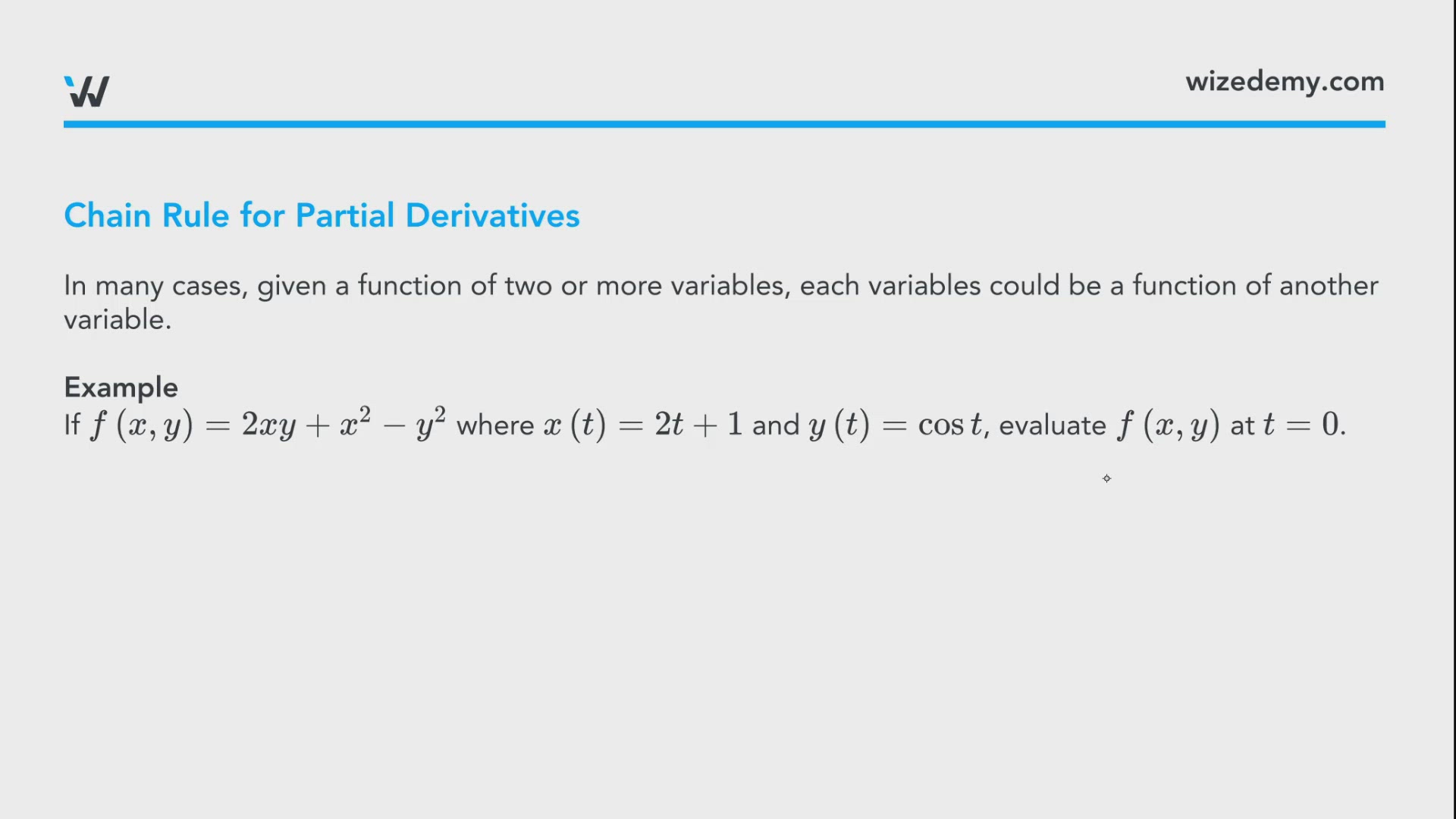
Chain Rule for Partial Derivatives

Disclaimer: At timestamp 4:19, the equation should read [2s-rt] instead of e^[2s-rt].

In many cases, given a function of two or more variables, each variables could be a function of another variable.

Example
If f(x,y)=2xy+x2y2f\left(x,y\right)=2xy+x^2-y^2 where x(t)=2t+1x\left(t\right)=2t+1 and y(t)=costy\left(t\right)=\cos t, evaluate f(x,y)f\left(x,y\right) at t=0t=0.
x(0)=2(0)+1=1x\left(0\right)=2\left(0\right)+1=1 and y(0)=cos0=1y\left(0\right)=\cos0=1
So, f(1,1)=2(1)(1)+1212=2f\left(1,1\right)=2\left(1\right)\left(1\right)+1^2-1^2=2


PAGE BREAK

Chain Rule

Suppose that z=f(x,y)z=f\left(x,y\right) is a differentiable function where x=g(t)x=g\left(t\right) and y=h(t)y=h\left(t\right), then
dzdt=zx dxdt+zy dydt\displaystyle \frac{dz}{dt}=\frac{\partial z}{\partial x}\ \frac{dx}{dt}+\frac{\partial z}{\partial y}\ \frac{dy}{dt}

Suppose that z=f(x,y)z=f(x,y) is a differentiable function where x=g(s,t)x=g(s,t) and y=h(s,t)y=h(s,t), then
zs=zx xs+zy ys\displaystyle\frac{\partial z}{\partial s}=\frac{\partial z}{\partial x}\ \frac{\partial x}{\partial s}+\frac{\partial z}{\partial y}\ \frac{\partial y}{\partial s} and zt=zx xt+zy yt\displaystyle\frac{\partial z}{\partial t}=\frac{\partial z}{\partial x}\ \frac{\partial x}{\partial t}+\frac{\partial z}{\partial y}\ \frac{\partial y}{\partial t}

Strategy
  • Use a “tree diagram” to list all the variables and how they depend on one another
  • Consider all possible paths from the top of the tree diagram to the variable you want to differentiate with respect to
  • Multiply along the path
  • Add the results of different paths
  • Which symbol to use?
  • When differentiating a variable that depend on 2 or more variables, use the ......\frac{\partial...}{\partial...} symbol
  • When differentiating a variable that only depends on 1 variable, use the d...d...\frac{d...}{d...} symbol

PAGE BREAK
Example
If z=exy+3x2y2z=e^xy+3x^2y^2, x=2srtx=2s-rt and y=s2ty=s^2t, find zr, zs, and  zt\frac{\partial z}{\partial r},\ \frac{\partial z}{\partial s},\ \text{and }\ \frac{\partial z}{\partial t}
zr=zx xr+zy yr\displaystyle\frac{\partial z}{\partial r}=\frac{\partial z}{\partial x}\ \frac{\partial x}{\partial r}+\frac{\partial z}{\partial y}\ \frac{\partial y}{\partial r}
zr=(yex+6y2x)(t)\displaystyle\frac{\partial z}{\partial r}=\left(ye^x+6y^2x\right)\left(-t\right)
zr=t(s2te2srt+6s4t2(2srt))\displaystyle\frac{\partial z}{\partial r}=-t\left(s^2te^{2s-rt}+6s^4t^2\left(2s-rt\right)\right)

zs=zx xs+zy ys\displaystyle\frac{\partial z}{\partial s}=\frac{\partial z}{\partial x}\ \frac{\partial x}{\partial s}+\frac{\partial z}{\partial y}\ \frac{\partial y}{\partial s}
zs=(yex+6y2x)(2)+(ex+6x2y)(2st)\displaystyle\frac{\partial z}{\partial s}=\left(ye^x+6y^2x\right)\left(2\right)+\left(e^x+6x^2y\right)\left(2st\right)
zs=2(s2te2srt+6s4t2(2srt))+(2st)(e2srt+6(2srt)2s2t)\displaystyle\frac{\partial z}{\partial s}=2\left(s^2te^{2s-rt}+6s^4t^2\left(2s-rt\right)\right)+\left(2st\right)\left(e^{2s-rt}+6\left(2s-rt\right)^2s^2t\right)

zt=zx xt+zy yt\displaystyle\frac{\partial z}{\partial t}=\frac{\partial z}{\partial x}\ \frac{\partial x}{\partial t}+\frac{\partial z}{\partial y}\ \frac{\partial y}{\partial t}
zs=(yex+6y2x)(r)+(ex+6x2y)(s2)\frac{\partial z}{\partial s}=\left(ye^x+6y^2x\right)\left(-r\right)+\left(e^x+6x^2y\right)\left(s^2\right)
zs=r(s2te2srt+6s4t2(2srt))+s2(e2srt+6(2srt)2s2t)\displaystyle\frac{\partial z}{\partial s}=-r\left(s^2te^{2s-rt}+6s^4t^2\left(2s-rt\right)\right)+s^2\left(e^{2s-rt}+6\left(2s-rt\right)^2s^2t\right)

Practice: Chain Rule

Write the chain rule for zu \frac{\partial z}{\partial u} if z=f(x,y,u,v), x=x(u,v)z = f (x, y, u, v),\ x = x(u, v) and y=y(u,v).y = y(u, v).

Practice: Chain Rule

If w=zzyxw = z^z y^x where x=6u+vx=6u+v, y=uvy=uv and z=tanvz=\tan v.

How many terms in wu\displaystyle \frac{\partial w}{\partial u} has vv in it?

Practice: Chain Rule

Write the chain rule for zr\displaystyle \frac{\partial z}{\partial r} and 2zs r\displaystyle \frac{\partial^2 z}{\partial s\ \partial r} if z=z(f,g), f=f(r,s), g=g(u,v), u=u(r,s),z = z(f, g),\ f = f(r, s),\ g = g(u,v),\ u = u(r, s), and v=v(s)v=v(s)
0:00 / 0:00

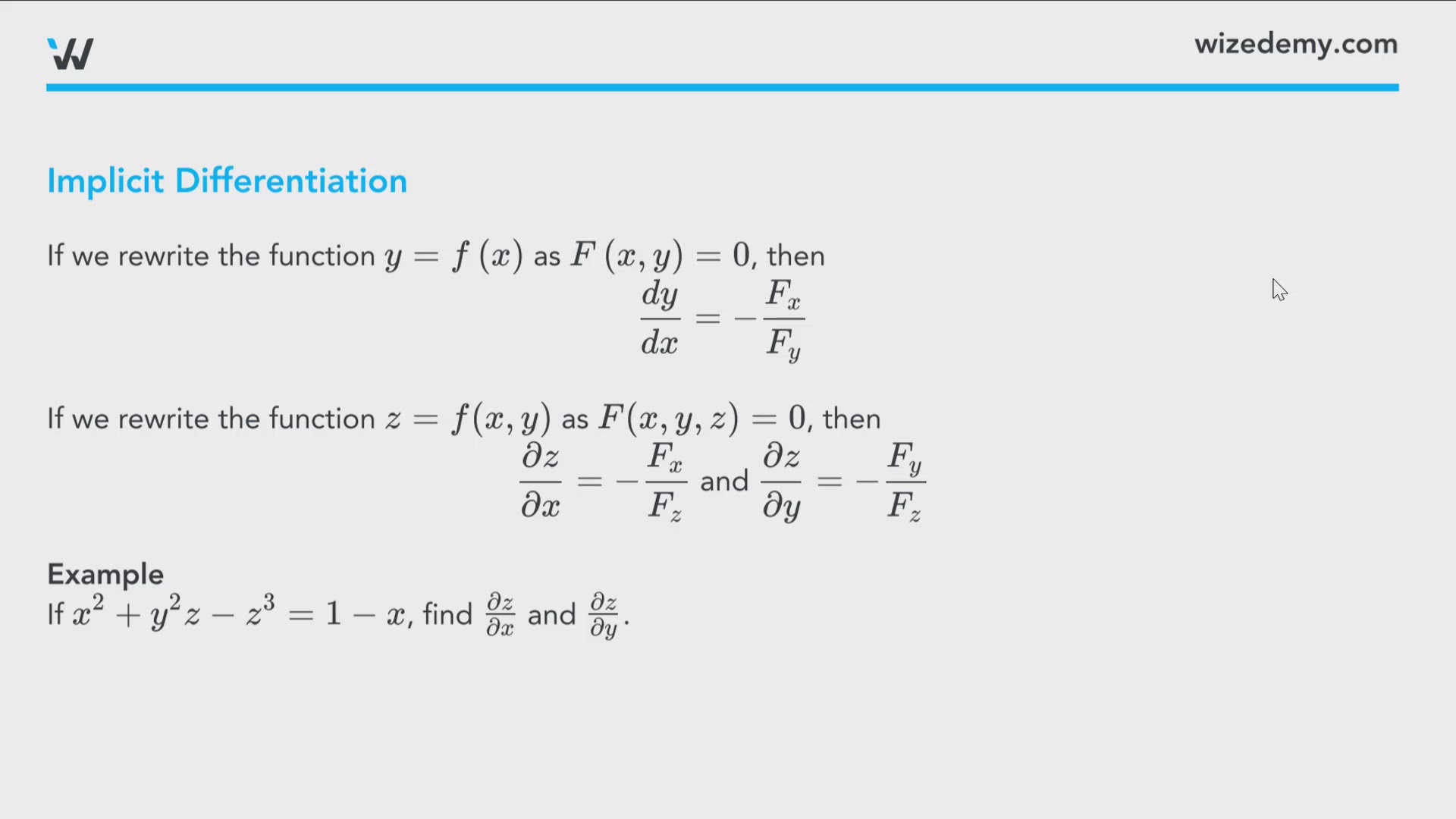
Implicit Differentiation

If we rewrite the function y=f(x)y=f\left(x\right) as F(x,y)=0F\left(x,y\right)=0, then
dydx=FxFy\displaystyle\frac{dy}{dx}=-\frac{F_x}{F_y}

If we rewrite the function z=f(x,y)z=f(x,y) as F(x,y,z)=0F(x,y,z)=0, then
zx=FxFz\displaystyle\frac{\partial z}{\partial x}=-\frac{F_x}{F_z} and zy=FyFz\displaystyle\frac{\partial z}{\partial y}=-\frac{F_y}{F_z}

Example
If x2+y2zz3=1xx^2+y^2z-z^3=1-x, find zx\frac{\partial z}{\partial x} and zy\frac{\partial z}{\partial y}.
First we rewrite the function as F(x,y,z)=x2+y2zz3+x1=0F\left(x,y,z\right)=x^2+y^2z-z^3+x-1=0
zx=FxFz=2x+1y23z2\displaystyle \frac{\partial z}{\partial x}=-\frac{F_x}{F_z}=-\frac{2x+1}{y^2-3z^2}
zy=FyFz=2zyy23z2\displaystyle \frac{\partial z}{\partial y}=-\frac{F_y}{F_z}=-\frac{2zy}{y^2-3z^2}
Extra Practice