Wize University Calculus 2 Textbook > Multivariable Functions
Gradient and the directional derivative
Popular Courses
Calculus 2
University Study Guides
MATH 100A
University of British Columbia
MATH 100C
University of British Columbia
MATH 100B
University of British Columbia
Calculus 2
General Course
Calculus 2
University Study Guides
MAT 1322
University of Ottawa
MAT133Y1
University of Toronto
MATH 262
McGill University
MAT 1332
University of Ottawa
MATH 157
Simon Fraser University
MTH 240
Toronto Metropolitan University
MATH 1700
University of Manitoba
MATH 119
University of Waterloo
MATH 1LT3
McMaster University
MATH 10B
University of California - San Diego
MATH 1005
Carleton University
MATH 1B
University of California - Berkeley
MAT 021C
University of California - Davis
M 408D
The University of Texas at Austin
0:00 / 0:00
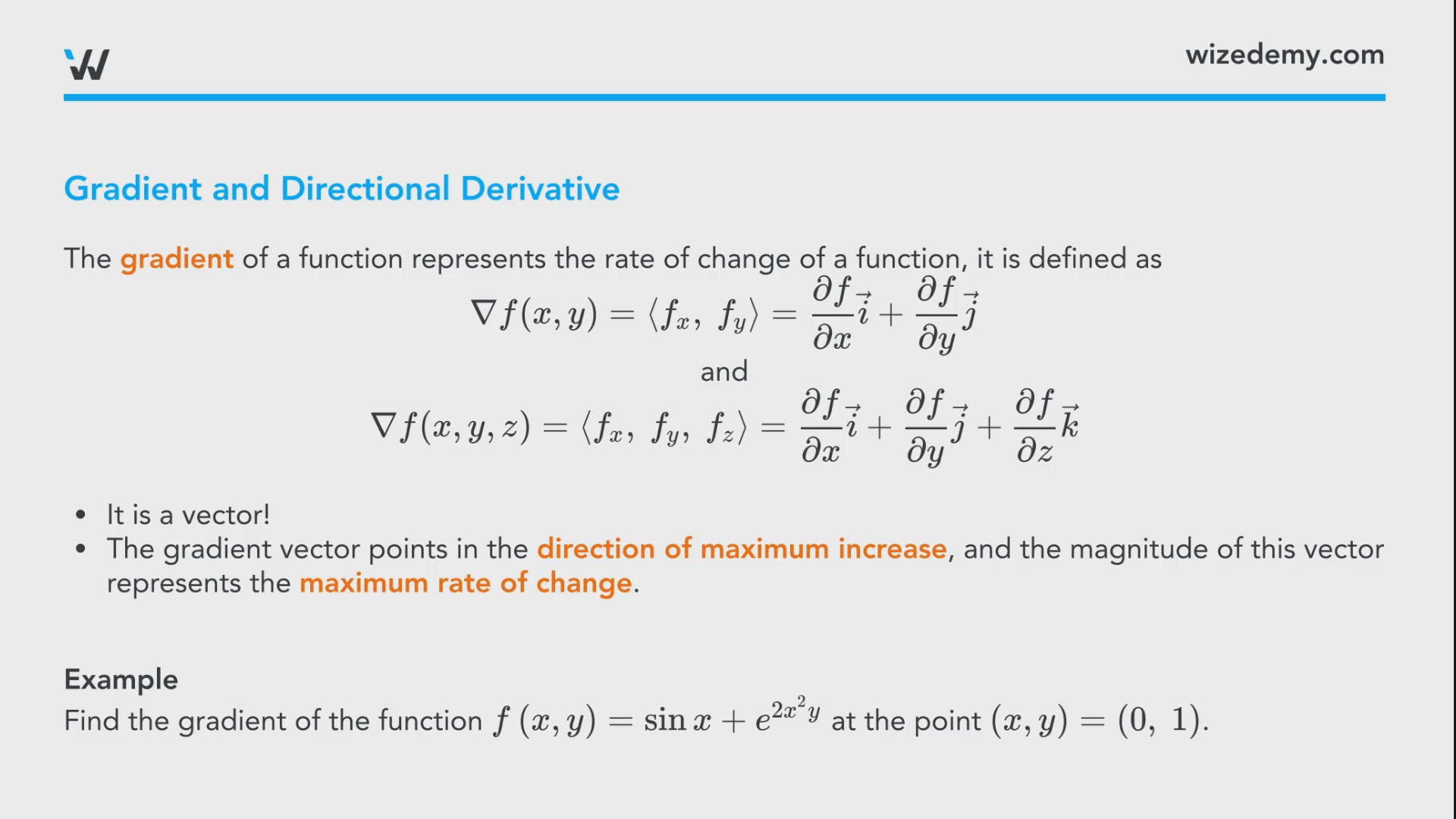
Gradient and Directional Derivative
The gradient of a function represents the rate of change of a function, it is defined as
and
- It is a vector!
- The gradient vector points in the direction of maximum increase, and the magnitude of this vector represents the maximum rate of change.
Example
Find the gradient of the function at the point .
The directional derivative tells us the rate of change of a function in the direction of a unit vector , and is defined by
or
- It is a scalar!
- It is the projection of the gradient vector along the unit vector
- Its maximum value is when the unit vector is in the direction of the gradient vector, and is equal to
Example
Suppose that and is the unit vector with an angle of with the positive x-axis.
a.) Find .
b.) In what direction does have the max rate of change at this point? What is the max rate of change?
a.) Since , we know that
Method 1
Method 2
b.) increases fastest (max rate of change) in the direction of the gradient vector at this point , and its maximum value is
Practice: Gradient and directional derivative
For the function
a) Calculate directional derivative in the direction of the unit vector which makes angle with the polar axis.
b) In which direction does the maximum directional derivative occur and what is this maximum value?
c) Answer a) and b) again at the point
Select the correct answer for c) only.